Institute for Medical Sociology, Health Services Research and Rehabilitation Science, Department of Health Services Research, University of Cologne, Cologne, Germany.
Center for Health Economics and Health Services Research, Schumpeter School of Business and Economics, University of Wuppertal, Wuppertal, Germany.
Implement Sci. 2020 Sep 21;15(1):82. doi: 10.1186/s13012-020-01043-6.
Formative evaluation of the implementation process for a digitally supported intervention in polypharmacy in Germany. Qualitative research was conducted within a cluster randomized controlled trial (C-RCT). It focused on understanding how the intervention influences behavior-related outcomes in the prescription and medication review process.
METHODS/SETTING: Twenty-seven general practitioners (GPs) were included in the study in the two groups of the C-RCT, the intervention, and the wait list control group. Behavior-related outcomes were investigated using three-step data analysis (content analytic approach, documentary method, and design of a model of implementation pathways).
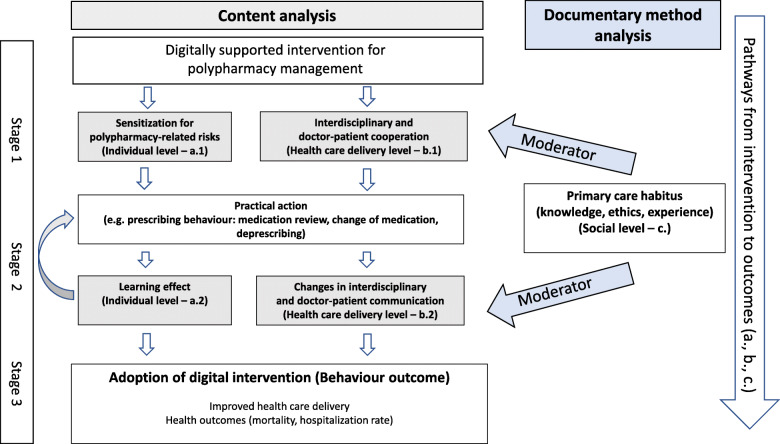
Content analysis showed that physicians were more intensely aware of polypharmacy-related risks, described positive learning effects of the digital technology on their prescribing behavior, and perceived a change in communication with patients and pharmacists. Conversely, they felt uncertain about their own responsibility when prescribing. Three main dimensions were discovered which influenced adoption behavior: (1) the physicians' interpretation of the relevance of pharmaceutical knowledge provided by the intervention in changing decision-making situations in polypharmacy; (2) their medical code of ethics for clinical decision making in the context of progressing digitalization; and (3) their concepts of evidence-based medicine on the basis of professional experiences with polypharmacy in primary care settings. In our sample, both simple and complex pathways from sensitization to adoption were observed. The resulting model on adoption behavior includes a paradigmatic description of different pathways and a visualization of different observed levels and applied methodological approaches. We assumed that the GP habitus can weaken or strengthen interventional effects towards intervention uptake. This formative evaluation strategy is beneficial for the identification of behavior-related implementation barriers and facilitators.
Our analyses of the adoption behavior of a digitally supported intervention in polypharmacy revealed both simple and complex pathways from awareness to adoption, which may impact the implementation of the intervention and therefore, its effectiveness. Future consideration of adoption behavior in the planning and evaluation of digitally supported interventions may enhance uptake and support the interpretation of effects.
NCT03430336 , 12 February 2018.
对德国数字化支持的多药治疗干预措施实施过程进行形成性评估。定性研究是在一项整群随机对照试验(C-RCT)中进行的。重点是了解干预措施如何影响处方和药物审查过程中的行为相关结果。
方法/设置:在 C-RCT 的干预组和等待名单对照组中,共有 27 名全科医生(GP)参与了这项研究。使用三步数据分析(内容分析方法、文献法和实施途径模型设计)调查行为相关结果。
内容分析表明,医生对与多药治疗相关的风险有了更深入的认识,描述了数字技术对其处方行为的积极学习效果,并认为与患者和药剂师的沟通有所改变。相反,他们在开处方时对自己的责任感到不确定。发现了三个主要维度,这些维度影响了采用行为:(1)医生对干预措施提供的药物知识在改变多药治疗决策情况下的相关性的解释;(2)他们在数字化进程中对临床决策的医学伦理准则;(3)他们在初级保健环境中基于多药治疗的经验对循证医学的概念。在我们的样本中,既观察到简单的也观察到复杂的从意识觉醒到采用的途径。采用行为的模型包括对不同途径的典型描述以及对不同观察到的水平和应用的方法学方法的可视化。我们假设 GP 习惯可以削弱或增强干预措施的干预效果。这种形成性评估策略有助于识别行为相关的实施障碍和促进因素。
我们对数字化支持的多药治疗干预措施的采用行为的分析揭示了从意识觉醒到采用的简单和复杂途径,这可能会影响干预措施的实施,从而影响其效果。在规划和评估数字化支持的干预措施时,考虑采用行为可以提高采用率,并有助于对效果的解释。
NCT03430336,2018 年 2 月 12 日。