Federal Research Centre "Fundamentals of Biotechnology", Russian Academy of Sciences, Moscow, Russia.
Central Research Institute of Epidemiology of Russian Federal Service for Surveillance on Consumer Rights Protection and Human Wellbeing (Rospotrebnadzor) and I.M. Sechenov First Moscow State Medical University of the Ministry of Health of the Russian Federation (Sechenov University), Moscow, Russia.
PLoS One. 2020 Sep 22;15(9):e0239147. doi: 10.1371/journal.pone.0239147. eCollection 2020.
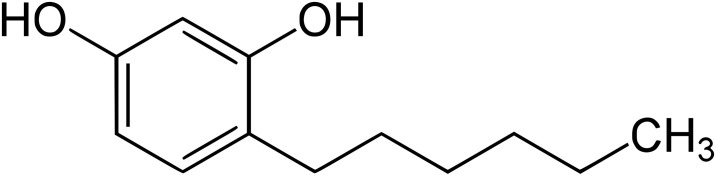
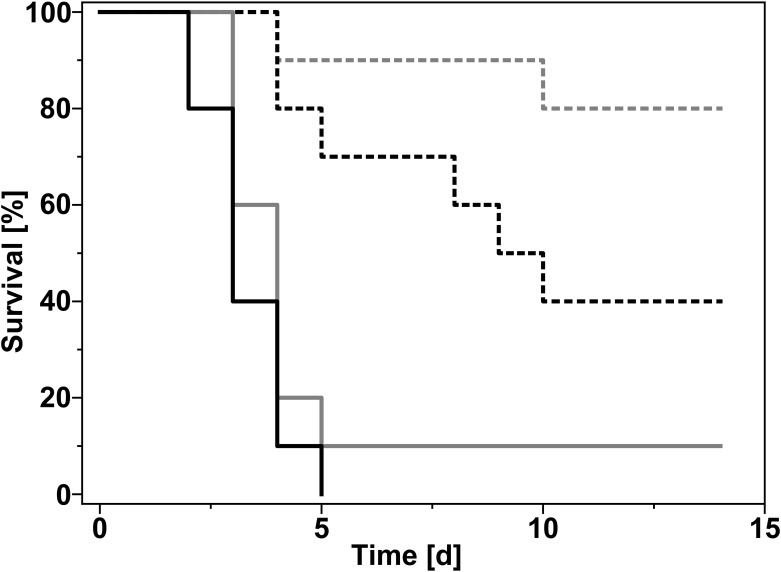
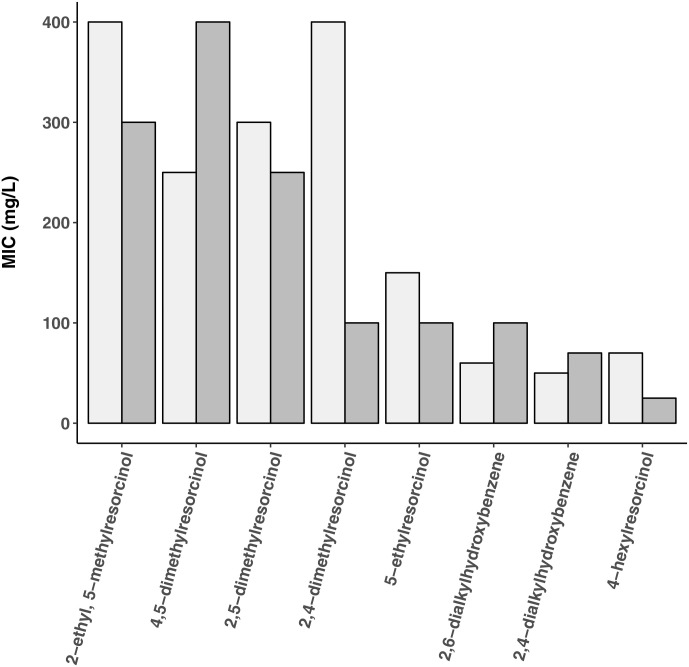
Ever decreasing efficiency of antibiotic treatment due to growing antibiotic resistance of pathogenic bacteria is a critical issue in clinical practice. The two generally accepted major approaches to this problem are the search for new antibiotics and the development of antibiotic adjuvants to enhance the antimicrobial activity of known compounds. It was therefore the aim of the present study to test whether alkylresorcinols, a class of phenolic lipids, can be used as adjuvants to potentiate the effect of various classes of antibiotics. Alkylresorcinols were combined with 12 clinically used antibiotics. Growth-inhibiting activity against a broad range of pro- and eukaryotic microorganisms was determined. Test organisms did comprise 10 bacterial and 2 fungal collection strains, including E. coli and S. aureus, and clinical isolates of K. pneumoniae. The highest adjuvant activity was observed in the case of 4-hexylresorcinol (4-HR), a natural compound found in plants with antimicrobial activity. 50% of the minimal inhibitory concentration (MIC) of 4-HR caused an up to 50-fold decrease in the MIC of antibiotics of various classes. Application of 4-HR as an adjuvant revealed its efficiency against germination of bacterial dormant forms (spores) and prevented formation of antibiotic-tolerant persister cells. Using an in vivo mouse model of K. pneumoniae-induced sepsis, we could demonstrate that the combination of 4-HR and polymyxin was highly effective. 75% of animals were free of infection after treatment as compared to none of the animals receiving the antibiotic alone. We conclude that alkylresorcinols such as 4-HR can be used as an adjuvant to increase the efficiency of several known antibiotics. We suggest that by this approach the risk for development of genetically determined antibiotic resistance can be minimized due to the multimodal mode of action of 4-HR.
由于致病菌对抗生素的耐药性不断增强,抗生素治疗的效率不断下降,这是临床实践中的一个关键问题。解决这个问题的两种公认的主要方法是寻找新的抗生素和开发抗生素佐剂来增强已知化合物的抗菌活性。因此,本研究的目的是测试烷基间苯二酚(一类酚类脂质)是否可作为佐剂来增强各种抗生素的作用。将烷基间苯二酚与 12 种临床使用的抗生素结合,测定其对广谱原核和真核微生物的生长抑制活性。测试的生物包括 10 株细菌和 2 株真菌的收集株,包括大肠杆菌和金黄色葡萄球菌,以及肺炎克雷伯菌的临床分离株。在 4-己基间苯二酚(4-HR)的情况下观察到最高的佐剂活性,4-HR 是一种具有抗菌活性的植物中天然存在的化合物。50%的最小抑菌浓度(MIC)的 4-HR 导致各种抗生素的 MIC 降低了 50 倍。4-HR 作为佐剂的应用显示了其对细菌休眠形式(孢子)萌发的效率,并防止了抗生素耐受持久细胞的形成。在使用肺炎克雷伯菌诱导败血症的体内小鼠模型中,我们可以证明 4-HR 和多粘菌素的组合非常有效。与单独使用抗生素的动物相比,治疗后有 75%的动物没有感染。我们得出结论,烷基间苯二酚(如 4-HR)可用作佐剂来提高几种已知抗生素的效率。我们建议,通过这种方法,由于 4-HR 的多模式作用方式,可以最大限度地降低遗传决定的抗生素耐药性发展的风险。