Department of General Pediatrics, University Children's Hospital Münster, Albert-Schweitzer-Campus 1, 48149, Münster, Germany.
Orphanet J Rare Dis. 2020 Sep 22;15(1):258. doi: 10.1186/s13023-020-01528-z.
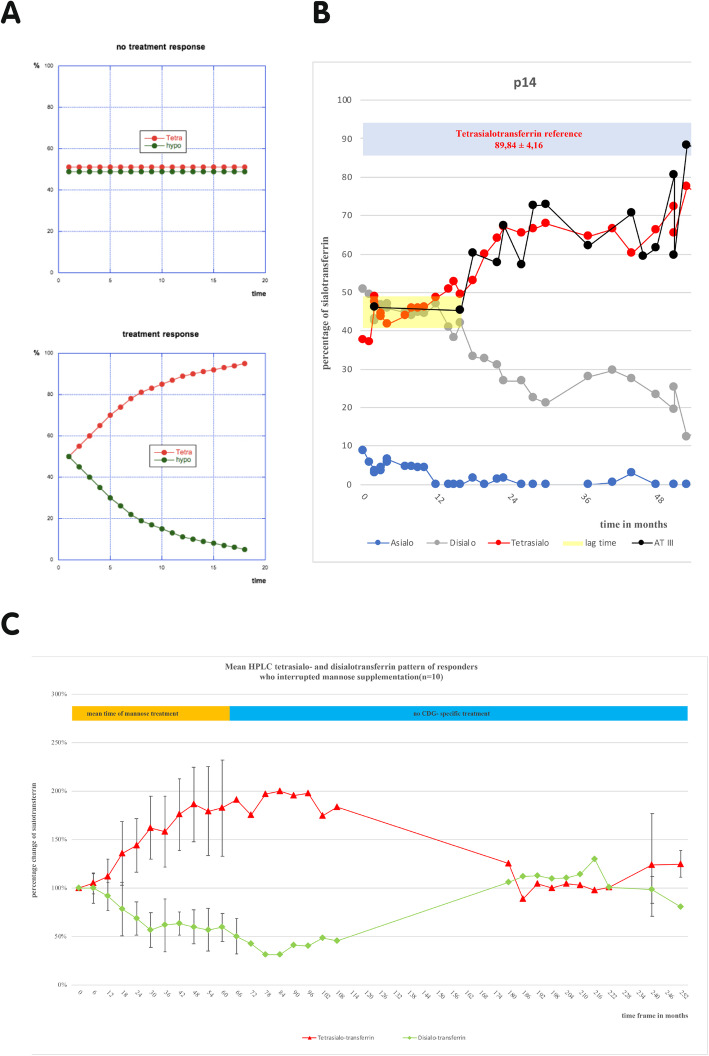
PMM2-CDG (CDG-Ia) is the most frequent N-glycosylation disorder. While supplying mannose to PMM2-deficient fibroblasts corrects the altered N-glycosylation in vitro, short term therapeutic approaches with mannose supplementation in PMM2-CDG patients have been unsuccessful. Mannose found no further mention in the design of a potential therapy for PMM2-CDG in the past years, as it applies to be ineffective. This retrospective study analyzes the first long term mannose supplementation in 20 PMM2-CDG patients. Mannose was given at a total of 1-2 g mannose/kg b.w./d divided into 5 single doses over a mean time of 57,75 ± 25,85 months. Protein glycosylation, blood mannose concentration and clinical presentation were monitored in everyday clinical practice.
After a mean time period of more than 1 year the majority of patients showed significant improvements in protein glycosylation.
Dietary mannose supplementation shows biological effects in PMM2-CDG patients improving glycosylation in the majority of patients. A double-blind randomized study is needed to examine the role of mannose in the design of a therapy for children with PMM2-CDG in more detail.
PMM2-CDG(CDG-Ia)是最常见的 N-糖基化疾病。虽然向 PMM2 缺陷型成纤维细胞中补充甘露糖可以纠正体外改变的 N-糖基化,但在 PMM2-CDG 患者中短期补充甘露糖的治疗方法并不成功。在过去的几年中,甘露糖在 PMM2-CDG 潜在治疗方法的设计中没有进一步提及,因为它被证明是无效的。本回顾性研究分析了 20 例 PMM2-CDG 患者首次长期补充甘露糖的情况。甘露糖的总剂量为 1-2g 甘露糖/kg b.w./d,分为 5 次单剂量,平均时间为 57.75±25.85 个月。在日常临床实践中监测蛋白质糖基化、血液甘露糖浓度和临床表现。
在平均 1 年以上的时间后,大多数患者的蛋白质糖基化显著改善。
饮食补充甘露糖在 PMM2-CDG 患者中具有生物学效应,可改善大多数患者的糖基化。需要进行双盲随机研究,以更详细地研究甘露糖在 PMM2-CDG 儿童治疗方案设计中的作用。