Département de biologie, Université de Sherbrooke, Sherbrooke, QC, J1K 2R1, Canada.
Commun Biol. 2020 Sep 22;3(1):523. doi: 10.1038/s42003-020-01253-0.
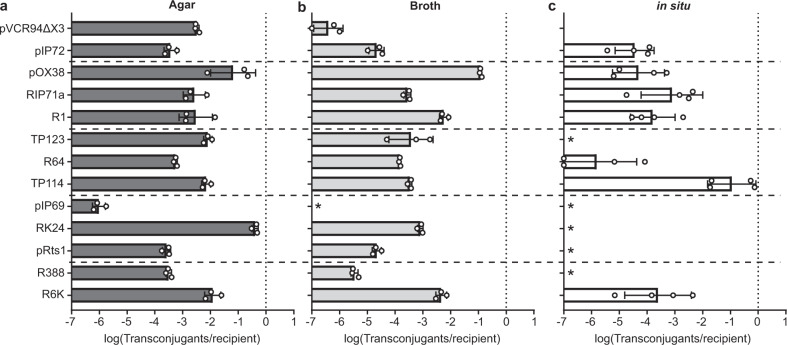
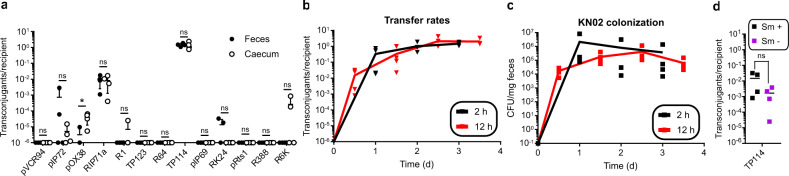
The gut microbiota is a suspected hotspot for bacterial conjugation due to its high density and diversity of microorganisms. However, the contribution of different conjugative plasmid families to horizontal gene transfer in this environment remains poorly characterized. Here, we systematically quantified the transfer rates in the mouse intestinal tract for 13 conjugative plasmids encompassing 10 major incompatibility groups. The vast majority of these plasmids were unable to perform conjugation in situ or only reached relatively low transfer rates. Surprisingly, IncI conjugative plasmid TP114 was identified as a proficient DNA delivery system in this environment, with the ability to transfer to virtually 100% of the probed recipient bacteria. We also show that a type IV pilus present in I-complex conjugative plasmids plays a crucial role for the transfer of TP114 in the mouse intestinal microbiota, most likely by contributing to mating pair stabilization. These results provide new insights on the mobility of genes in the gut microbiota and highlights TP114 as a very efficient DNA delivery system of interest for microbiome editing tools.
肠道微生物群是细菌接合的一个可疑热点,因为其微生物的密度和多样性都很高。然而,不同的可移动性基因盒家族在这种环境中对水平基因转移的贡献仍未得到充分描述。在这里,我们系统地定量了 13 种包含 10 种主要不相容群的可移动性基因盒在小鼠肠道中的转移率。这些质粒中的绝大多数不能在原位进行接合,或者只能达到相对较低的转移率。令人惊讶的是,IncI 可移动性基因盒 TP114 被鉴定为该环境中一种有效的 DNA 输送系统,能够几乎 100%地将供体细菌转移到受体内。我们还表明,I 型复杂可移动性基因盒中的一种 IV 型菌毛在 TP114 在小鼠肠道微生物群中的转移中起着至关重要的作用,很可能是通过促进交配对的稳定。这些结果为肠道微生物群中基因的移动性提供了新的见解,并强调了 TP114 作为一种非常有效的 DNA 输送系统,是微生物组编辑工具的研究重点。