Department of Pediatrics, The Third Xiangya Hospital, Central South University, Hunan Province, Changsha 410013, China.
Guangdong Cardiovascular Institute, Guangdong Provincial People's Hospital, Guangdong Academy of Medical Sciences, Guangzhou, Guangdong 510100, China.
Oxid Med Cell Longev. 2020 Sep 5;2020:8384742. doi: 10.1155/2020/8384742. eCollection 2020.
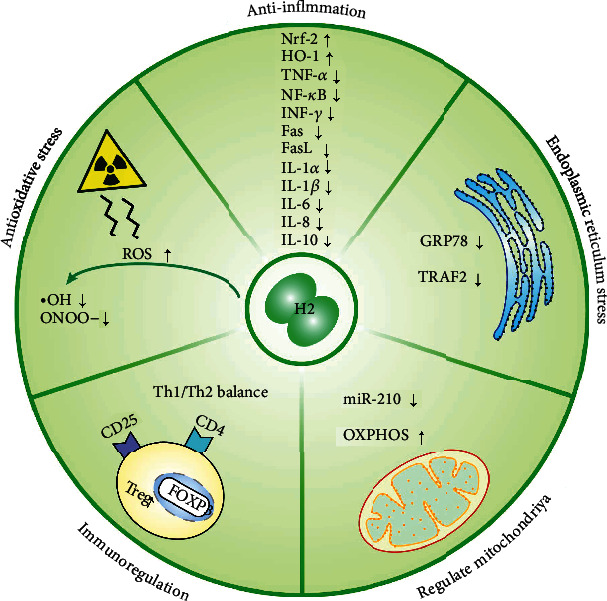
H has shown anti-inflammatory and antioxidant ability in many clinical trials, and its application is recommended in the latest Chinese novel coronavirus pneumonia (NCP) treatment guidelines. Clinical experiments have revealed the surprising finding that H gas may protect the lungs and extrapulmonary organs from pathological stimuli in NCP patients. The potential mechanisms underlying the action of H gas are not clear. H gas may regulate the anti-inflammatory and antioxidant activity, mitochondrial energy metabolism, endoplasmic reticulum stress, the immune system, and cell death (apoptosis, autophagy, pyroptosis, ferroptosis, and circadian clock, among others) and has therapeutic potential for many systemic diseases. This paper reviews the basic research and the latest clinical applications of H gas in multiorgan system diseases to establish strategies for the clinical treatment for various diseases.
H 在许多临床试验中表现出抗炎和抗氧化能力,其应用在最新的中国新型冠状病毒肺炎(NCP)治疗指南中被推荐。临床实验揭示了一个令人惊讶的发现,H 气体可能保护 NCP 患者的肺部和肺外器官免受病理刺激。H 气体作用的潜在机制尚不清楚。H 气体可能调节抗炎和抗氧化活性、线粒体能量代谢、内质网应激、免疫系统和细胞死亡(细胞凋亡、自噬、细胞焦亡、铁死亡和生物钟等),并对许多全身性疾病具有治疗潜力。本文综述了 H 气体在多器官系统疾病中的基础研究和最新临床应用,为各种疾病的临床治疗建立策略。