Tang Quan, Liu Hua, Shi Xiao-Jie, Cheng Yong
Key Laboratory of Ethnomedicine for Ministry of Education, Center on Translational Neuroscience, College of Life and Environmental Sciences, Minzu University of China, Beijing, China 100081.
Oxid Med Cell Longev. 2020 Sep 8;2020:9187195. doi: 10.1155/2020/9187195. eCollection 2020.
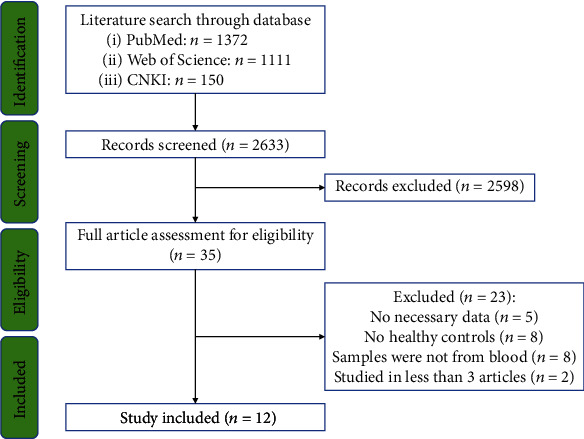
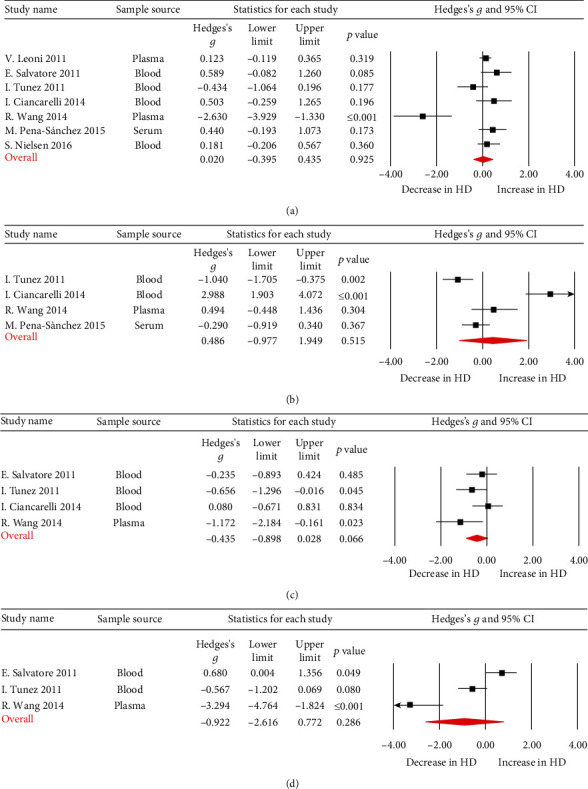
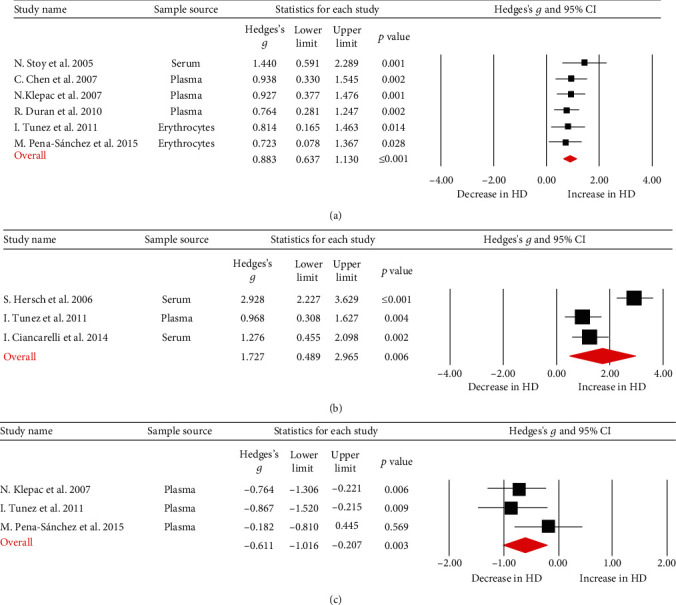
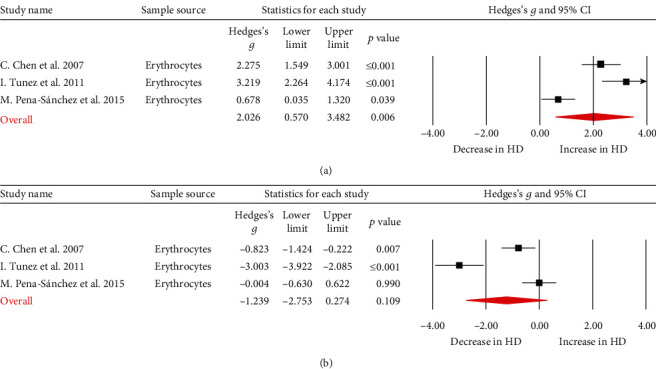
Huntington's disease (HD) is a hereditary autosomal dominant neurodegenerative disease. Although studies have shown that blood oxidative stress markers are dysregulated in HD patients, clinical data on the blood oxidative stress markers of HD patients is inconsistent. To better understand the pathogenesis of HD, we performed a systematic review and meta-analysis of blood oxidative stress markers in HD patients and healthy control (HC) subjects. A database search from PubMed and Web of Science identified 12 studies with 375 HD patients and 447 HC subjects in this meta-analysis. A random-effects meta-analysis showed that blood lipid peroxidation products (Hedges' = 0.883, 95%CI = 0.637 to 1.130, < 0.001), 8-hydroxyguanosine (Hedges' = 1.727, 95%CI = 0.489 to 2.965, = 0.006) levels, and the activity of glutathione peroxidase (Hedges' = 2.026, 95%CI = 0.570 to 3.482, = 0.006) were significantly increased in HD patients compared to controls. In contrast, reduced glutathione levels were lower in HD patients than in controls (Hedges' = -0.611, 95%CI = -1.016 to - 0.207, = 0.003). However, blood superoxide dismutase, cholesterol, high-density lipoproteins, low-density lipoproteins, and triglycerides did not show significant differences between cases and controls. Taken together, this study clarified the associations between blood oxidative stress markers and HD, supporting the clinical evidence that HD is accompanied by increased oxidative stress.
亨廷顿舞蹈症(HD)是一种常染色体显性遗传性神经退行性疾病。尽管研究表明HD患者血液中的氧化应激标志物失调,但关于HD患者血液氧化应激标志物的临床数据并不一致。为了更好地理解HD的发病机制,我们对HD患者和健康对照(HC)受试者的血液氧化应激标志物进行了系统评价和荟萃分析。通过在PubMed和Web of Science数据库中检索,本荟萃分析纳入了12项研究,共375例HD患者和447例HC受试者。随机效应荟萃分析结果显示,与对照组相比,HD患者的血脂过氧化产物(Hedges' = 0.883,95%CI = 0.637至1.130,P < 0.001)、8-羟基鸟苷(Hedges' = 1.727,95%CI = 0.489至2.965,P = 0.006)水平以及谷胱甘肽过氧化物酶活性(Hedges' = 2.026,95%CI = 0.570至3.482,P = 0.006)显著升高。相反,HD患者的还原型谷胱甘肽水平低于对照组(Hedges' = -0.611,95%CI = -1.016至 - 0.207,P = 0.003)。然而,病例组和对照组之间血液中的超氧化物歧化酶、胆固醇、高密度脂蛋白、低密度脂蛋白和甘油三酯没有显著差异。综上所述,本研究阐明了血液氧化应激标志物与HD之间的关联,支持了HD伴有氧化应激增加的临床证据。