Huerta-Delgado Anna S, Roffe-Vazquez Daniel N, Gonzalez-Gil Adrian M, Villarreal-Calderón José R, Tamez-Rivera Oscar, Rodriguez-Gutierrez Nora A, Castillo Elena C, Silva-Platas Christian, Garcia-Rivas Gerardo, Elizondo-Montemayor Leticia
Center for Research in Obesity and Clinical Nutrition, Tecnologico de Monterrey-Escuela de Medicina, Monterrey 64710, Mexico.
Department of Pediatrics, Tecnologico de Monterrey-Hospital Zambrano Hellion, San Pedro Garza-Garcia 66278, Mexico.
J Diabetes Res. 2020 Sep 4;2020:1949415. doi: 10.1155/2020/1949415. eCollection 2020.
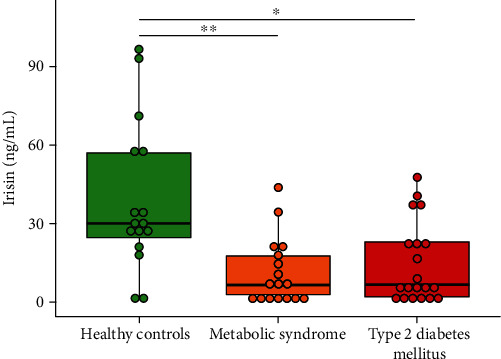
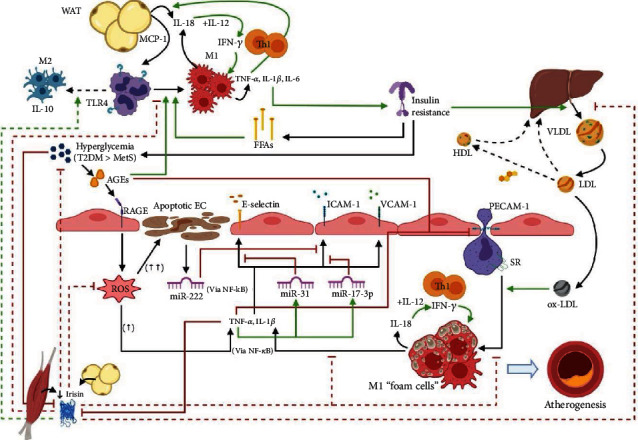
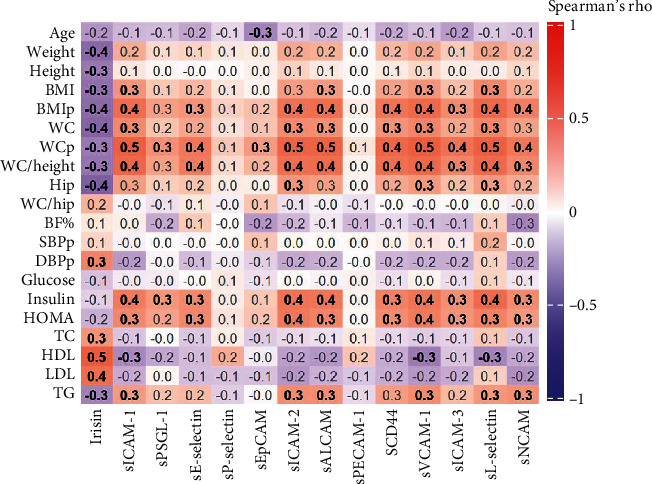
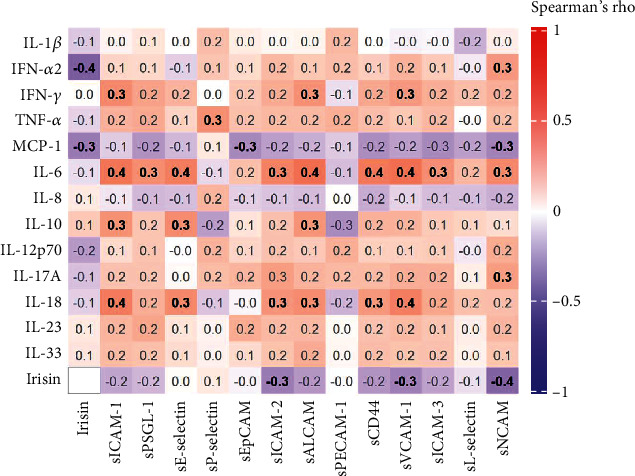
The prevalence of type 2 diabetes mellitus (T2DM) and metabolic syndrome (MetS) has increased in the pediatric population. Irisin, an adipomyokine, is involved in white adipose tissue browning, energy expenditure, insulin sensitivity, and anti-inflammatory pathways. Data on the associations among circulating irisin levels, soluble cell adhesion molecules (sCAMs), and inflammatory cytokines is scarce in children and adolescents with MetS and T2DM. Subjects aged 6-16 years were grouped into T2DM, MetS, and healthy controls. Serum irisin levels were significantly lower in the MetS (6.6 [2.8-18.0] ng/mL) and T2DM (6.8 [2.2-23.2] ng/mL) groups compared with controls (30.3 [24.6-57.1] ng/mL). Negative correlations between irisin and the BMI percentile ( = -0.358), WC percentile ( = -0.308), and triglycerides ( = -0.284) were identified, while positive associations with TC ( = 0.287), HDL-c ( = 0.488), and LDL-c ( = 0.414) were observed. Significant negative correlations were found between irisin and sNCAM ( = -0.382), sICAM-2 ( = -0.300), sVCAM-1 ( = -0.292), MCP-1 ( = -0.308), and IFN-2 ( = -0.406). Of note, lower concentrations of most sCAMs (sICAM-1, sPSGL-1, sP-selectin, sEpCAM, sICAM-2, sALCAM, sPECAM-1, sCD44, sVCAM-1, sICAM-3, sL-selectin, and sNCAM) were shown in T2DM subjects compared with MetS patients. Lower irisin levels induce a lack of inhibition of oxidative stress and inflammation. In T2DM, higher ROS, AGEs, glucotoxicity, and inflammation trigger endothelial cell apoptosis, which downregulates the sCAM expression as a compensatory mechanism to prevent further vascular damage. In opposition, in subjects with MetS that have not yet developed T2DM and its accompanying stressors, the upregulation of the sCAM expression is ensued.
2型糖尿病(T2DM)和代谢综合征(MetS)在儿童人群中的患病率有所上升。鸢尾素是一种脂肪肌动蛋白,参与白色脂肪组织褐变、能量消耗、胰岛素敏感性和抗炎途径。在患有MetS和T2DM的儿童和青少年中,关于循环鸢尾素水平、可溶性细胞粘附分子(sCAMs)和炎性细胞因子之间关联的数据很少。将6至16岁的受试者分为T2DM组、MetS组和健康对照组。与对照组(30.3 [24.6 - 57.1] ng/mL)相比,MetS组(6.6 [2.8 - 18.0] ng/mL)和T2DM组(6.8 [2.2 - 23.2] ng/mL)的血清鸢尾素水平显著降低。鸢尾素与BMI百分位数(r = -0.358)、腰围百分位数(r = -0.308)和甘油三酯(r = -0.284)之间存在负相关,而与总胆固醇(r = 0.287)、高密度脂蛋白胆固醇(r = 0.488)和低密度脂蛋白胆固醇(r = 0.414)之间存在正相关。鸢尾素与可溶性神经细胞粘附分子(sNCAM,r = -0.382)、可溶性细胞间粘附分子-2(sICAM-2,r = -0.300)、可溶性血管细胞粘附分子-1(sVCAM-1,r = -0.292)、单核细胞趋化蛋白-1(MCP-1,r = -0.308)和干扰素-γ(IFN-γ,r = -0.406)之间存在显著负相关。值得注意的是,与MetS患者相比,T2DM患者中大多数sCAMs(可溶性细胞间粘附分子-1、可溶性P选择素糖蛋白配体-1、可溶性P选择素、可溶性上皮细胞粘附分子、可溶性细胞间粘附分子-2、可溶性活化白细胞粘附分子、可溶性血小板内皮细胞粘附分子-1、可溶性CD44、可溶性血管细胞粘附分子-1、可溶性细胞间粘附分子-3、可溶性L选择素和可溶性神经细胞粘附分子)的浓度较低。较低的鸢尾素水平会导致对氧化应激和炎症缺乏抑制作用。在T2DM中,较高的活性氧、晚期糖基化终末产物、糖毒性和炎症会引发内皮细胞凋亡,从而下调sCAM的表达,作为一种防止进一步血管损伤的代偿机制。相反,在尚未发展为T2DM及其伴随应激源的MetS患者中,sCAM的表达会上调。