Chair of Economic and Social Policy, WHU - Otto Beisheim School of Management, Vallendar, Germany.
JMIR Mhealth Uhealth. 2020 Sep 23;8(9):e16444. doi: 10.2196/16444.
Germany is the first country worldwide that has introduced a digital care act as an incentive system to enhance the use of digital health devices, namely health apps and wearables, among its population. The act allows physicians to prescribe statutory financed and previously certified health apps and wearables to patients. This initiative has the potential to improve treatment quality through better disease management and monitoring.
The aim of this paper was to outline the key concepts related to the potential risks and benefits discussed in the current literature about health apps and wearables. Furthermore, this study aimed to answer the research question: Which risks and benefits may result from the implementation of the digital care act in Germany?
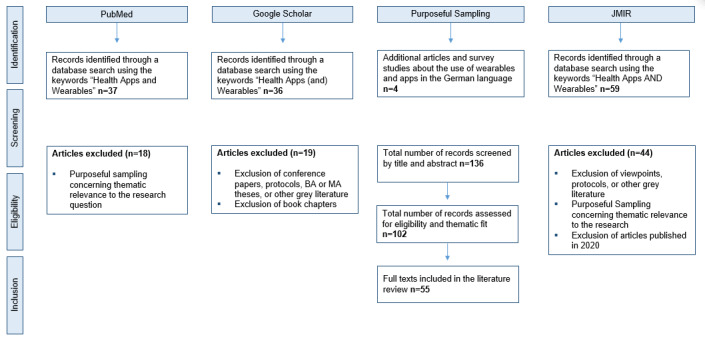
We conducted the scoping study by searching the databases PubMed, Google Scholar, and JMIR using the keywords health apps and wearables. We discussed 55 of 136 identified articles published in the English language from 2015 to March 2019 in this paper using a qualitative thematic analysis approach.
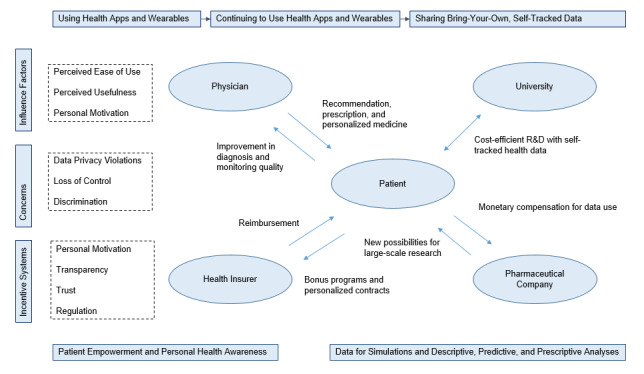
We identified four key themes within the articles: Effectivity of health apps and wearables to improve health; users of health apps and wearables; the potential of bring-your-own, self-tracked data; and concerns and data privacy risks. Within these themes, we identified three main stages of benefits for the German health care system: Usage of health apps and wearables; continuing to use health apps and wearables; and sharing bring-your-own; self-tracked data with different agents in the health care sector.
The digital care act could lead to an improvement in treatment quality through better patient monitoring, disease management, personalized therapy, and better health education. However, physicians should play an active role in recommending and supervising health app use to reach digital-illiterate or health-illiterate people. Age must not be an exclusion criterion. Yet, concerns about data privacy and security are very strong in Germany. Transparency about data processing should be provided at all times for continuing success of the digital care act in Germany.
德国是全球首个引入数字护理法案的国家,该法案将作为激励机制,以提高其国民使用数字健康设备(即健康应用程序和可穿戴设备)的频率。该法案允许医生为患者开具法定资助和先前认证的健康应用程序和可穿戴设备的处方。这一举措有潜力通过更好的疾病管理和监测来提高治疗质量。
本文旨在概述与当前文献中讨论的健康应用程序和可穿戴设备相关的潜在风险和益处的关键概念。此外,本研究旨在回答研究问题:德国实施数字护理法案可能会带来哪些风险和益处?
我们使用 PubMed、Google Scholar 和 JMIR 数据库,以健康应用程序和可穿戴设备为关键词进行了范围界定研究。我们使用定性主题分析方法讨论了 2015 年至 2019 年 3 月期间在英语期刊上发表的 136 篇文章中的 55 篇。
我们在文章中确定了四个关键主题:健康应用程序和可穿戴设备提高健康效果的有效性;健康应用程序和可穿戴设备的使用者;自带、自我追踪数据的潜力;以及关注和数据隐私风险。在这些主题中,我们确定了德国医疗保健系统的三个主要获益阶段:健康应用程序和可穿戴设备的使用;持续使用健康应用程序和可穿戴设备;以及与医疗保健领域的不同代理共享自带、自我追踪数据。
数字护理法案可以通过更好地监测患者、管理疾病、提供个性化治疗和更好的健康教育来提高治疗质量。然而,医生应该积极推荐和监督健康应用程序的使用,以覆盖数字文盲或健康文盲人群。年龄不应作为排除标准。然而,德国对数据隐私和安全的担忧非常强烈。应始终提供有关数据处理的透明度,以确保数字护理法案在德国的持续成功。