Chauhan Gauri Kumari, Vavken Patrick, Jacob Christine
FHNW - University of Applied Sciences Northwestern Switzerland, Bahnhofstrasse 6, Windisch, 5210, Switzerland, 41 562027464.
Vavken Health Lab, Zürich, Switzerland.
JMIR Mhealth Uhealth. 2025 Apr 4;13:e65782. doi: 10.2196/65782.
Cardiovascular diseases (CVDs) continue to be the leading cause of global morbidity and mortality. Aiming to reduce the risk of CVD development and better manage them, an increasing number of individuals are adopting mobile health (mHealth) apps and wearable devices (wearables). These technologies provide critical insights into heart health and fitness, supporting users to monitor their lifestyle behaviors and adhere to preventative medication.
In this review, we aimed to investigate the current state of mHealth apps and wearables designed for cardiovascular health, with a specific focus on the DACH region (Germany, Austria, and Switzerland). We assessed the benefits these technologies provide to clinicians and patients, particularly in addressing unmet needs like sex-specific symptoms, while also examining their potential integration into the broader health care ecosystem.
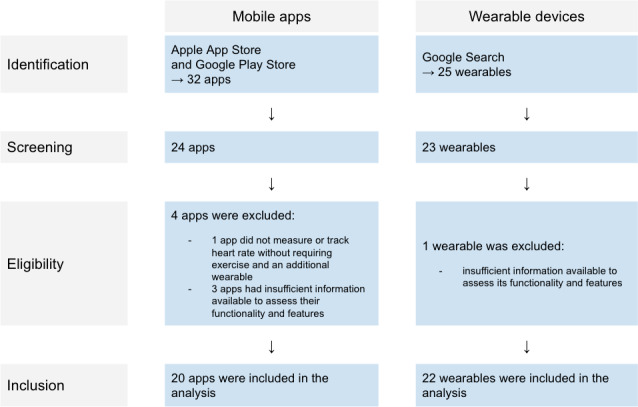
To identify heart health apps, a keyword search was performed on both the Swiss Apple App Store and Google Play Stores. A separate search was performed on Google to identify heart health wearables. The identified apps and wearables were evaluated using the foundational and contextual criteria of the sociotechnical framework for assessing patient-facing eHealth tools.
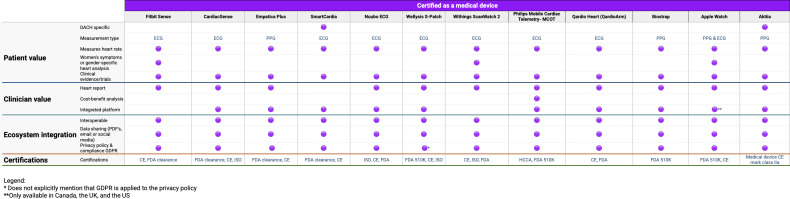
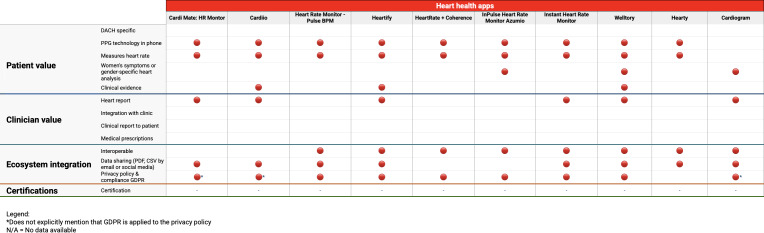
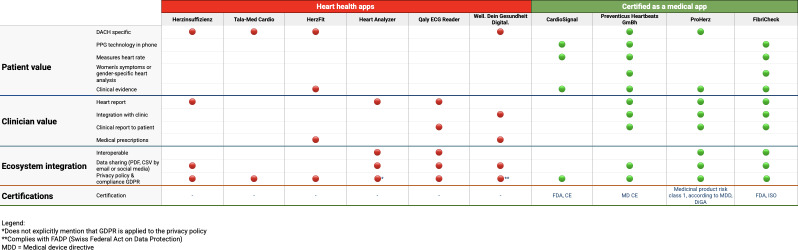
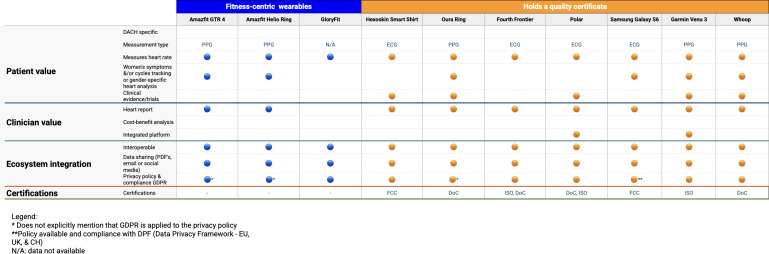
After filtering out apps and wearables that did not meet our inclusion criteria, 20 apps and 22 wearables were included in the review. While all the apps were available in the DACH region, only 30% (6/20) were specifically designed for these countries. Only 25% (5/20) of the apps included sex-specific information; 40% (8/20) provided information from evidence-based research, 35% (7/20) provided general health information without academic and clinical references, and 25% (5/20) did not include any evidence-based or general health information. While 20% (4/20) of the included apps had clinical integration features such as clinician dashboards, only 10% (2/20) had the potential to effectively enhance clinician workflows. Privacy policies were present in 95% (19/20) of the apps, with 75% (15/20) adhering to General Data Protection Regulation (GDPR) regulations; 1 app had no data protection policy. Only 20% (4/20) of the apps were medically certified. For wearables, only 9% (2/22) were tailored to the DACH region, and 40% (9/22) addressed women's health. While around 60% (13/22) offered features to support clinical integration, only 9% (2/22) had the potential to improve clinical workflows. More than half (12/22) of the wearables were medically certified, and 77% (17/22) referenced scientific or peer-reviewed research. All wearables included a privacy policy.
While many mHealth tools for cardiovascular health are available, only a few provide meaningful value to both patients and clinicians or have the potential to integrate effectively into the health care system. Women's sex-specific needs are often overlooked, and the benefits for clinicians are limited. In addition, mHealth apps largely lack robust evidence, whereas wearables showed comparatively stronger support through evidence-based and medical certification.
心血管疾病(CVDs)仍然是全球发病和死亡的主要原因。为了降低心血管疾病发生的风险并更好地进行管理,越来越多的人开始使用移动健康(mHealth)应用程序和可穿戴设备。这些技术为心脏健康和健身提供了关键见解,帮助用户监测生活方式行为并坚持预防性用药。
在本综述中,我们旨在调查为心血管健康设计的移动健康应用程序和可穿戴设备的现状,特别关注德语区(德国、奥地利和瑞士)。我们评估了这些技术为临床医生和患者带来的益处,特别是在解决诸如性别特异性症状等未满足的需求方面,同时还研究了它们融入更广泛医疗保健生态系统的潜力。
为了识别心脏健康应用程序,我们在瑞士苹果应用商店和谷歌应用商店进行了关键词搜索。在谷歌上进行了单独搜索以识别心脏健康可穿戴设备。使用评估面向患者的电子健康工具的社会技术框架的基础和背景标准对识别出的应用程序和可穿戴设备进行评估。
在筛选出不符合我们纳入标准的应用程序和可穿戴设备后,本综述纳入了20个应用程序和22个可穿戴设备。虽然所有应用程序在德语区都可用,但只有30%(6/20)是专门为这些国家设计的。只有25%(5/20)的应用程序包含性别特异性信息;40%(8/20)提供基于循证研究的信息,35%(7/20)提供无学术和临床参考文献的一般健康信息,25%(5/20)未包含任何基于循证或一般健康的信息。虽然20%(4/20)的纳入应用程序具有临床整合功能,如临床医生仪表板,但只有10%(2/20)有潜力有效改善临床医生的工作流程。95%(19/20)的应用程序有隐私政策,75%(15/20)遵守通用数据保护条例(GDPR);1个应用程序没有数据保护政策。只有20%(4/20)的应用程序获得了医学认证。对于可穿戴设备,只有9%(2/22)针对德语区进行了定制,40%(9/22)涉及女性健康。虽然约60%(13/22)提供支持临床整合的功能,但只有9%(2/22)有潜力改善临床工作流程。超过一半(12/22)的可穿戴设备获得了医学认证,77%(17/22)引用了科学或同行评审研究。所有可穿戴设备都包含隐私政策。
虽然有许多用于心血管健康的移动健康工具,但只有少数能为患者和临床医生提供有意义的价值,或有潜力有效融入医疗保健系统。女性的性别特异性需求常常被忽视,对临床医生的益处有限。此外,移动健康应用程序在很大程度上缺乏有力证据,而可穿戴设备通过循证和医学认证显示出相对更强的支持。