Department of Animal Science, University of California Davis, 2251 Meyer Hall, One Shields Ave, Davis, CA, 95616, USA.
Department of Neurobiology, Physiology, and Behavior, University of California Davis, 195 Briggs Hall, One Shields Ave, Davis, CA, 95616, USA.
BMC Musculoskelet Disord. 2020 Sep 23;21(1):627. doi: 10.1186/s12891-020-03650-2.
Tendon injuries amount to one of the leading causes of career-ending injuries in horses due to the inability for tendon to completely repair and the high reinjury potential. As a result, novel therapeutics are necessary to improve repair with the goal of decreasing leg lameness and potential reinjury. Small leucine-rich repeat proteoglycans (SLRPs), a class of regulatory molecules responsible for collagen organization and maturation, may be one such therapeutic to improve tendon repair. Before SLRP supplementation can occur in vivo, proper evaluation of the effect of these molecules in vitro needs to be assessed. The objective of this study was to evaluate the effectiveness of purified bovine biglycan or decorin on tendon proper and peritenon cell populations in three-dimensional tendon constructs.
Equine tendon proper or peritenon cell seeded fibrin three-dimensional constructs were supplemented with biglycan or decorin at two concentrations (5 nM or 25 nM). The functionality and ultrastructural morphology of the constructs were assessed using biomechanics, collagen content analysis, transmission electron microscopy (TEM), and gene expression by real time - quantitative polymerase chain reaction (RT-qPCR).
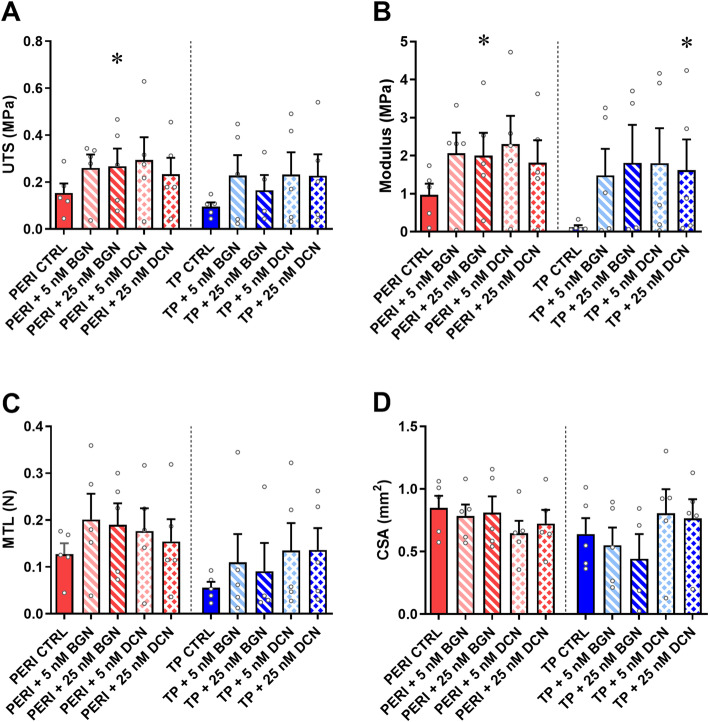
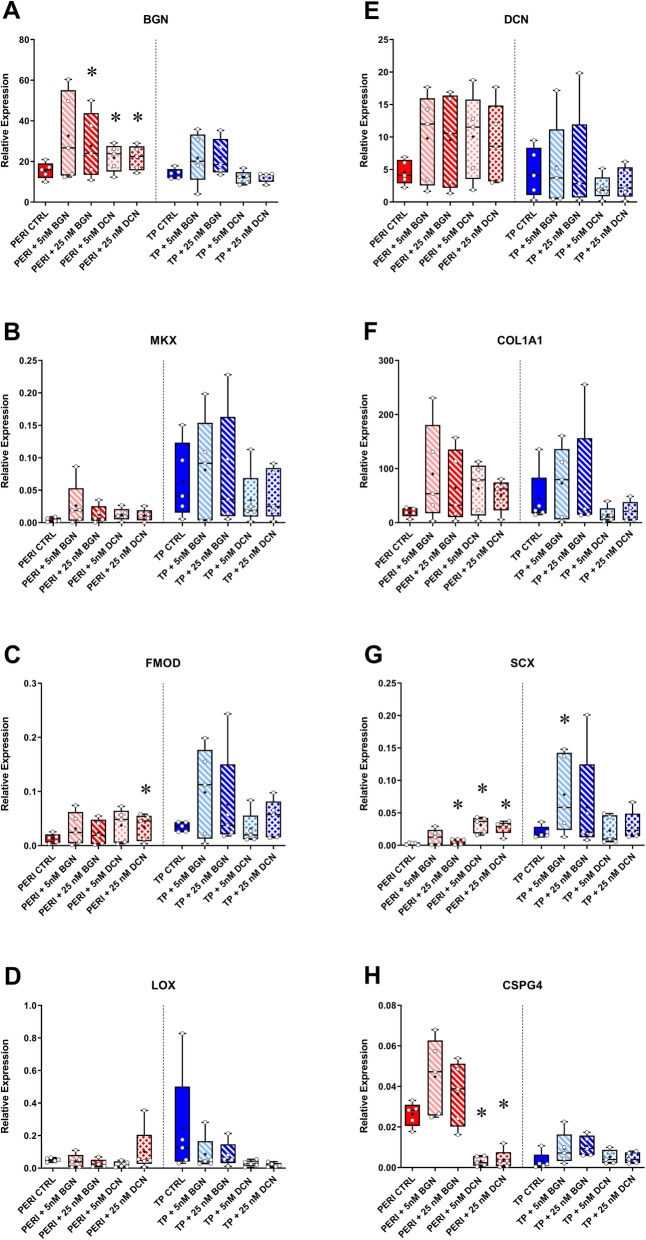
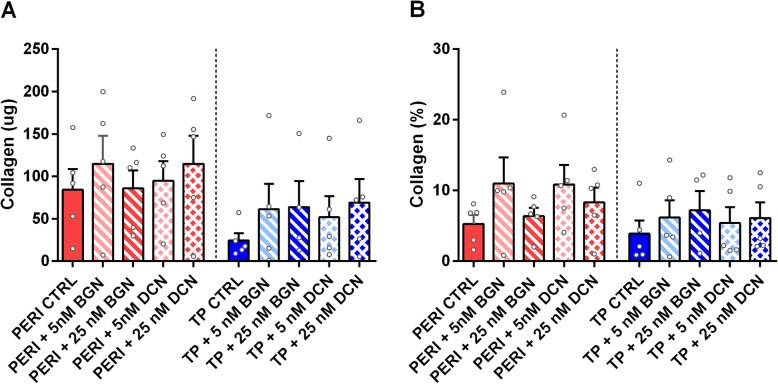
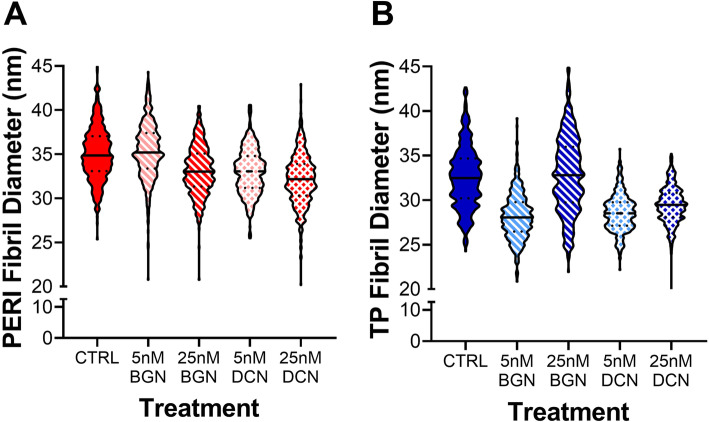
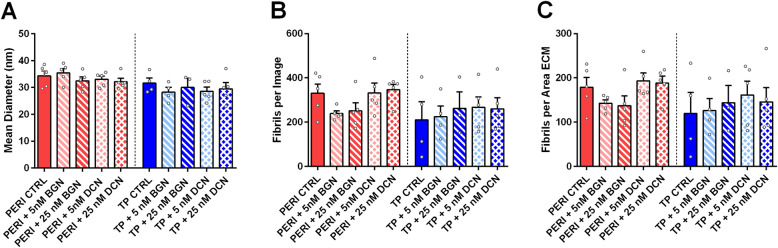
SLRP supplementation affected both tendon proper and peritenon cells-seeded constructs. With additional SLRPs, material and tensile properties of constructs strengthened, though ultrastructural analyses indicated production of similar-sized or smaller fibrils. Overall expression of tendon markers was bolstered more in peritenon cells supplemented with either SLRP, while supplementation of SLRPs to TP cell-derived constructs demonstrated fewer changes in tendon and extracellular matrix markers. Moreover, relative to non-supplemented tendon proper cell-seeded constructs, SLRP supplementation of the peritenon cells showed increases in mechanical strength, material properties, and collagen content.
The SLRP-supplemented peritenon cells produced constructs with greater mechanical and material properties than tendon proper seeded constructs, as well as increased expression of matrix assembly molecules. These findings provide evidence that SLRPs should be further investigated for their potential to improve tendon formation in engineered grafts or post-injury.
由于肌腱无法完全修复且再受伤的可能性高,肌腱损伤成为导致马匹退役的主要原因之一。因此,需要新的治疗方法来改善修复,以减少腿部跛行和潜在的再受伤。富含亮氨酸的小富含亮氨酸的重复蛋白聚糖(SLRPs)是一类负责胶原组织和成熟的调节分子,可能是改善肌腱修复的一种治疗方法。在体内进行 SLRP 补充之前,需要对这些分子在体外的作用进行适当评估。本研究的目的是评估纯化的牛 biglycan 或 decorin 对三维肌腱构建体中肌腱固有细胞和腱周细胞群体的有效性。
向 biglycan 或 decorin 浓度为 5 nM 或 25 nM 的肌腱固有或腱周细胞接种纤维蛋白三维构建体中添加 biglycan 或 decorin。通过生物力学、胶原含量分析、透射电子显微镜(TEM)和实时定量聚合酶链反应(RT-qPCR)评估构建体的功能和超微结构形态。
SLRP 补充影响肌腱固有和腱周细胞接种的构建体。随着额外的 SLRPs 的加入,构建体的力学和拉伸性能得到了增强,尽管超微结构分析表明生成的纤维更小或相同大小。在外周细胞中补充 SLRP 后,肌腱标志物的总体表达得到了增强,而在向 TP 细胞衍生的构建体中补充 SLRP 后,肌腱和细胞外基质标志物的变化较少。此外,与未补充肌腱固有细胞接种的构建体相比,SLRP 补充外周细胞显示出机械强度、材料性能和胶原含量的增加。
SLRP 补充的腱周细胞产生的构建体具有比肌腱固有细胞接种的构建体更大的机械和材料性能,以及增加的基质组装分子的表达。这些发现为 SLRPs 应该进一步研究其在工程移植物或损伤后改善肌腱形成的潜力提供了证据。