Institut Curie, Paris Sciences et Lettres Research University, CNRS, UMR3244, 75248 Paris Cedex 05, France.
Sorbonne Universités, Université Pierre et Marie Curie Paris 06, CNRS, UMR3244, 75248 Paris Cedex 05, France.
Proc Natl Acad Sci U S A. 2020 Oct 6;117(40):24947-24956. doi: 10.1073/pnas.2011332117. Epub 2020 Sep 23.
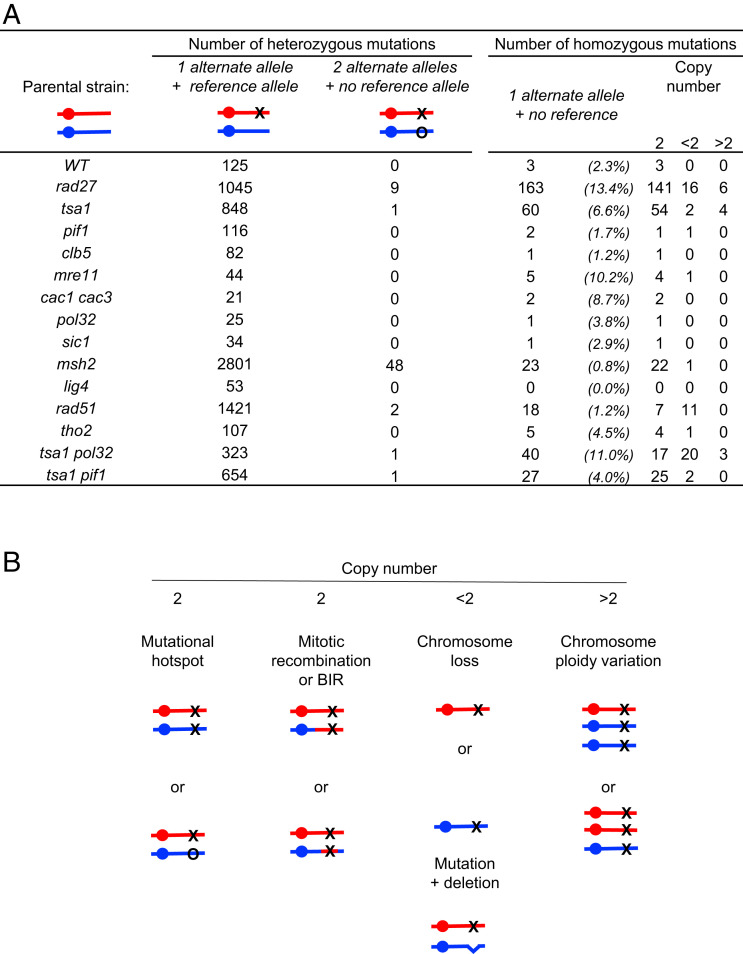
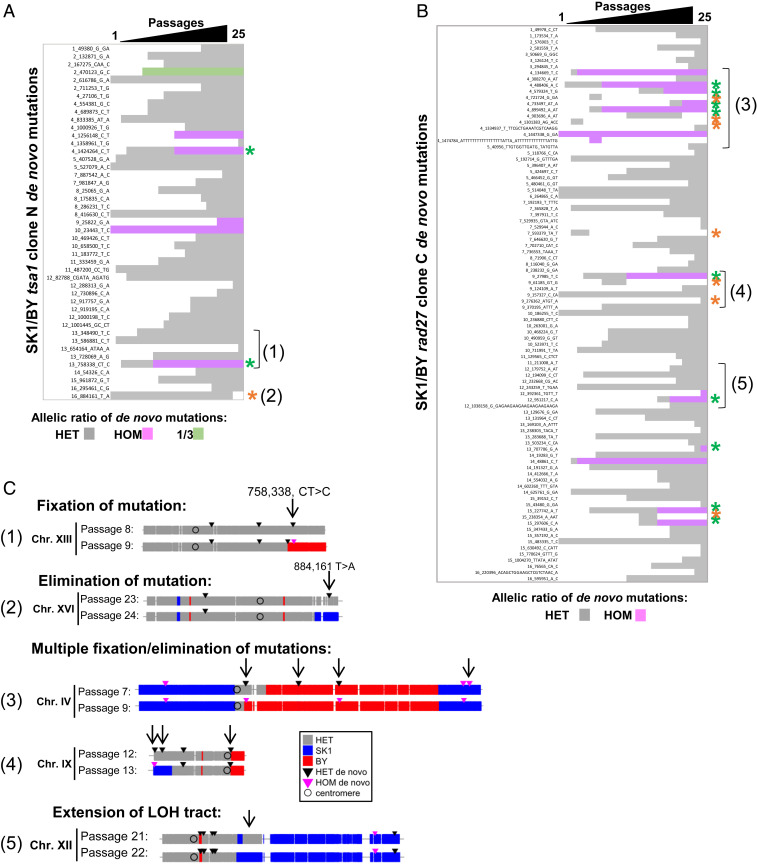
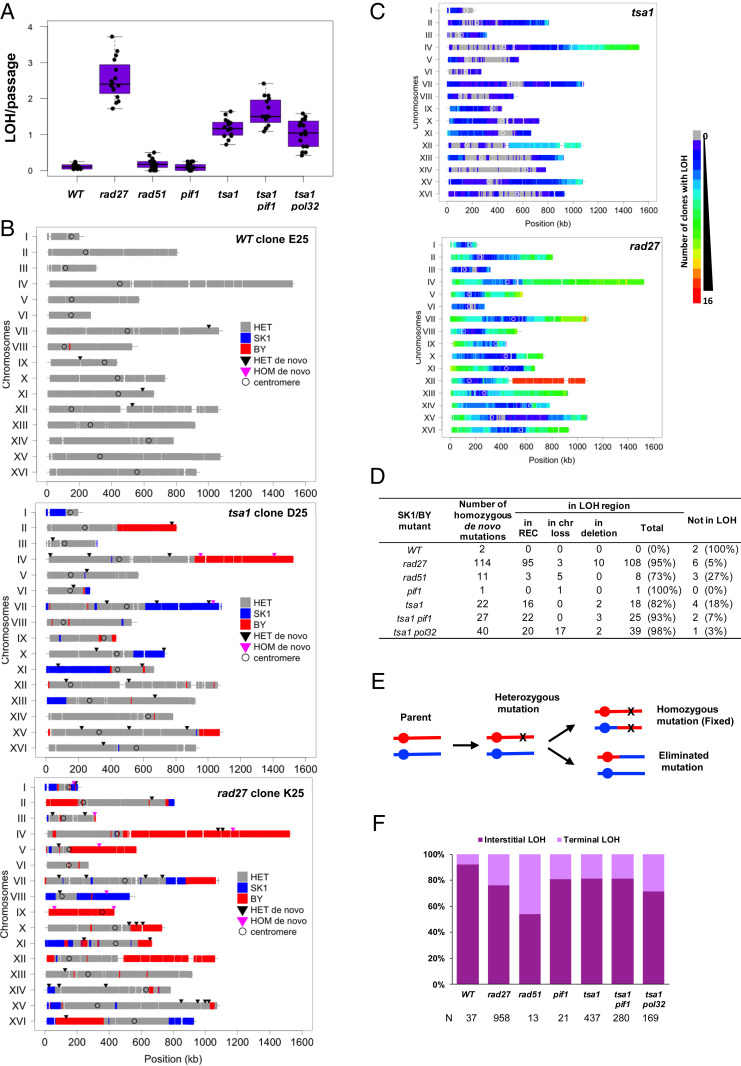
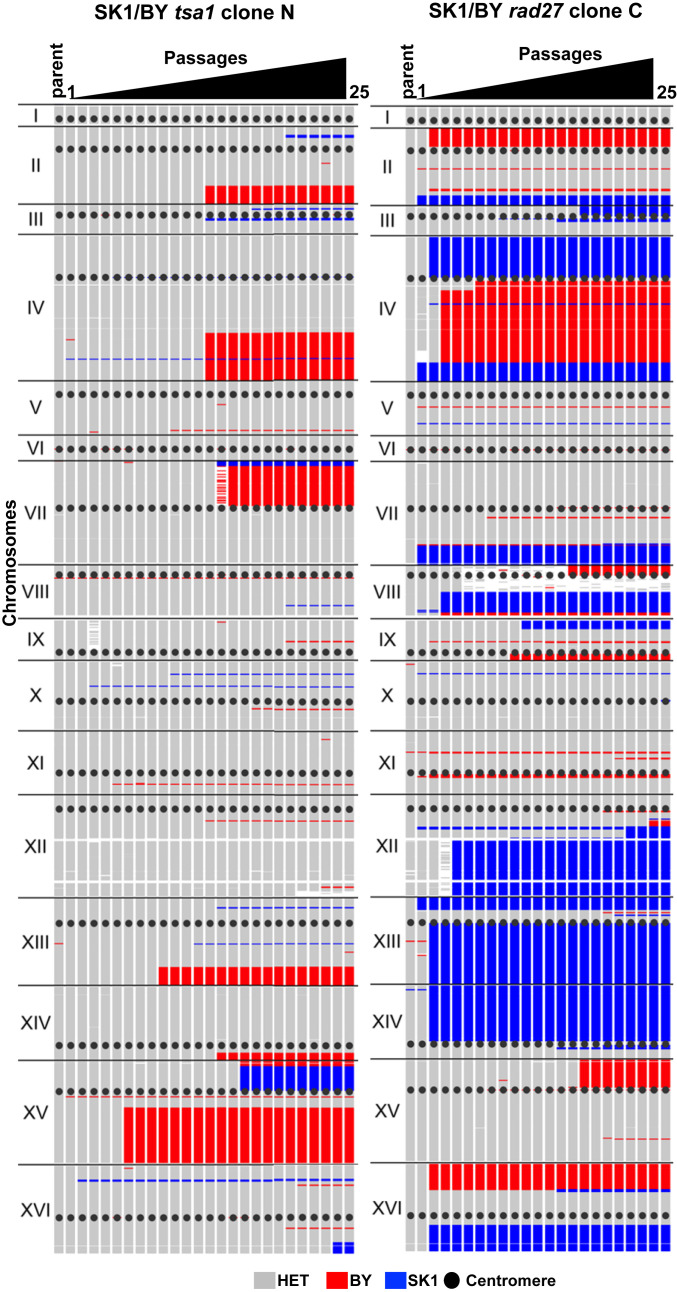
The acquisition of mutations plays critical roles in adaptation, evolution, senescence, and tumorigenesis. Massive genome sequencing has allowed extraction of specific features of many mutational landscapes but it remains difficult to retrospectively determine the mechanistic origin(s), selective forces, and trajectories of transient or persistent mutations and genome rearrangements. Here, we conducted a prospective reciprocal approach to inactivate 13 single or multiple evolutionary conserved genes involved in distinct genome maintenance processes and characterize de novo mutations in 274 diploid mutation accumulation lines. This approach revealed the diversity, complexity, and ultimate uniqueness of mutational landscapes, differently composed of base substitutions, small insertions/deletions (InDels), structural variants, and/or ploidy variations. Several landscapes parallel the repertoire of mutational signatures in human cancers while others are either novel or composites of subsignatures resulting from distinct DNA damage lesions. Notably, the increase of base substitutions in the homologous recombination-deficient Rad51 mutant, specifically dependent on the Polζ translesion polymerase, yields COSMIC signature 3 observed in BRCA1/BRCA2-mutant breast cancer tumors. Furthermore, "mutome" analyses in highly polymorphic diploids and single-cell bottleneck lineages revealed a diverse spectrum of loss-of-heterozygosity (LOH) signatures characterized by interstitial and terminal chromosomal events resulting from interhomolog mitotic cross-overs. Following the appearance of heterozygous mutations, the strong stimulation of LOHs in the and backgrounds leads to fixation of homozygous mutations or their loss along the lineage. Overall, these mutomes and their trajectories provide a mechanistic framework to understand the origin and dynamics of genome variations that accumulate during clonal evolution.
突变的获得在适应、进化、衰老和肿瘤发生中起着关键作用。大规模基因组测序允许提取许多突变景观的特定特征,但仍然难以追溯确定瞬时或持久突变和基因组重排的机制起源、选择压力和轨迹。在这里,我们采用前瞻性的相互方法来失活 13 个涉及不同基因组维护过程的单一或多个进化保守基因,并在 274 个二倍体突变积累系中表征新出现的突变。这种方法揭示了突变景观的多样性、复杂性和最终独特性,它们由碱基替换、小插入/缺失 (InDels)、结构变体和/或倍性变化组成。一些景观与人类癌症中的突变特征谱相似,而另一些则是独特的或来自不同 DNA 损伤病变的亚特征的组合。值得注意的是,同源重组缺陷型 Rad51 突变体中碱基替换的增加,特别是依赖于 Polζ 跨损伤聚合酶,产生了在 BRCA1/BRCA2 突变乳腺癌肿瘤中观察到的 COSMIC 特征 3。此外,在高度多态性的二倍体和单细胞瓶颈谱系中的“突变组”分析揭示了广泛的杂合性丢失 (LOH) 特征谱,其特征是由同源染色体有丝交叉导致的间质和末端染色体事件。在出现杂合突变后, 和 背景下 LOH 的强烈刺激导致同型突变的固定或沿着谱系丢失。总体而言,这些突变组及其轨迹为理解在克隆进化过程中积累的基因组变异的起源和动态提供了一个机制框架。