Trudel-Fitzgerald Claudia, Boucher Gabrielle, Morin Clara, Mondragon Pamela, Guimond Anne-Josée, Nishimi Kristen, Choi Karmel W, Denckla Christy
Department of Psychology, Université du Québec à Trois-Rivières.
Research Center of Institut Universitaire en Santé Mentale de Montréal.
Can Psychol. 2024 Aug;65(3):149-162. doi: 10.1037/cap0000377. Epub 2023 Dec 7.
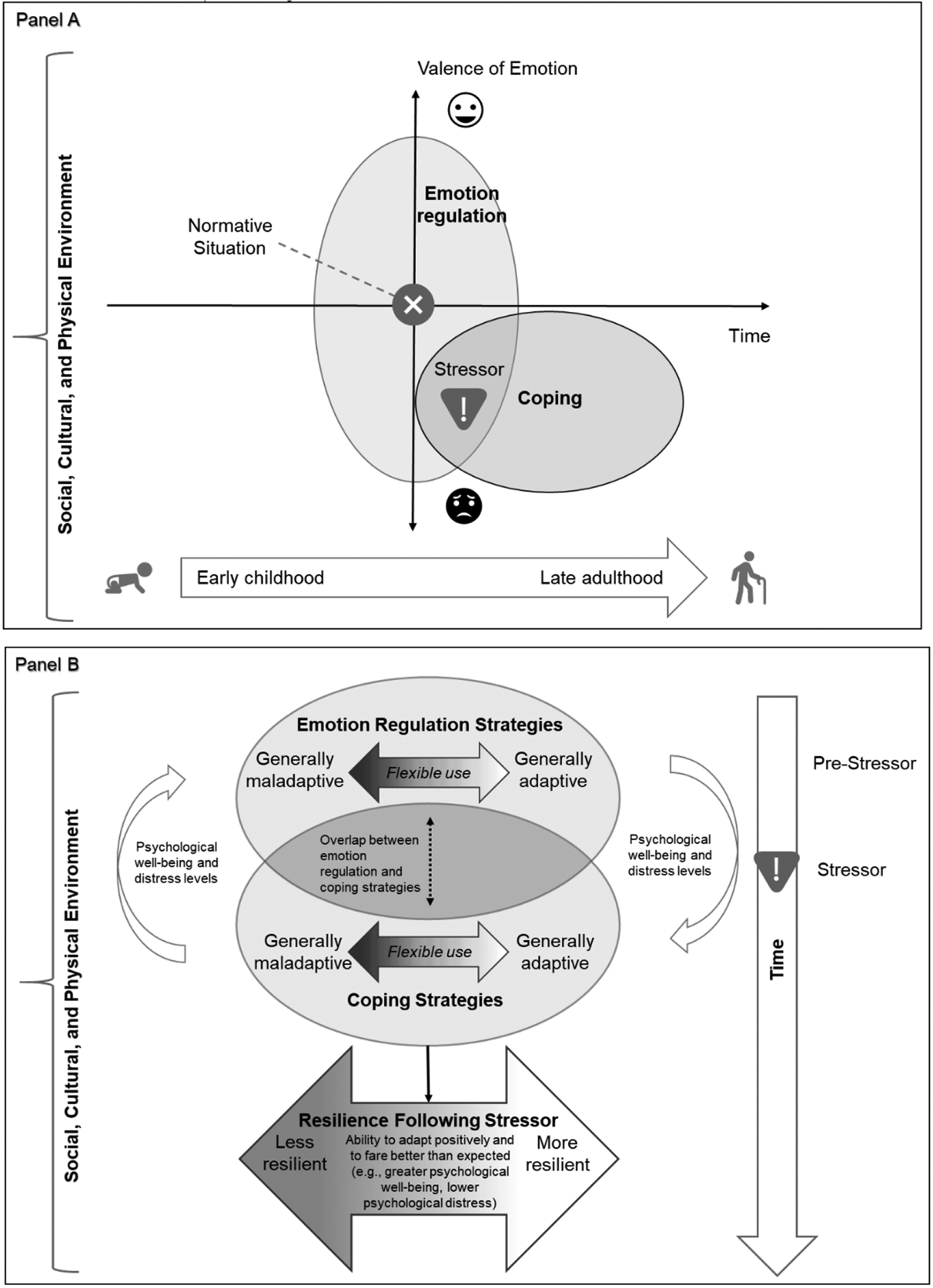
The fields of coping and emotion regulation have mostly evolved separately over decades, although considerable overlap exists. Despite increasing efforts to unite them from a conceptual standpoint, it remains unclear whether conceptual similarities translate into their measurement. The main objective of this review was to summarize and compare self-reported measures of coping and emotion regulation strategies. The secondary objective was to examine whether other psychological measures (e.g., resilience) indirectly reflect regulatory strategies' effectiveness, thus representing additionally informative approaches. Results indicated substantial overlap between coping and emotion regulation measures. In both frameworks, two to eight individual strategies were usually captured, but only a third included ≤20 items. Most commonly evaluated strategies were reappraisal/reinterpretation, active coping/problem-solving, acceptance, avoidance, and suppression. Evidence also suggested psychological distress and well-being measures, especially in certain contexts like natural stress experiments, and resilience measures are possible indirect assessments of these regulatory strategies' effectiveness. These results are interpreted in the light of a broader, integrative affect regulation framework and a conceptual model connecting coping, emotion regulation, resilience, psychological well-being and psychological distress is introduced. We further discussed the importance of alignment between individuals, contexts, and strategies used, and provide directions for future research. Altogether, coping and emotion regulation measures meaningfully overlap. Joint consideration of both frameworks in future research would widen the repertoire of available measures and orient their selection based on other aspects like length or strategies covered, rather than the framework only.
应对和情绪调节领域在过去几十年中大多是各自独立发展的,尽管存在相当多的重叠。尽管从概念角度将它们统一起来的努力不断增加,但概念上的相似性是否能转化为测量上的相似性仍不清楚。本综述的主要目的是总结和比较应对和情绪调节策略的自我报告测量方法。次要目的是研究其他心理测量方法(如心理韧性)是否间接反映调节策略的有效性,从而代表额外的信息丰富的方法。结果表明应对和情绪调节测量方法之间存在大量重叠。在这两个框架中,通常会捕捉到两到八种个体策略,但只有三分之一的策略包含≤20个项目。最常评估的策略是重新评价/重新诠释、积极应对/解决问题、接受、回避和抑制。证据还表明,心理困扰和幸福感测量方法,特别是在自然压力实验等特定背景下,以及心理韧性测量方法可能是这些调节策略有效性的间接评估。这些结果根据更广泛的综合情感调节框架进行解释,并引入了一个连接应对、情绪调节、心理韧性、心理健康和心理困扰的概念模型。我们进一步讨论了个体、背景和所使用策略之间一致性的重要性,并为未来研究提供了方向。总之,应对和情绪调节测量方法有意义地重叠。在未来研究中联合考虑这两个框架将扩大可用测量方法的范围,并根据长度或涵盖的策略等其他方面而非仅根据框架来指导测量方法的选择。