University of Massachusetts Medical School, Department of Emergency Medicine, Worcester, Massachusetts.
Boston Medical Center, Department of Emergency Medicine, Boston, Massachusetts.
West J Emerg Med. 2020 Aug 21;21(5):1234-1241. doi: 10.5811/westjem.2020.6.47032.
There is concern about the initiation of opiates in healthcare settings due to the risk of future misuse. Although opiate medications have historically been at the core of prehospital pain management, several states are introducing non-opiate alternatives to prehospital care. Prior studies suggest that non-opiate analgesics are non-inferior to opiates for many acute complaints, yet there is little literature describing practice patterns of pain management in prehospital care. Our goal was to describe the practice patterns and attitudes of paramedics toward pain management after the introduction of non-opiates to a statewide protocol.
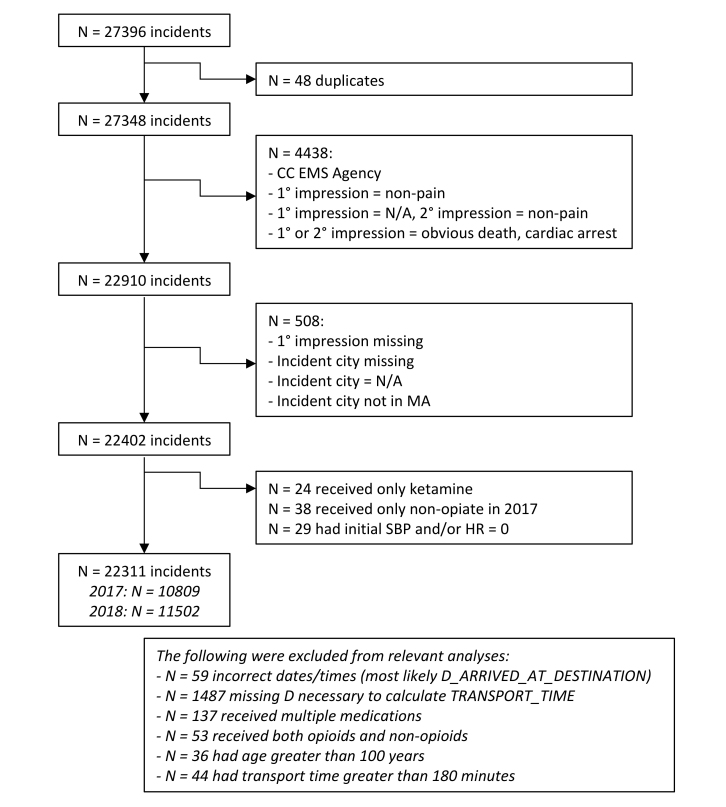
This study was two-armed. The first arm employed a pre/post retrospective chart review model examining medication administrations reported to the Massachusetts Ambulance Trip Information System between January 1, 2017-December 31, 2018. We abstracted instances of opiate and non-opiate utilizations along with patients' clinical course. The second arm consisted of a survey administered to paramedics one year after implementation of non-opiates in the state protocol, which used binary questions and Likert scales to describe beliefs pertaining to prehospital analgesia.
Pain medications were administered in 1.6% of emergency medical services incidents in 2017 and 1.7% of incidents in 2018. The rate of opiate analgesic use was reduced by 9.4% in 2018 compared to 2017 (90.6% vs 100.0%). The absolute reduction in opiate use in 2018 was 3.6%. Women were less likely (odds ratio [OR] = 0.78, 95% confidence interval [CI], 0.69-0.89) and trauma patients were more likely to receive opiates (OR = 2.36, CI, 1.96-2.84). Mean transport times were longer in opiate administration incidents (36.97 vs 29.35 minutes, t = 17.34, p<0.0001). We surveyed 100 paramedics (mean age 41.98, 84% male). Compositely, 85% of paramedics planned to use non-opiates and 35% reported having done so. Participants planning to use non-opiates were younger and less experienced. Participants indicated that concern about adverse effects, efficacy, and time to effect impacted their practice patterns.
The introduction of non-opiate pain medication to state protocols led to reduced opiate administration. Men and trauma patients were more likely to receive opiates. Paramedics reported enthusiasm for non-opiate medications. Beliefs about non-opioid analgesics pertaining to adverse effects, onset time, and efficacy may influence their utilization.
由于未来滥用的风险,人们对医疗保健环境中阿片类药物的使用启动感到担忧。尽管阿片类药物在历史上一直是院前疼痛管理的核心,但有几个州正在引入非阿片类药物替代院前护理。先前的研究表明,对于许多急性疾病,非阿片类镇痛药与阿片类药物同样有效,但关于院前护理中疼痛管理的实践模式的文献很少。我们的目标是描述在全州方案中引入非阿片类药物后,护理人员对疼痛管理的实践模式和态度。
本研究采用双臂设计。第一臂采用回顾性病历审查模型,对 2017 年 1 月 1 日至 2018 年 12 月 31 日期间向马萨诸塞州救护车旅行信息系统报告的药物治疗情况进行了检查。我们从患者的临床病程中提取了阿片类药物和非阿片类药物的使用情况。第二臂是在全州方案中实施非阿片类药物一年后向护理人员进行的一项调查,该调查使用二项问题和李克特量表来描述与院前镇痛相关的信念。
在 2017 年,有 1.6%的紧急医疗服务事件中使用了止痛药,而在 2018 年,这一比例为 1.7%。与 2017 年相比,2018 年阿片类镇痛药的使用率降低了 9.4%(90.6%对 100.0%)。2018 年阿片类药物使用量的绝对减少量为 3.6%。女性使用阿片类药物的可能性较低(比值比[OR] = 0.78,95%置信区间[CI],0.69-0.89),而创伤患者更有可能使用阿片类药物(OR = 2.36,CI,1.96-2.84)。使用阿片类药物的事件中平均转运时间较长(36.97 分钟对 29.35 分钟,t = 17.34,p<0.0001)。我们调查了 100 名护理人员(平均年龄 41.98 岁,84%为男性)。综合而言,85%的护理人员计划使用非阿片类药物,35%的护理人员报告已经这样做了。计划使用非阿片类药物的参与者更年轻,经验更少。参与者表示,对不良反应、疗效和起效时间的担忧影响了他们的治疗模式。
在州方案中引入非阿片类止痛药导致阿片类药物的使用减少。男性和创伤患者更有可能使用阿片类药物。护理人员报告对非阿片类药物有热情。与非甾体类镇痛药的不良反应、起效时间和疗效相关的信念可能会影响其使用。