Thomas Julian, Kleinschmidt Stefan, Mörsdorf Philipp, Conrad David, Berwanger Ulrich, Armbruster Werner
Klinik für Anästhesie, Intensivmedizin und Schmerztherapie, Universitätsklinikum des Saarlandes, Gebäude 57, 66421, Homburg, Deutschland.
Klinik für Unfall‑, Hand-& Wiederherstellungschirurgie, Universitätsklinikum des Saarlandes, Gebäude 57, 66421, Homburg, Deutschland.
Anaesthesiologie. 2024 Sep;73(9):576-582. doi: 10.1007/s00101-024-01447-9. Epub 2024 Aug 6.
Adequate prehospital pain management is a critical component of emergency medical services. With the introduction of the paramedic profession and the Paramedics Act in Germany, the basis for more extensive competencies of paramedics was established. In many emergency medical service areas it is thus possible for paramedics to perform analgesia and sedation with esketamine/midazolam according to pre-established instructions and/or standard operating procedures. This study assessed the quality of analgesia administered to trauma patients by paramedics compared to emergency medical service physicians.
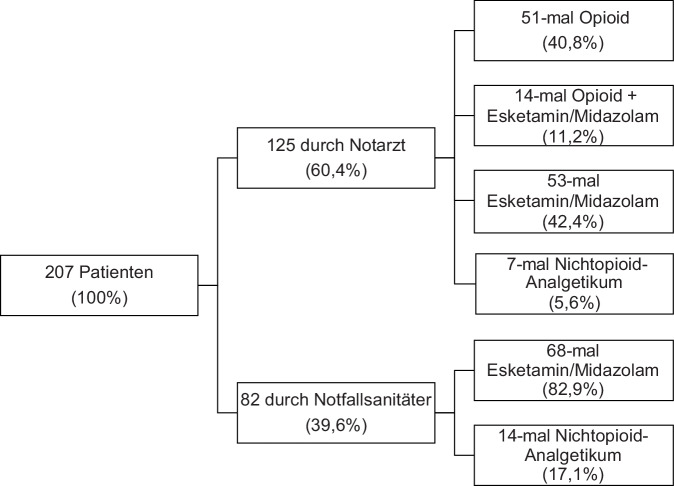
The study included trauma patients who received prehospital administration of analgesia by either emergency medical service physicians or paramedics and were subsequently admitted to the central emergency department of the Saarland University Hospital. A standardized data collection form was used to collect information from the emergency service protocol and initial emergency department assessment. The evaluation employed descriptive statistical methods and a total of 207 completed records were analyzed.
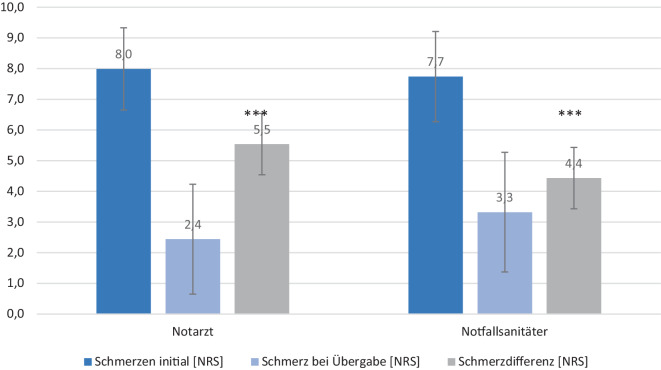
Both professional groups achieved significant pain reduction and fulfilled the criteria for effective pain management (pain reduction: emergency medical service physicians 5.5 ± 2.0/paramedic 4.4 ± 2.1, p < 0.001). Emergency medical service physicians, however, more frequently attained a higher reduction in numerical rating scale scores and administered oxygen. Notable differences were observed in the range of medications used and the dosages.
This study could show that prehospital analgesia is comparable between emergency medical service physicians and paramedics in terms of effectiveness for trauma patients if the indications are correctly set, while observing pre-existing instructions. With their competencies paramedics are able to perform an effective and safe analgesic treatment within the framework of preformulated procedural instructions, which can be equal to that of an emergency medical service physician.
充分的院前疼痛管理是紧急医疗服务的关键组成部分。随着护理人员职业的引入以及德国的《护理人员法》,护理人员更广泛能力的基础得以确立。因此,在许多紧急医疗服务领域,护理人员可以根据预先制定的说明和/或标准操作程序,使用艾司氯胺酮/咪达唑仑进行镇痛和镇静。本研究评估了护理人员与紧急医疗服务医生相比,对创伤患者实施镇痛的质量。
该研究纳入了在院前接受紧急医疗服务医生或护理人员给予镇痛治疗,随后被收治到萨尔兰大学医院中央急诊科的创伤患者。使用标准化的数据收集表从紧急服务记录和急诊科初始评估中收集信息。评估采用描述性统计方法,共分析了207份完整记录。
两个专业组均实现了显著的疼痛减轻,并符合有效疼痛管理的标准(疼痛减轻程度:紧急医疗服务医生5.5±2.0/护理人员4.4±2.1,p<0.001)。然而,紧急医疗服务医生更频繁地实现了数字评分量表得分的更大降低,并给予了氧气。在使用的药物范围和剂量方面观察到显著差异。
本研究表明,如果正确设定适应症并遵循预先存在的说明,对于创伤患者,紧急医疗服务医生和护理人员在院前镇痛的有效性方面具有可比性。护理人员凭借其能力能够在预先制定的程序说明框架内进行有效且安全的镇痛治疗,这可以与紧急医疗服务医生的治疗效果相当。