Shi Yan-Jie, Zhu Hai-Tao, Liu Yu-Liang, Wei Yi-Yuan, Qin Xiu-Bo, Zhang Xiao-Yan, Li Xiao-Ting, Sun Ying-Shi
Department of Radiology, Key Laboratory of Carcinogenesis and Translational Research, Peking University Cancer Hospital, Beijing, China.
Front Oncol. 2020 Aug 21;10:1624. doi: 10.3389/fonc.2020.01624. eCollection 2020.
To develop and validate a radiomics model of diffusion kurtosis imaging (DKI) and T2 weighted imaging for discriminating pancreatic neuroendocrine tumors (PNETs) from solid pseudopapillary tumors (SPTs).
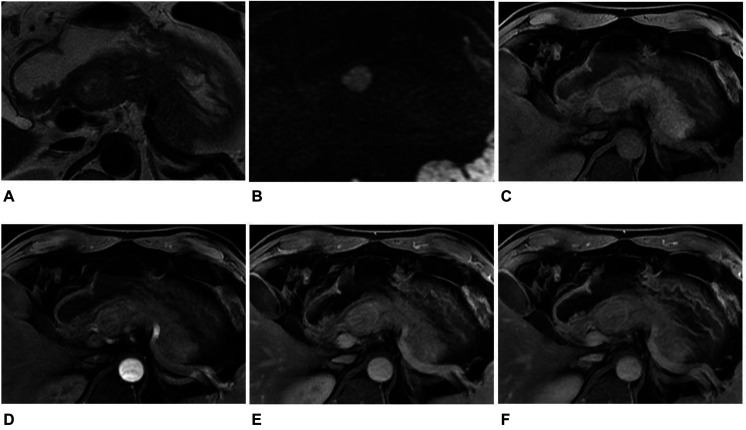
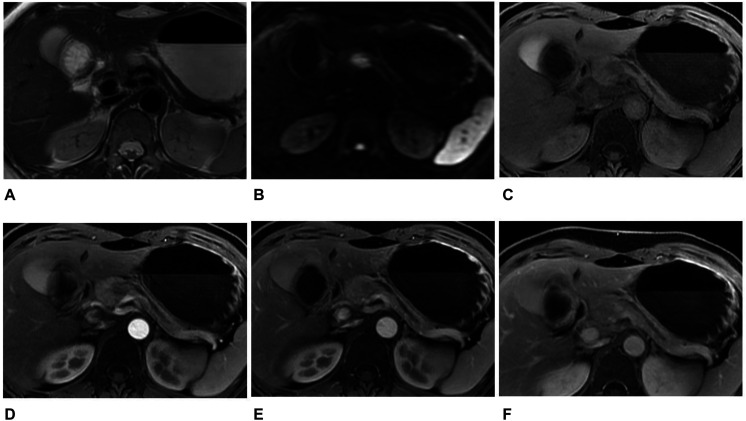
Sixty-six patients with histopathological confirmed PNETs ( = 31) and SPTs ( = 35) were enrolled in this study. ROIs of tumors were manually drawn on each slice at T2WI and DWI ( = 1,500 s/mm) from 3T MRI. Intraclass correlation coefficients were used to evaluate the interobserver agreement. Mean diffusivity (MD) and mean kurtosis (MK) were derived from DKI. The least absolute shrinkage and selection operator regression were used for feature selection.
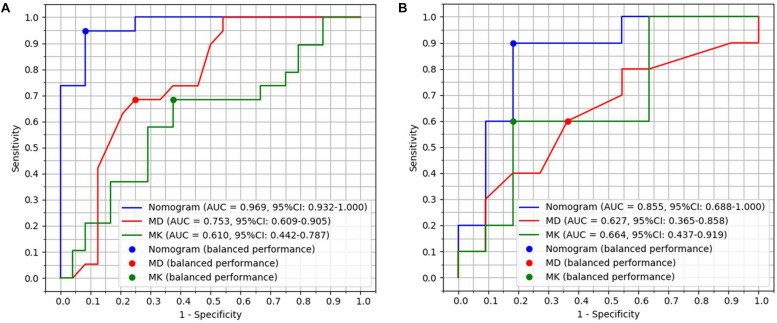
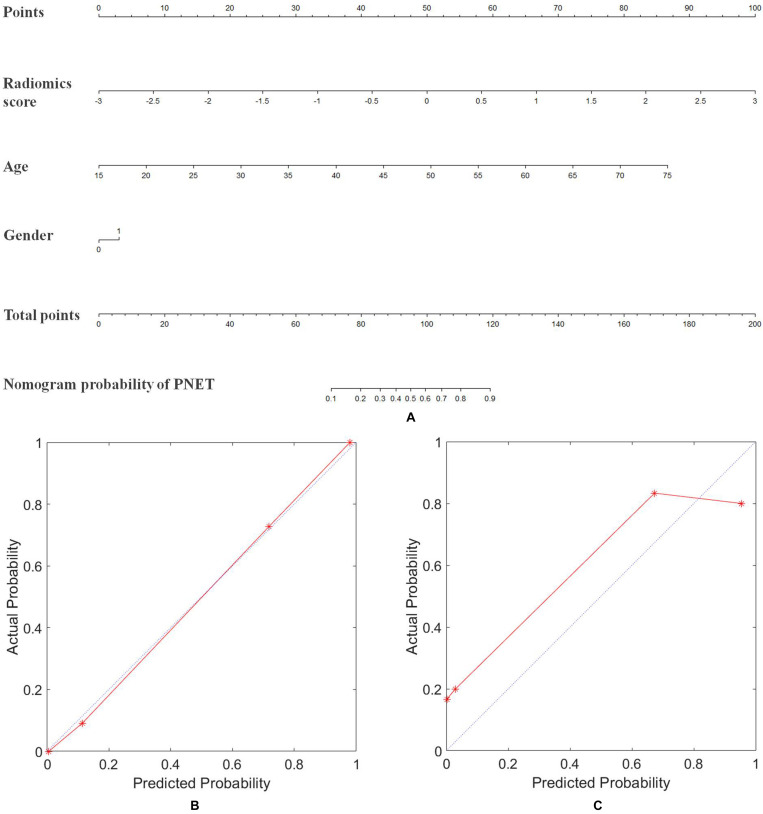
MD and MK had a moderate diagnostic performancewith the area under curve (AUC) of 0.71 and 0.65, respectively. A radiomics model, which incorporated sex and age of patients and radiomics signature of the tumor, showed excellent discrimination performance with AUC of 0.97 and 0.86 in the primary and validation cohort. Moreover, the new model had better diagnostic performance than that of MD ( = 0.023) and MK ( = 0.004), and showed excellent differentiation with a sensitivity of 95.00% and specificity of 91.67% in primary cohort, and the sensitivity of 90.91% and specificity of 81.82% in the validation cohort. The accuracy of radiomics analysis, radiologist 1, and radiologist 2 for diagnosing SPTs and PNETs were 92.42, 77.27, and 78.79%, respectively. The accuracy of radiomics analysis was significantly higher than that of subjective diagnosis ( < 0.05).
Radiomics model could improve the diagnostic accuracy of SPTs and PNETs and contribute to determining an appropriate treatment strategy for pancreatic tumors.
建立并验证一种基于扩散峰度成像(DKI)和T2加权成像的影像组学模型,用于鉴别胰腺神经内分泌肿瘤(PNETs)和实性假乳头状肿瘤(SPTs)。
本研究纳入66例经组织病理学确诊的PNETs患者(n = 31)和SPTs患者(n = 35)。在3T MRI的T2WI和DWI(b = 1500 s/mm²)图像上,手动绘制肿瘤的感兴趣区(ROIs)。组内相关系数用于评估观察者间的一致性。从DKI中得出平均扩散率(MD)和平均峰度(MK)。采用最小绝对收缩和选择算子回归进行特征选择。
MD和MK具有中等诊断性能,曲线下面积(AUC)分别为0.71和0.65。一个纳入患者性别、年龄和肿瘤影像组学特征的影像组学模型,在主要队列和验证队列中显示出优异的鉴别性能,AUC分别为0.97和0.86。此外,新模型的诊断性能优于MD(P = 0.023)和MK(P = 0.004),在主要队列中显示出优异的区分能力,敏感性为95.00%,特异性为91.67%,在验证队列中敏感性为90.91%,特异性为81.82%。影像组学分析、放射科医生1和放射科医生2诊断SPTs和PNETs的准确率分别为92.42%、77.27%和78.79%。影像组学分析的准确率显著高于主观诊断(P < 0.05)。
影像组学模型可提高SPTs和PNETs的诊断准确性,并有助于确定胰腺肿瘤的合适治疗策略。