Department of Government, Cornell University, Ithaca, NY, USA.
Sci Adv. 2020 Oct 21;6(43). doi: 10.1126/sciadv.abd4563. Print 2020 Oct.
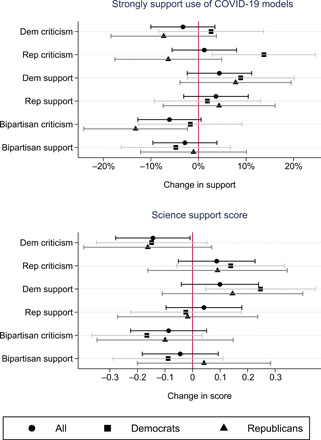
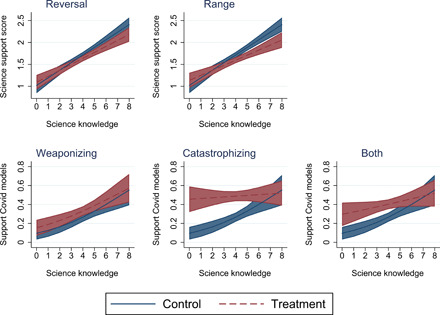
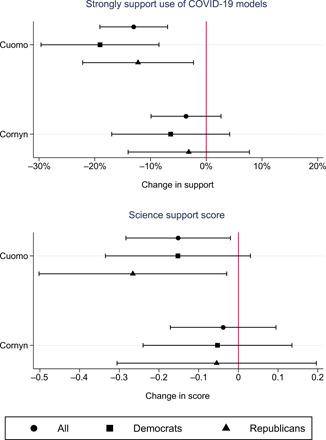
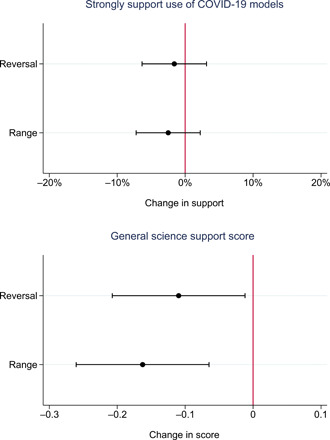
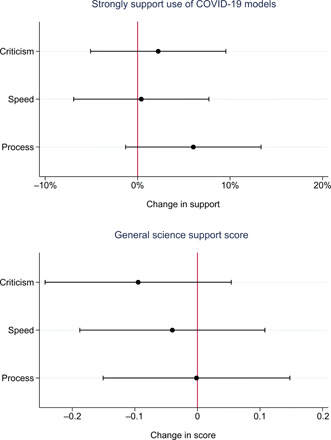
While scientific uncertainty always invites the risk of politicization and raises questions of how to communicate about science, this risk is magnified for COVID-19. The limited data and accelerated research timelines mean that some prominent models or findings inevitably will be overturned or retracted. In this research, we examine the attitudes of more than 6000 Americans across five different survey experiments to understand how the cue giver and cue given about scientific uncertainty regarding COVID-19 affect public trust in science and support for science-based policy. Criticism from Democratic political elites undermines trust more than criticism from Republicans. Emphasizing uncertainty in projections can erode public trust in some contexts. Downplaying uncertainty can raise support in the short term, but reversals in projections may temper these effects or even reduce scientific trust. Careful science communication is critical to maintaining public support for science-based policies as the scientific consensus shifts over time.
虽然科学不确定性总是会带来被政治化的风险,并引发如何就科学问题进行交流的问题,但对于 COVID-19 来说,这种风险更为突出。有限的数据和加速的研究时间表意味着一些突出的模型或发现不可避免地会被推翻或撤回。在这项研究中,我们调查了来自五个不同调查实验的 6000 多名美国人的态度,以了解关于 COVID-19 的科学不确定性的提示者和提示内容如何影响公众对科学的信任以及对基于科学的政策的支持。来自民主党政治精英的批评比来自共和党的批评更能破坏信任。在某些情况下,强调预测中的不确定性可能会削弱公众对科学的信任。在短期内淡化不确定性可以提高支持率,但预测的逆转可能会削弱这些影响,甚至降低对科学的信任。随着科学界共识随时间推移发生变化,谨慎的科学传播对于维护公众对基于科学的政策的支持至关重要。