Department of Statistics, College of Liberal Arts and Sciences, University of Florida, United States.
Department of Epidemiology, College of Public Health and Health Professions and College of Medicine, University of Florida, United States.
Int J Med Inform. 2020 Nov;143:104272. doi: 10.1016/j.ijmedinf.2020.104272. Epub 2020 Sep 15.
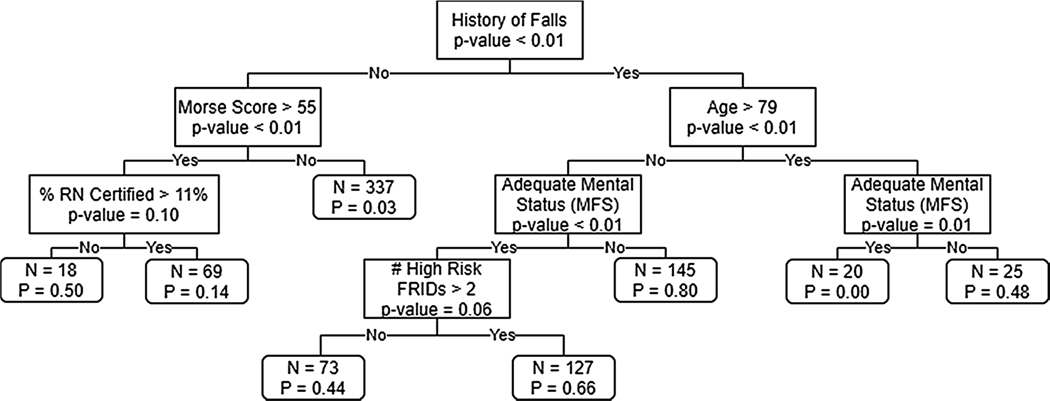
Inpatient falls, many resulting in injury or death, are a serious problem in hospital settings. Existing falls risk assessment tools, such as the Morse Fall Scale, give a risk score based on a set of factors, but don't necessarily signal which factors are most important for predicting falls. Artificial intelligence (AI) methods provide an opportunity to improve predictive performance while also identifying the most important risk factors associated with hospital-acquired falls. We can glean insight into these risk factors by applying classification tree, bagging, random forest, and adaptive boosting methods applied to Electronic Health Record (EHR) data.
The purpose of this study was to use tree-based machine learning methods to determine the most important predictors of inpatient falls, while also validating each via cross-validation.
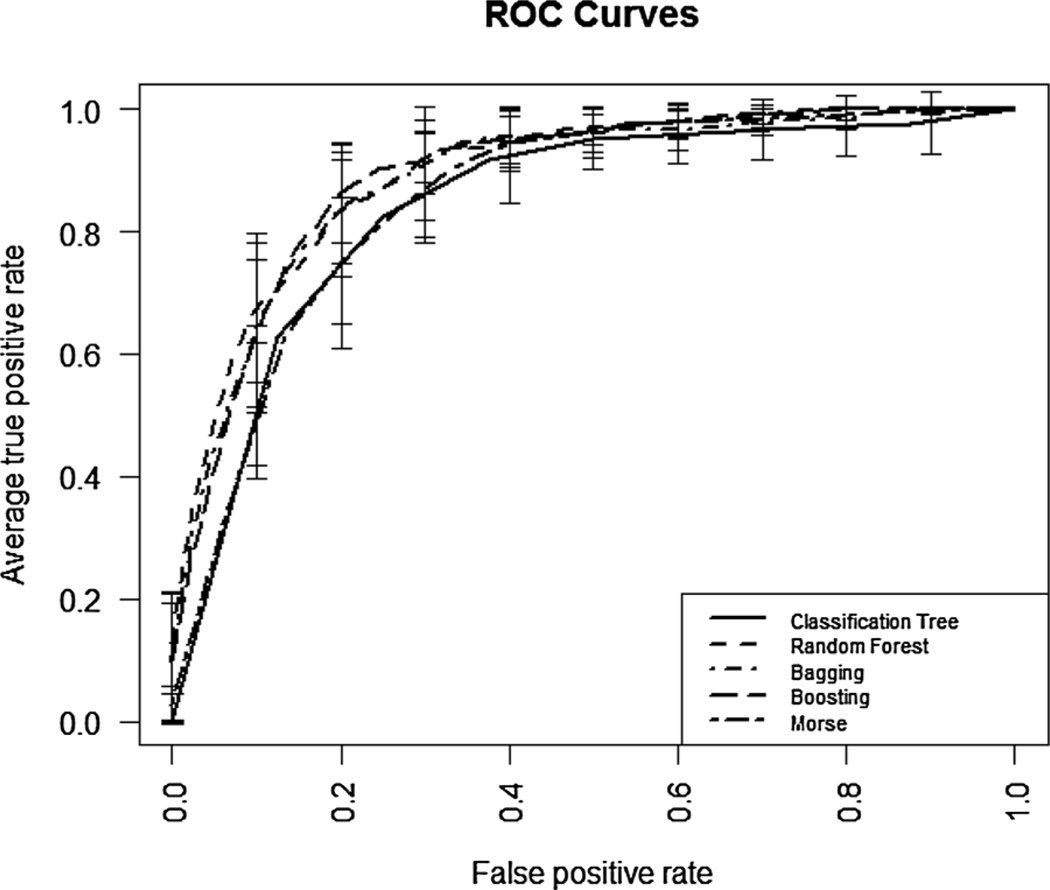
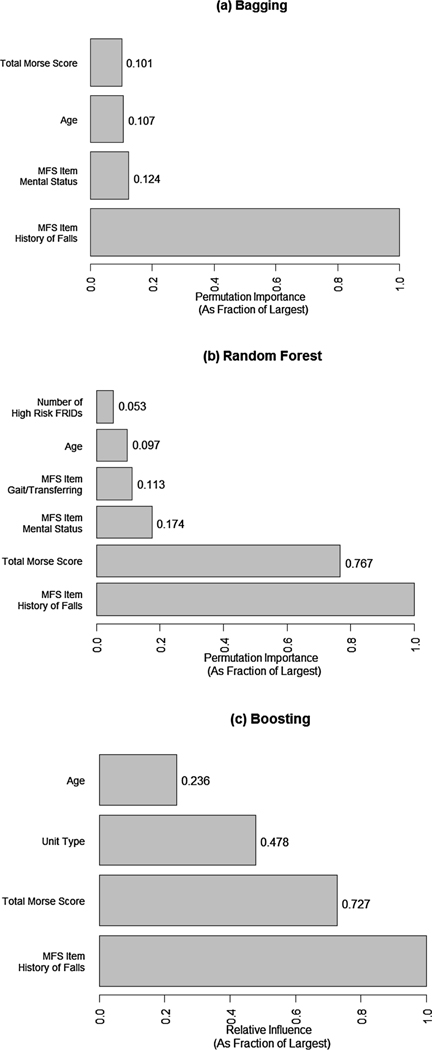
A case-control study was designed using EHR and electronic administrative data collected between January 1, 2013 to October 31, 2013 in 14 medical surgical units. The data contained 38 predictor variables which comprised of patient characteristics, admission information, assessment information, clinical data, and organizational characteristics. Classification tree, bagging, random forest, and adaptive boosting methods were used to identify the most important factors of inpatient fall-risk through variable importance measures. Sensitivity, specificity, and area under the ROC curve were computed via ten-fold cross validation and compared via pairwise t-tests. These methods were also compared to a univariate logistic regression of the Morse Fall Scale total score.
In terms of AUROC, bagging (0.89), random forest (0.90), and boosting (0.89) all outperformed the Morse Fall Scale (0.86) and the classification tree (0.85), but no differences were measured between bagging, random forest, and adaptive boosting, at a p-value of 0.05. History of Falls, Age, Morse Fall Scale total score, quality of gait, unit type, mental status, and number of high fall risk increasing drugs (FRIDs) were considered the most important features for predicting inpatient fall risk.
Machine learning methods have the potential to identify the most relevant and novel factors for the detection of hospitalized patients at risk of falling, which would improve the quality of patient care, and to more fully support healthcare provider and organizational leadership decision-making. Nurses would be able to enhance their judgement to caring for patients at risk for falls. Our study may also serve as a reference for the development of AI-based prediction models of other iatrogenic conditions. To our knowledge, this is the first study to report the importance of patient, clinical, and organizational features based on the use of AI approaches.
住院患者跌倒事件屡有发生,许多由此导致受伤甚至死亡,这是医院环境中一个严重的问题。现有的跌倒风险评估工具,如 Morse 跌倒量表,根据一组因素给出风险评分,但不一定能表明哪些因素对预测跌倒最重要。人工智能 (AI) 方法提供了一个提高预测性能的机会,同时还可以确定与医院获得性跌倒相关的最重要的风险因素。我们可以通过应用分类树、套袋法、随机森林和自适应增强方法来挖掘这些风险因素,并应用于电子健康记录 (EHR) 数据。
本研究旨在使用基于树的机器学习方法来确定住院患者跌倒的最重要预测因素,并通过交叉验证对其进行验证。
本研究采用病例对照设计,使用 2013 年 1 月 1 日至 2013 年 10 月 31 日期间在 14 个内科外科病房收集的电子病历和电子行政数据。数据包含 38 个预测变量,包括患者特征、入院信息、评估信息、临床数据和组织特征。通过变量重要性测量,使用分类树、套袋法、随机森林和自适应增强方法来确定住院跌倒风险的最重要因素。通过 10 折交叉验证计算灵敏度、特异性和 ROC 曲线下面积,并通过两两 t 检验进行比较。还将这些方法与 Morse 跌倒量表总分的单变量逻辑回归进行了比较。
在 AUROC 方面,套袋法 (0.89)、随机森林法 (0.90) 和自适应增强法 (0.89) 均优于 Morse 跌倒量表 (0.86) 和分类树 (0.85),但套袋法、随机森林法和自适应增强法之间没有差异,p 值为 0.05。跌倒史、年龄、Morse 跌倒量表总分、步态质量、单元类型、精神状态和高跌倒风险增加药物 (FRIDs) 的数量被认为是预测住院患者跌倒风险的最重要特征。
机器学习方法有可能识别出与检测住院患者跌倒风险相关的最相关和新颖的因素,从而提高患者护理质量,并更全面地支持医疗保健提供者和组织领导层的决策。护士可以增强他们对跌倒风险患者的护理判断。我们的研究也可以为其他医源性疾病的基于人工智能的预测模型的开发提供参考。据我们所知,这是第一项基于人工智能方法报告患者、临床和组织特征重要性的研究。