Rubiola Selene, Chiesa Francesco, Dalmasso Alessandra, Di Ciccio Pierluigi, Civera Tiziana
Department of Veterinary Sciences, University of Turin, Turin, Italy.
Front Microbiol. 2020 Aug 26;11:1983. doi: 10.3389/fmicb.2020.01983. eCollection 2020.
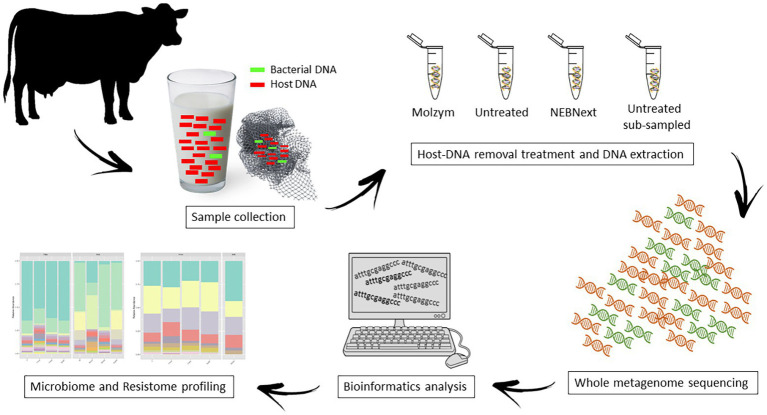
Over the past decades, antimicrobial resistance (AMR) has been recognized as one of the most serious threats to public health. Although originally considered a problem to human health, the emerging crisis of AMR requires a "One Health" approach, considering human, animal, and environmental reservoirs. In this regard, the extensive use of antibiotics in the livestock production systems to treat mastitis and other bacterial diseases can lead to the presence of AMR genes in bacteria that contaminate or naturally occur in milk and dairy products, thereby introducing them into the food chain. The recent development of high-throughput next-generation sequencing (NGS) technologies is improving the fast characterization of microbial communities and their functional capabilities. In this context, whole metagenome sequencing (WMS), also called shotgun metagenomic sequencing, allows the generation of a vast amount of data which can be interrogated to generate the desired evidence, including the resistome. However, the amount of host DNA poses a major challenge to metagenome analysis. Given the current absence of literature concerning the application of WMS on milk to detect the presence of AMR genes, in the present study, we evaluated the effect of different sequencing depths, host DNA depletion methods and matrices to characterize the resistome of a milk production environment. WMS was conducted on three aliquots of bulk tank milk and three aliquots of the in-line milk filter collected from a single dairy farm; a fourth aliquot of milk and milk filter was bioinformatically subsampled. Two commercially available host DNA depletion methods were applied, and metagenomic DNA was sequenced to two different sequencing depth. Milk filters proved to be the most suitable matrices to evaluate the presence of AMR genes; besides, the pre-extraction host DNA depletion method was the most efficient approach to remove host reads. To our knowledge, this is the first study to evaluate the limitations posed by the host DNA in investigating the milk resistome with a WMS approach, confirming the circulation of AMR genes in the milk production environment.
在过去几十年中,抗菌药物耐药性(AMR)已被公认为对公众健康最严重的威胁之一。尽管AMR最初被认为是人类健康问题,但新出现的AMR危机需要采用“同一健康”方法,考虑人类、动物和环境宿主。在这方面,在畜牧生产系统中广泛使用抗生素治疗乳腺炎和其他细菌性疾病,可能导致污染牛奶和乳制品或在其中自然存在的细菌中出现AMR基因,从而将它们引入食物链。高通量下一代测序(NGS)技术的最新发展正在改善对微生物群落及其功能能力的快速表征。在这种背景下,全宏基因组测序(WMS),也称为鸟枪法宏基因组测序,能够生成大量数据,对这些数据进行分析可以获得所需证据,包括耐药基因组。然而,宿主DNA的数量对宏基因组分析构成了重大挑战。鉴于目前缺乏关于应用WMS检测牛奶中AMR基因存在的文献,在本研究中,我们评估了不同测序深度、宿主DNA去除方法和样本类型对表征牛奶生产环境中耐药基因组的影响。对从单个奶牛场采集的三份散装罐奶和三份在线牛奶过滤器样本进行了WMS;第四份牛奶和牛奶过滤器样本进行了生物信息学重抽样。应用了两种市售的宿主DNA去除方法,并将宏基因组DNA测序至两种不同的深度。牛奶过滤器被证明是评估AMR基因存在的最合适样本类型;此外,提取前宿主DNA去除方法是去除宿主读数最有效的方法。据我们所知,这是第一项评估宿主DNA在通过WMS方法研究牛奶耐药基因组时所带来的局限性的研究,证实了AMR基因在牛奶生产环境中的传播。