Elfadaly Doaa, Abdelrazik Sahar Torky, Thomas Peter B M, Dekker Tessa M, Dahlmann-Noor Annegret, Jones Pete R
Moorfields Eye Hospital NHS Foundation Trust, London, United Kingdom.
Department of Ophthalmology, Faculty of Medicine, Minia University, Minia, Egypt.
Front Med (Lausanne). 2020 Aug 26;7:469. doi: 10.3389/fmed.2020.00469. eCollection 2020.
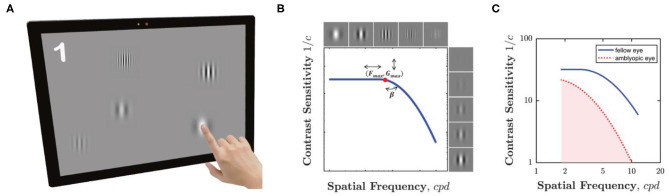
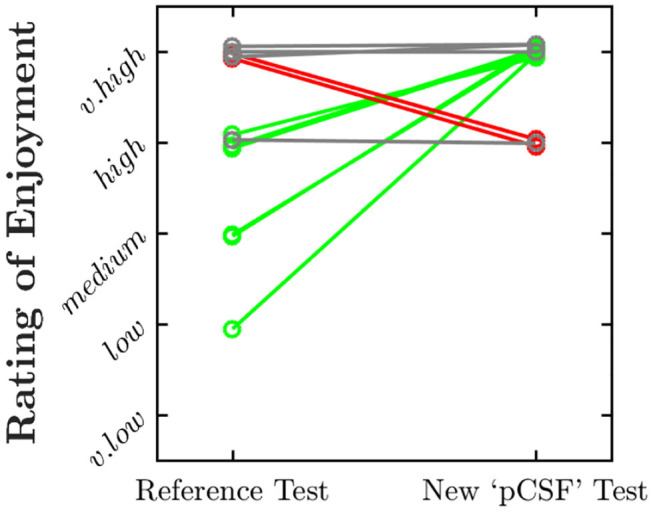
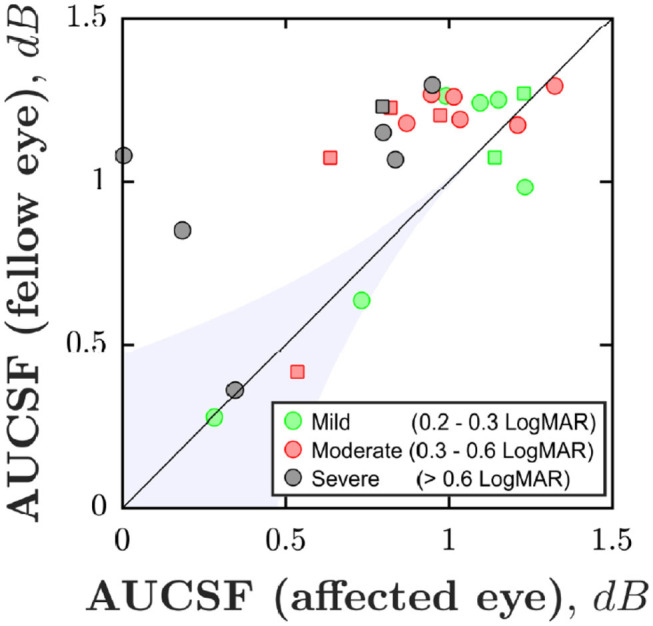
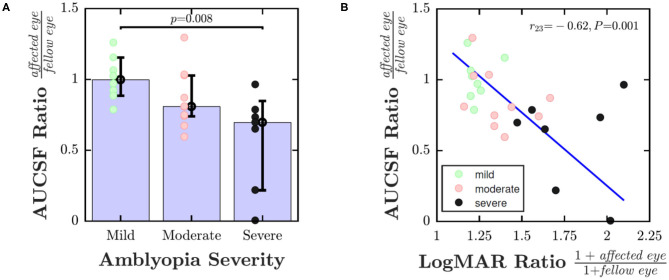
Routine assessments of the Contrast Sensitivity Function [CSF] could be useful for the diagnosis and monitoring of amblyopia. However, current CSF measures are not clinically practical, as they are too slow, too boring, and too uncomfortable to sustain a young child's interest. Here we assess the feasibility of a more gamified approach to CSF testing, in which a maximum likelihood psychophysical algorithm (QUEST+) is combined with a largely unconstrained user interface (no fixation target, head restraints, or discrete trials). Twenty-five amblyopes (strabismic, anisometropic, or mixed) aged 4.0-9.2 years performed the gamified CSF assessment monocularly (once per eye). The test required the child to "pop" (press) grating stimuli as they "bounced" around a tablet screen. Head tracking via the tablet's front-facing camera was used to adjust for variations in viewing distance . CSFs were fitted for each eye, and Area Under the CSF (AUCSF) computed as a summary measure of sensitivity. The results showed that AUCSF measurements were able to separate moderately and severely amblyopic eyes from fellow eyes (case-control effect), and to distinguish individuals with varying degrees of vision loss (dose effect). Even the youngest children exhibited no difficulties completing the test or comprehending what to do, and most children appeared to find the test genuinely enjoyable. Informal feedback from a focus group of older children was also positive, although potential shortcomings with the present design were identified. This feasibility study indicates that gamified, child-friendly vision assessments have promise as a future means of pediatric clinical assessment. Such measures could be particularly valuable for assessing children outside of conventional eye-care facilities (e.g., home-monitoring, school screening).
对比敏感度函数(CSF)的常规评估可能有助于弱视的诊断和监测。然而,目前的CSF测量方法在临床上并不实用,因为它们过于缓慢、枯燥且令人不适,难以维持幼儿的兴趣。在此,我们评估一种更具游戏化的CSF测试方法的可行性,该方法将最大似然心理物理学算法(QUEST+)与基本无限制的用户界面(无注视目标、头部固定装置或离散试验)相结合。25名年龄在4.0至9.2岁之间的弱视儿童(斜视性、屈光参差性或混合性)单眼进行了游戏化CSF评估(每只眼睛一次)。该测试要求儿童在平板电脑屏幕上光栅刺激“弹跳”时“点击”(按压)它们。通过平板电脑的前置摄像头进行头部跟踪,以调整观看距离的变化。为每只眼睛拟合CSF,并计算CSF曲线下面积(AUCSF)作为敏感度的综合测量指标。结果表明,AUCSF测量能够将中度和重度弱视眼与对侧眼区分开来(病例对照效应),并区分不同程度视力丧失的个体(剂量效应)。即使是最小的儿童在完成测试或理解要做什么方面也没有困难,而且大多数儿童似乎真的觉得测试很有趣。来自一个大龄儿童焦点小组的非正式反馈也是积极的,尽管发现了当前设计存在的潜在缺点。这项可行性研究表明,游戏化、儿童友好型视力评估有望成为未来儿科临床评估的一种手段。此类措施对于在传统眼科护理机构之外评估儿童(例如家庭监测、学校筛查)可能特别有价值。