Longhitano Yaroslava, Racca Fabrizio, Zanza Christian, Muncinelli Marina, Guagliano Alberto, Peretti Elisa, Minerba Anna Chiara, Mari Marta, Boverio Riccardo, Salio Mario, Chichino Guido, Franceschi Francesco, Piccioni Andrea, Abenavoli Ludovico, Salvini Mauro, Artico Marco
Department of Anesthesiology and Critical Care Medicine, Azienda Ospedaliera SS. Antonio e Biagio e Cesare Arrigo, 15121 Alessandria, Italy.
Department of Anesthesia, Critical Care and Emergency Medicine, Pietro and Michele Ferrero Hospital, 12051 Verduno-Alba, Italy.
Biology (Basel). 2020 Sep 24;9(10):310. doi: 10.3390/biology9100310.
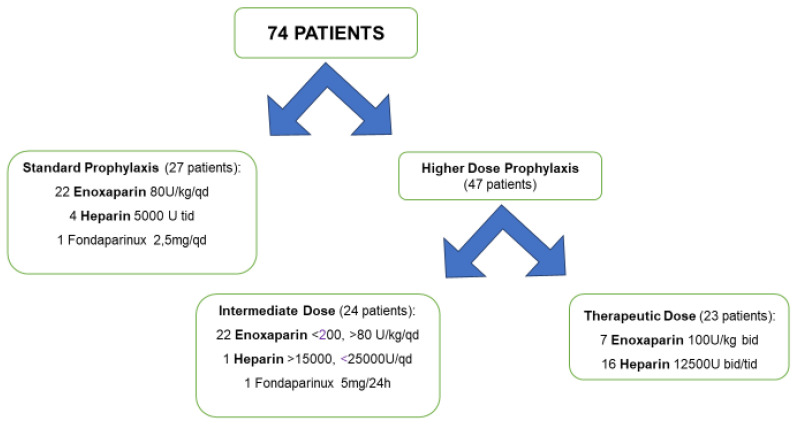
The purpose of this study is to assess thrombotic risk in CoViD-19/pneumonia patients with acute respiratory failure and to compare populations treated with three different antithrombotic prophylaxis protocols. The primary outcome is to analyze the prevalence of thrombotic events in hospitalized patients, while the secondary outcome is to analyze the correlation between different anticoagulation targets with thrombotic events. All patients referred to our hospital for acute respiratory failure due to COVID-19 pneumonia between 18 and 31 May 2020 were included. Seventy-four patients were enrolled (44 men and 30 women, average age 68.6). Diagnosis of venous thromboembolism was made in 21 cases (28.4%) and thrombotic events were associated with positive pressure ventilation support ( = 0.024) and hospitalization in ICU ( < 0.0001). These patients presented higher levels of D-dimer ( < 0.0001) and their hospital length of stay was >16 days longer. Forty-seven out of 74 patients (63.5%) received intermediate or therapeutic dose of anticoagulation, while twenty-seven patients (34.5%) received standard antithrombotic prophylaxis. The analysis showed that an intermediate or therapeutic dose of anticoagulation did not decrease the prevalence of thrombotic events. On the other hand, six patients reported severe hemorrhagic complications. Despite intermediate or therapeutic-dose of anticoagulation, a high number of patients with acute respiratory failure secondary to COVID-19 developed thrombotic complications.
本研究的目的是评估患有急性呼吸衰竭的新冠病毒感染/肺炎患者的血栓形成风险,并比较接受三种不同抗血栓预防方案治疗的人群。主要结局是分析住院患者血栓形成事件的发生率,次要结局是分析不同抗凝目标与血栓形成事件之间的相关性。纳入了2020年5月18日至31日期间因新冠病毒肺炎导致急性呼吸衰竭转诊至我院的所有患者。共纳入74例患者(44例男性和30例女性,平均年龄68.6岁)。21例(28.4%)诊断为静脉血栓栓塞,血栓形成事件与正压通气支持相关(P = 0.024),与入住重症监护病房相关(P < 0.0001)。这些患者的D - 二聚体水平更高(P < 0.0001),住院时间延长超过16天。74例患者中有47例(63.5%)接受了中等剂量或治疗剂量的抗凝治疗,27例患者(34.5%)接受了标准抗血栓预防治疗。分析表明,中等剂量或治疗剂量的抗凝治疗并未降低血栓形成事件的发生率。另一方面,有6例患者报告了严重出血并发症。尽管进行了中等剂量或治疗剂量的抗凝治疗,但大量新冠病毒感染继发急性呼吸衰竭的患者仍发生了血栓形成并发症。