Oosterloo Berthe C, Croll Pauline H, Baatenburg de Jong Robert J, Ikram M Kamran, Goedegebure André
Department of Otorhinolaryngology-Head and Neck Surgery, Erasmus University Medical Center, Rotterdam, the Netherlands.
Department of Epidemiology, Erasmus University Medical Center, Rotterdam, the Netherlands.
Otolaryngol Head Neck Surg. 2021 Apr;164(4):859-868. doi: 10.1177/0194599820957296. Epub 2020 Sep 29.
Tinnitus is a common hearing-related disorder, which may have a large impact on daily life. With aging populations worldwide, it is important to gain insight in the occurrence of tinnitus at older ages and to understand its relationship with age-related hearing loss. We investigated the prevalence of tinnitus among a general aging population, across age strata and hearing status.
Cross-sectional.
The population-based Rotterdam Study.
A total of 6098 participants underwent tinnitus assessment, and 4805 had additional hearing assessment. We determined tinnitus prevalence per 5-year age groups. Hearing impairment was defined as ≥25-dB HL worse ear pure tone average (0.5, 1, 2, 4 kHz). We investigated with multivariable logistic regression the association between hearing impairment and tinnitus. Tinnitus handicap was assessed in 663 participants with daily tinnitus via the Tinnitus Handicap Inventory-screening version (THI-s).
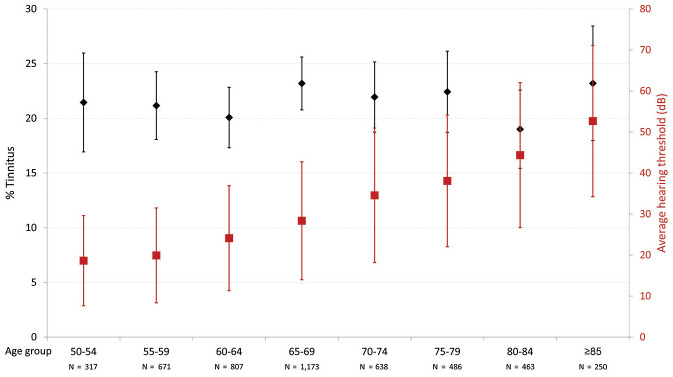
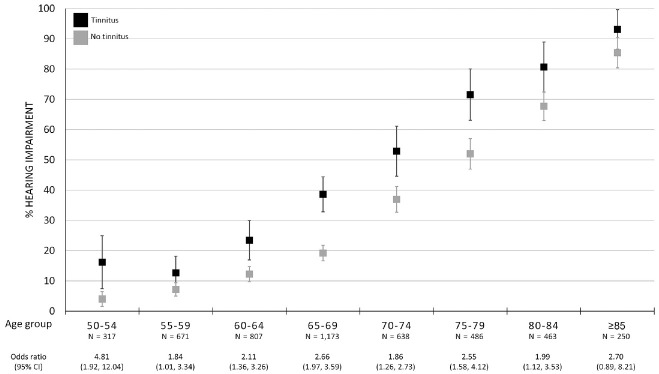
Tinnitus was prevalent in 21.4% (n = 1304). Prevalent tinnitus was evenly distributed over 5-year age groups. Participants with hearing impairment were more likely to have tinnitus (odds ratio, 2.27; 95% CI, 1.92-2.69) as compared with those without hearing impairment. The median THI-s score was 4 (interquartile range, 0-10), indicating a slight handicap, and 14.6% of the participants reported a moderate or severe handicap (THI-s ≥16).
In a general elderly population, 1 in 5 persons has tinnitus. Of those with tinnitus, for 1 per 10 persons, the presence of tinnitus interfered with daily life. Participants with hearing impairment were twice as likely to have tinnitus. Despite the age-dependent occurrence of hearing impairment, no such age dependency was found for tinnitus.
耳鸣是一种常见的听力相关疾病,可能对日常生活产生重大影响。随着全球人口老龄化,了解老年人耳鸣的发生情况并理解其与年龄相关性听力损失的关系非常重要。我们调查了普通老年人群中耳鸣的患病率,涵盖不同年龄层和听力状况。
横断面研究。
基于人群的鹿特丹研究。
共有6098名参与者接受了耳鸣评估,其中4805人还接受了听力评估。我们确定了每5岁年龄组的耳鸣患病率。听力障碍定义为较差耳纯音平均听阈(0.5、1、2、4kHz)≥25dB HL。我们通过多变量逻辑回归研究了听力障碍与耳鸣之间的关联。通过耳鸣障碍量表筛查版(THI-s)对663名每日有耳鸣的参与者进行了耳鸣障碍评估。
耳鸣患病率为21.4%(n = 1304)。现患耳鸣在5岁年龄组中分布均匀。与无听力障碍者相比,有听力障碍的参与者更易患耳鸣(比值比,2.27;95%CI,1.92 - 2.69)。THI-s评分中位数为4(四分位间距,0 - 10),表明有轻微障碍,14.6%的参与者报告有中度或重度障碍(THI-s≥16)。
在普通老年人群中,五分之一的人患有耳鸣。在这些耳鸣患者中,每十人中就有一人耳鸣会干扰日常生活。有听力障碍的参与者患耳鸣的可能性是其他人的两倍。尽管听力障碍的发生与年龄有关,但未发现耳鸣存在这种年龄依赖性。