Department of General Psychology, University of Padova, via Venezia 8, 35131, Padova, Italy.
Child Neurology and Clinical Neurophysiology, Padua University Hospital, via Giustiniani 3, 35133, Padova, Italy.
Eur J Pediatr. 2021 Mar;180(3):909-918. doi: 10.1007/s00431-020-03818-x. Epub 2020 Sep 29.
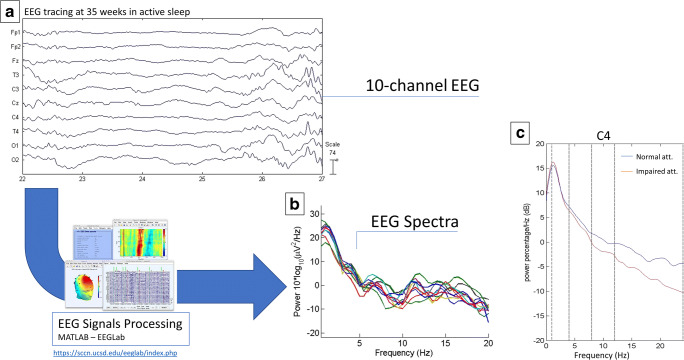
Prematurity is a prototype of biological risk that could affect the late neurocognitive outcome; however, the condition itself remains a non-specific marker. This longitudinal 6-year study aimed to evaluate the prognostic role of neonatal spectral EEG in premature infants without neurological complications. The study cohort was 26 children born 23-34 gestational ages; all neonates underwent multichannel EEG recordings at 35 weeks post-conception. EEG data were transformed into the frequency domain and divided into delta (0.5-4 Hz), theta (5-7 Hz), alpha (8-13 Hz), and beta (14-20 Hz) frequency bands. At 6 years, a neuropsychological and behavioral evaluation was performed. Correlations between spectral bands and neuropsychological assessments were performed with a conservative and robust Bayesian correlation model using weakly informative priors. The correlation of neuropsychological tasks to spectral frequency bands highlighted a significant association with visual and auditory attention tests. The performance on the same tests appears to be mainly impaired.Conclusions: We found that spectral EEG frequencies are independent predictors of performance in attention tasks. We hypothesized that spectral EEG might reflect early circuitries' imbalance in the reticular ascending system and cumulative effect on ongoing development, pointing to the importance of early prognostic instruments. What is Known: • Prematurity is a non-specific marker of late neurocognitive risk. • Precise prognostic instruments are lacking, mostly in patients with low-grade conditions. What is New: • Longitudinal long-term studies are scarce but crucial for the inferential attributive process. • Spectral EEG frequencies are independent predictors of performance in attention tasks.
早产是生物风险的原型,可能会影响晚期神经认知结局;然而,这种情况本身仍然是非特异性的标志物。这项为期 6 年的纵向研究旨在评估无神经并发症的早产儿新生儿频谱脑电图的预后作用。研究队列包括 26 名出生于 23-34 孕周的儿童;所有新生儿在妊娠后 35 周接受多通道脑电图记录。脑电图数据转换为频域,并分为 delta(0.5-4 Hz)、theta(5-7 Hz)、alpha(8-13 Hz)和 beta(14-20 Hz)频段。在 6 岁时,进行了神经心理学和行为评估。使用保守和稳健的贝叶斯相关模型,使用弱信息先验,对频谱带和神经心理学评估之间的相关性进行了分析。对神经心理学任务与频谱频率带之间的相关性进行了分析,结果表明与视觉和听觉注意力测试之间存在显著相关性。在相同测试中的表现似乎主要受损。结论:我们发现,频谱脑电图频率是注意力任务表现的独立预测因子。我们假设,频谱脑电图可能反映了网状上行系统中早期回路的不平衡和对持续发育的累积影响,这表明早期预后工具的重要性。已知:•早产是晚期神经认知风险的非特异性标志物。•缺乏精确的预后工具,尤其是在低级别条件的患者中。新发现:•纵向长期研究很少,但对于推理归因过程至关重要。•频谱脑电图频率是注意力任务表现的独立预测因子。