Department of Medicine, Neuroendocrine Unit, Massachusetts General Hospital, Boston, MA, USA; Harvard Medical School, Boston, MA, USA; Department of Medicine, Division of Endocrinology, Neuroendocrinology Unit, University of Pittsburgh School of Medicine, Pittsburgh, PA, USA; Center for Human Integrative Physiology, University of Pittsburgh School of Medicine, Pittsburgh, PA, USA.
Department of Medicine, Division of Genetics, Brigham and Women's Hospital, Boston, MA, USA; Aging Institute, University of Pittsburgh School of Medicine, Pittsburgh, PA, USA.
Mol Metab. 2020 Dec;42:101082. doi: 10.1016/j.molmet.2020.101082. Epub 2020 Sep 28.
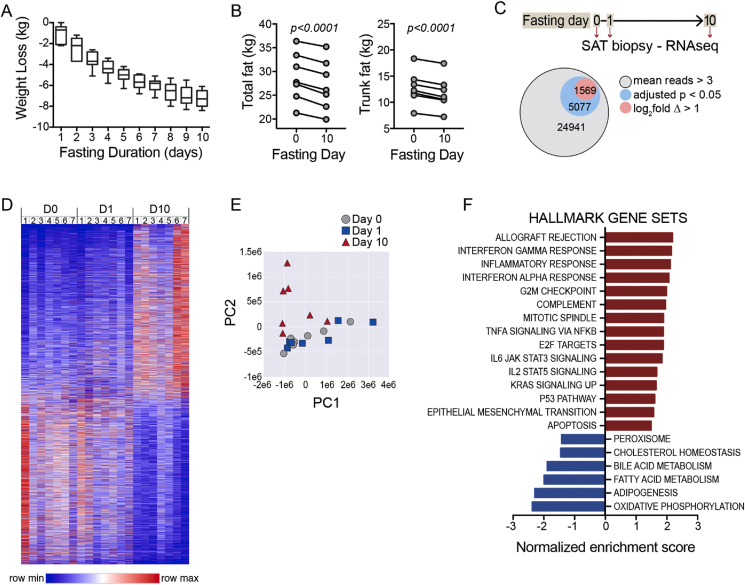
The human adaptive fasting response enables survival during periods of caloric deprivation. A crucial component of the fasting response is the shift from glucose metabolism to utilization of lipids, underscoring the importance of adipose tissue as the central lipid-storing organ. The objective of this study was to investigate the response of adipose tissue to a prolonged fast in humans.
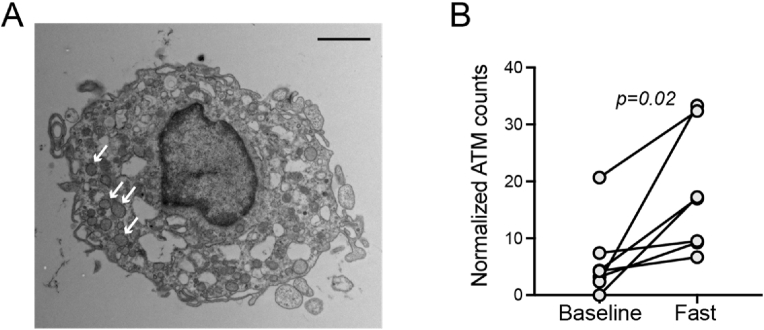
We performed RNA sequencing of subcutaneous adipose tissue samples longitudinally collected during a 10-day, 0-calorie fast in humans. We further investigated observed transcriptional signatures utilizing cultured human monocytes and Thp1 cells. We examined the cellularity of adipose tissue biopsies with transmission electron microscopy and tested for associated changes in relevant inflammatory mediators in the systemic circulation by ELISA assays of longitudinally collected blood samples.
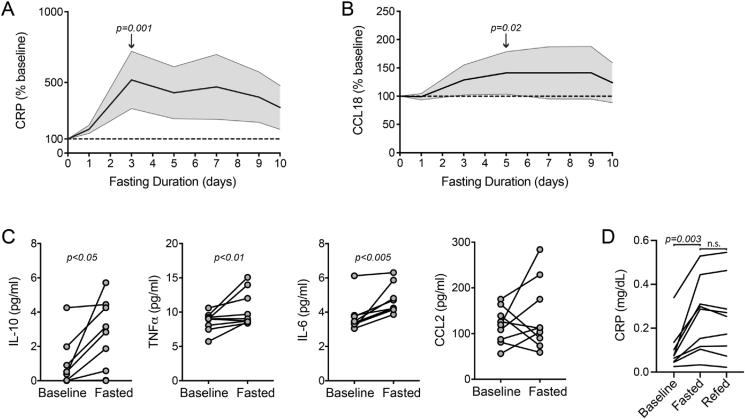
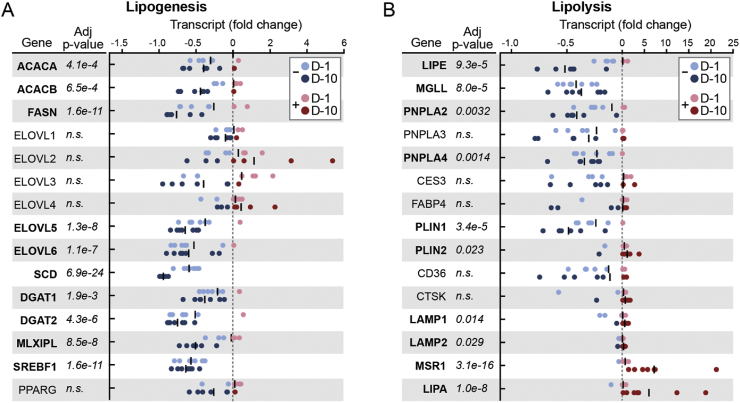
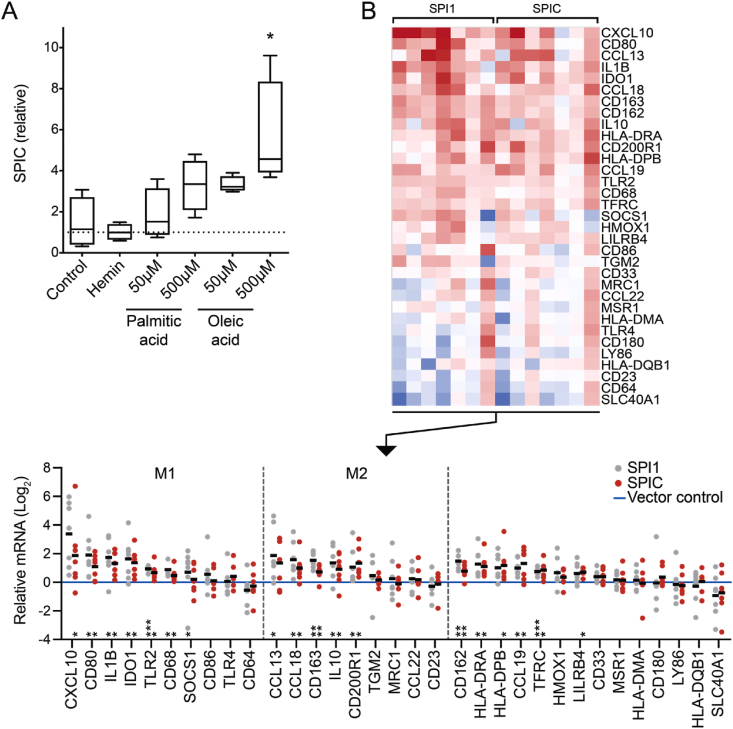
Coincident with the expected shift away from glucose utilization and lipid storage, we demonstrated downregulation of pathways related to glycolysis, oxidative phosphorylation, and lipogenesis. The canonical lipolysis pathway was also downregulated, whereas fasting drove alternative lysosomal paths to lipid digestion. Unexpectedly, the dominant induced pathways were associated with immunity and inflammation, although this only became evident at the 10-day time point. Among the most augmented transcripts were those associated with macrophage identity and function, such as members of the erythroblast transformation-specific (ETS) transcription factor family. Key components of the macrophage transcriptional signal in fasting adipose tissue were recapitulated with induced expression of two of the ETS transcription factors via cultured macrophages, SPIC and SPI1. The inflammatory signal was further reflected by an increase in systemic inflammatory mediators.
Collectively, this study demonstrates an unexpected role of metabolic inflammation in the human adaptive fasting response.
人类适应性禁食反应使机体能够在热量摄入不足的时期存活。禁食反应的一个关键组成部分是从葡萄糖代谢转变为利用脂肪,这突显了脂肪组织作为中央脂质储存器官的重要性。本研究的目的是研究人类长时间禁食时脂肪组织的反应。
我们对人类进行了为期 10 天、0 卡路里禁食期间纵向采集的皮下脂肪组织样本进行了 RNA 测序。我们进一步利用培养的人单核细胞和 Thp1 细胞研究了观察到的转录特征。我们使用透射电子显微镜检查了脂肪组织活检的细胞结构,并通过对纵向采集的血液样本进行 ELISA 检测,测试了与相关炎症介质在全身循环中的关联变化。
与预期的葡萄糖利用和脂质储存减少一致,我们证明了与糖酵解、氧化磷酸化和脂肪生成相关的途径下调。经典的脂肪分解途径也被下调,而禁食则驱动了替代溶酶体途径来消化脂质。出乎意料的是,诱导的主要途径与免疫和炎症有关,尽管这仅在第 10 天时间点才变得明显。在最扩增的转录物中,有一些与巨噬细胞特征和功能相关,例如红细胞转化特异性(ETS)转录因子家族的成员。通过培养的巨噬细胞诱导表达两种 ETS 转录因子,可重现禁食脂肪组织中巨噬细胞转录信号的关键成分,即 SPIC 和 SPI1。炎症信号进一步反映在系统炎症介质的增加上。
总之,本研究表明代谢性炎症在人类适应性禁食反应中具有意想不到的作用。