Orthopaedic Research Unit, Department of Orthopaedic Surgery and Traumatology, Odense University Hospital, Odense, Denmark.
Department of Clinical Research, University of Southern Denmark, Odense, Denmark.
Bone Joint J. 2020 Oct;102-B(10):1303-1310. doi: 10.1302/0301-620X.102B10.BJJ-2020-0138.R1.
The most frequent indication for revision surgery in total hip arthroplasty (THA) is aseptic loosening. Aseptic loosening is associated with polyethylene liner wear, and wear may be reduced by using vitamin E-doped liners. The primary objective of this study was to compare proximal femoral head penetration into the liner between a) two cross-linked polyethylene (XLPE) liners (vitamin E-doped (vE-PE)) versus standard XLPE liners, and b) two modular femoral head diameters (32 mm and 36 mm).
Patients scheduled for a THA were randomized to receive a vE-PE or XLPE liner with a 32 mm or 36 mm metal head (four intervention groups in a 2 × 2 factorial design). Head penetration and acetabular component migration were measured using radiostereometric analysis at baseline, three, 12, 24, and 60 months postoperatively. The Harris Hip Score, University of California, Los Angeles (UCLA) Activity Score, EuroQol five-dimension questionnaire (EQ-5D), and 36-Item Short-Form Health Survey questionnaire (SF-36) were assessed at baseline, three, 12, 36, and 60 months.
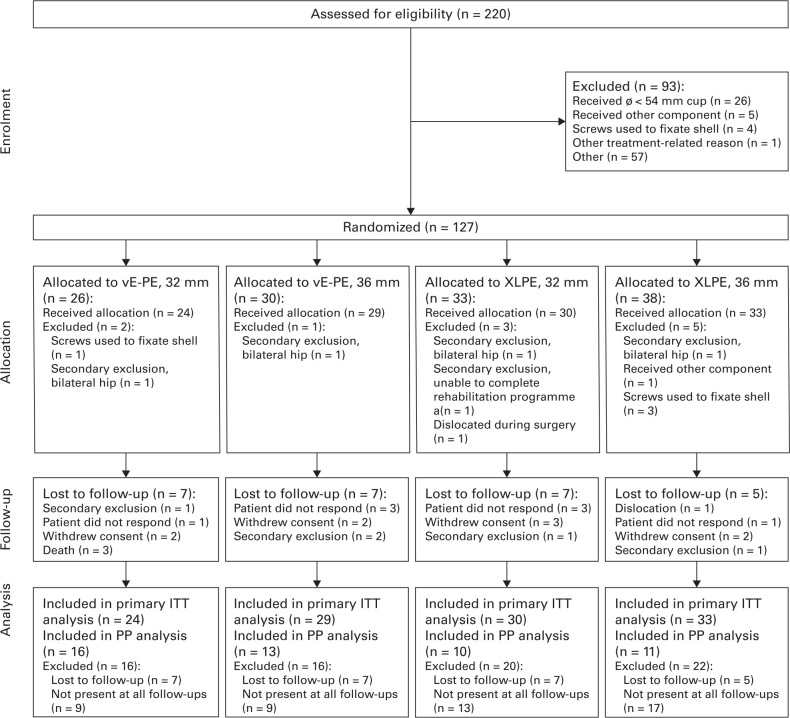
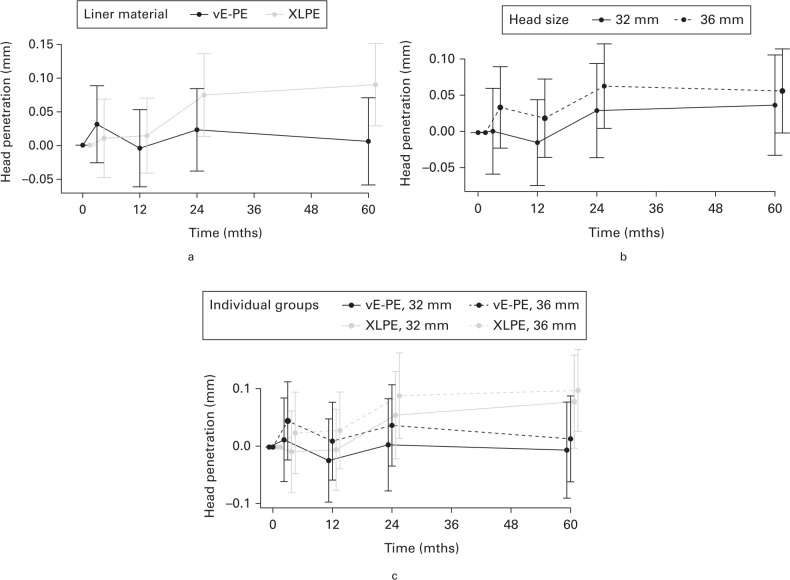
Of 220 screened patients, 127 were included in this study. In all, 116 received the allocated intervention, and 94 had their results analyzed at five years. Head penetration was similar between liner materials and head sizes at five years, vE-PE versus XLPE was -0.084 mm (95% confidence interval (CI) -0.173 to 0.005; p = 0.064), and 32 mm versus 36 mm was -0.020 mm (95% CI -0.110 to 0.071; p = 0.671), respectively. No differences were found in acetabular component migration or in the patient-reported outcome measures.
No significant difference in head penetration was found at five years between vE-PE and XLPE liners, nor between 32 mm and 36 mm heads. Cite this article: 2020;102-B(10):1303-1310.
全髋关节置换术(THA)中最常见的翻修手术指征是无菌性松动。无菌性松动与聚乙烯衬垫磨损有关,而使用维生素 E 掺杂衬垫可减少磨损。本研究的主要目的是比较 a)两种交联聚乙烯(XLPE)衬垫(维生素 E 掺杂(vE-PE)与标准 XLPE 衬垫,和 b)两种模块化股骨头直径(32mm 和 36mm)之间股骨头近端穿透衬垫的情况。
计划接受 THA 的患者被随机分配接受 vE-PE 或 XLPE 衬垫,带有 32mm 或 36mm 金属头(在 2×2 析因设计中有四个干预组)。在基线、术后 3、12、24 和 60 个月时,使用放射立体测量分析测量股骨头穿透和髋臼组件迁移情况。在基线、3、12、36 和 60 个月时,评估了 Harris 髋关节评分、加利福尼亚大学洛杉矶分校(UCLA)活动评分、欧洲五维健康量表(EQ-5D)和 36 项简明健康调查问卷(SF-36)。
在 220 名筛选患者中,有 127 名患者纳入本研究。共有 116 名患者接受了分配的干预措施,其中 94 名患者在五年时进行了结果分析。在五年时,衬垫材料和股骨头大小之间的股骨头穿透情况相似,vE-PE 与 XLPE 相比为 -0.084mm(95%置信区间(CI)-0.173 至 0.005;p=0.064),32mm 与 36mm 相比为-0.020mm(95%CI-0.110 至 0.071;p=0.671)。髋臼组件迁移或患者报告的结果测量均无差异。
在五年时,vE-PE 与 XLPE 衬垫之间以及 32mm 和 36mm 头之间,在股骨头穿透方面均未发现显著差异。