State Key Joint Laboratory of Environment Simulation and Pollution Control, School of Environment, Tsinghua University, Beijing, China.
Institute for Environmental Genomics, University of Oklahoma, Norman, Oklahoma, USA.
Nat Commun. 2020 Sep 29;11(1):4897. doi: 10.1038/s41467-020-18706-z.
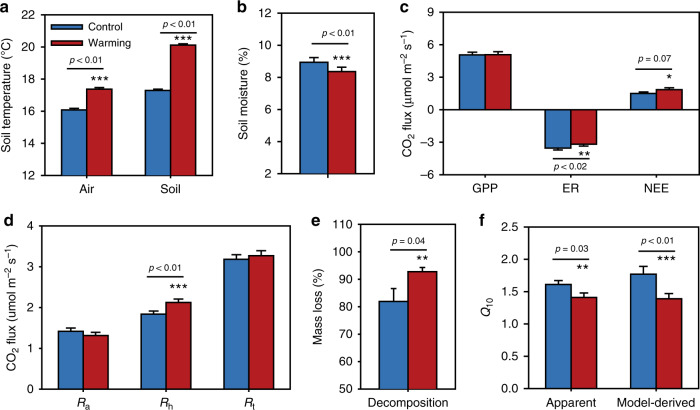
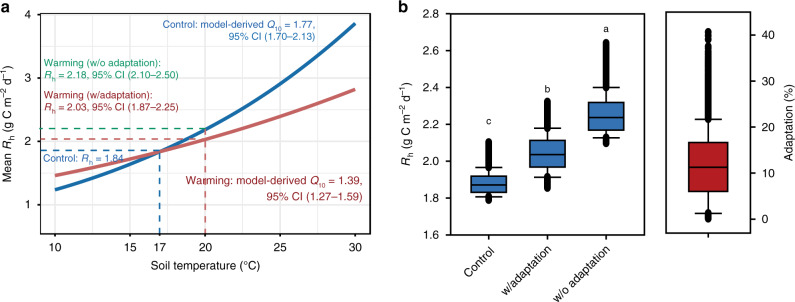
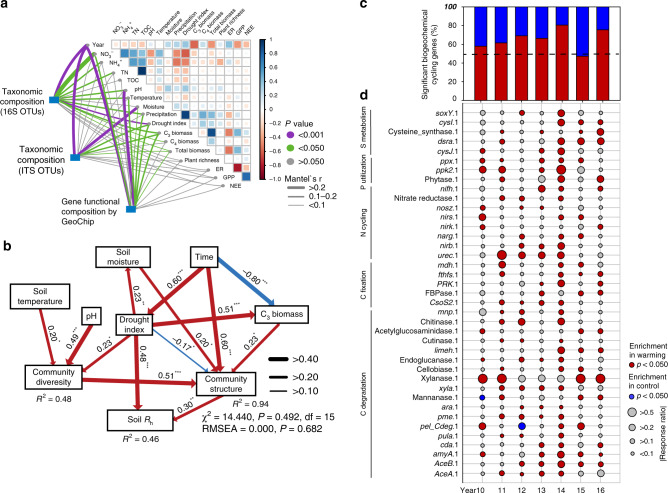
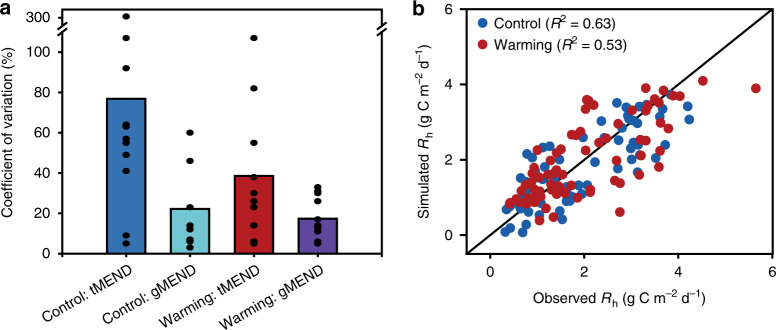
Soil microbial respiration is an important source of uncertainty in projecting future climate and carbon (C) cycle feedbacks. However, its feedbacks to climate warming and underlying microbial mechanisms are still poorly understood. Here we show that the temperature sensitivity of soil microbial respiration (Q) in a temperate grassland ecosystem persistently decreases by 12.0 ± 3.7% across 7 years of warming. Also, the shifts of microbial communities play critical roles in regulating thermal adaptation of soil respiration. Incorporating microbial functional gene abundance data into a microbially-enabled ecosystem model significantly improves the modeling performance of soil microbial respiration by 5-19%, and reduces model parametric uncertainty by 55-71%. In addition, modeling analyses show that the microbial thermal adaptation can lead to considerably less heterotrophic respiration (11.6 ± 7.5%), and hence less soil C loss. If such microbially mediated dampening effects occur generally across different spatial and temporal scales, the potential positive feedback of soil microbial respiration in response to climate warming may be less than previously predicted.
土壤微生物呼吸是预测未来气候和碳(C)循环反馈中不确定性的重要来源。然而,其对气候变暖的反馈以及潜在的微生物机制仍知之甚少。在这里,我们表明,在经过 7 年的变暖后,温带草原生态系统中土壤微生物呼吸的温度敏感性持续下降了 12.0±3.7%。此外,微生物群落的转变在调节土壤呼吸的热适应中起着关键作用。将微生物功能基因丰度数据纳入微生物增强型生态系统模型中,可将土壤微生物呼吸的建模性能提高 5-19%,并将模型参数不确定性降低 55-71%。此外,模型分析表明,微生物的热适应可能导致异养呼吸(11.6±7.5%)明显减少,因此土壤 C 损失也会减少。如果这种微生物介导的抑制作用普遍存在于不同的时空尺度上,那么土壤微生物呼吸对气候变暖的潜在正反馈可能小于先前的预测。