Lipiec Agnieszka, Sybilski Adam, Rapiejko Piotr, Furmañczyk Konrad, Namysłowski Andrzej, Zieliñski Wojciech, Malkiewicz Małgorzata, Biliñska Daria, Chłopek Kazimiera, Samoliñski Bolesław
Department of the Prevention of Environmental Hazards and Allergology, Medical University of Warsaw, Warsaw, Poland.
Department of Peadiatric and Neonatology, Central Clinical Hospital of the Ministry of Internal Affair, Warsaw, Poland.
Postepy Dermatol Alergol. 2020 Aug;37(4):540-547. doi: 10.5114/ada.2019.83624. Epub 2019 Mar 27.
Despite the known role of pollen allergens in causing allergy symptoms in sensitized individuals, there are few publications investigating the relationship between pollen exposure in different regions and the prevalence of inhalant allergy.
To assess the association between the prevalence of allergic rhinitis and asthma and the degree of exposure to pollen in various regions of Poland.
Completed questionnaires of 9,443 subjects living in four urban centres (Wroclaw, Katowice, Warsaw, Bialystok), collected within part of the ECAP project, were analyzed. Children aged 6-7 ( = 2,278), adolescents aged 13-14 ( = 2,418), and adults aged 20-44 ( = 4,747) constituted 24.2%, 25.6% and 50.3% of the respondents, respectively. The clinical part (including skin prick tests, an assay of Timothy grass-specific IgE), was attended by 24% of the respondents. Data from 6-year pollen monitoring served to characterize birch and grass pollen seasons.
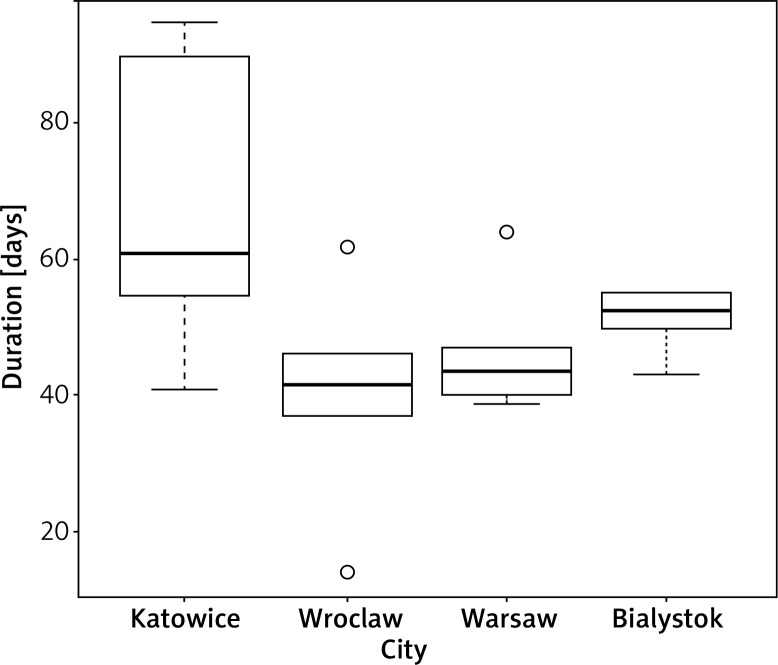
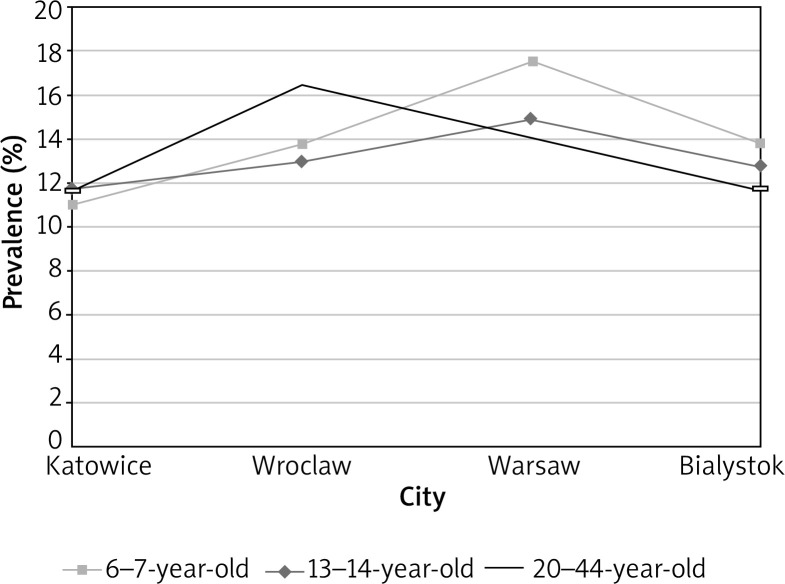
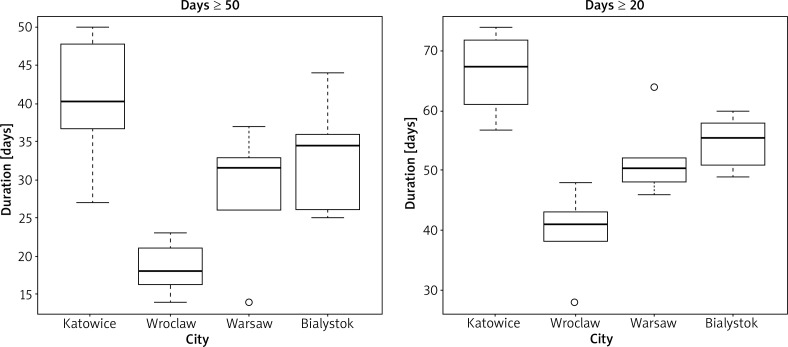
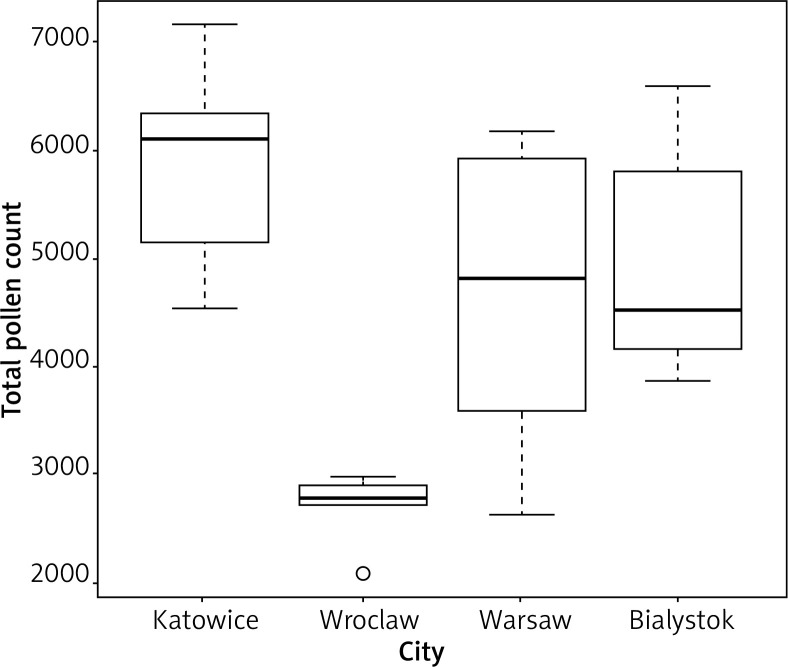
We found insignificant negative associations between the duration of birch pollen season and the prevalence of declared allergic rhinitis and asthma during the season across all age groups. There were insignificant inverse associations between the number of days with above-threshold and high grass pollen concentrations, total grass pollen count and the prevalence of declared allergic rhinitis and asthma during the season across all age groups. Associations noted in the clinical part were also non-significant; however, these trends were not uniform across the age groups.
Our findings do not confirm the hypothesis of a positive association between pollen exposure and the prevalence of allergic rhinitis and asthma.
尽管已知花粉过敏原在致敏个体中引发过敏症状的作用,但很少有出版物研究不同地区的花粉暴露与吸入性过敏患病率之间的关系。
评估波兰不同地区过敏性鼻炎和哮喘的患病率与花粉暴露程度之间的关联。
分析了在欧洲儿童哮喘和过敏研究(ECAP)项目的一部分中收集的、居住在四个城市中心(弗罗茨瓦夫、卡托维兹、华沙、比亚韦斯托克)的9443名受试者填写完整的问卷。6至7岁儿童(n = 2278)、13至14岁青少年(n = 2418)和20至44岁成年人(n = 4747)分别占受访者的24.2%、25.6%和50.3%。24%的受访者参加了临床部分(包括皮肤点刺试验、梯牧草特异性IgE检测)。来自6年花粉监测的数据用于描述桦树和草花粉季节。
我们发现,在所有年龄组中,桦树花粉季节的持续时间与该季节申报的过敏性鼻炎和哮喘患病率之间存在不显著的负相关。在所有年龄组中,高于阈值和高草花粉浓度的天数、草花粉总数与该季节申报的过敏性鼻炎和哮喘患病率之间存在不显著的负相关。临床部分观察到的关联也不显著;然而,这些趋势在各年龄组中并不一致。
我们的研究结果未证实花粉暴露与过敏性鼻炎和哮喘患病率之间存在正相关的假设。