Section of Occupational and Environmental Medicine, School of Public Health and Community Medicine, Institute of Medicine, Sahlgrenska Academy, University of Gothenburg, Medicinaregatan 16A, 40530, Gothenburg, Sweden.
Department of Public Health and Clinical Medicine, University Hospital, Sustainable Health, Umeå University, Building 1A, 4st, 901 87, Umeå, Sweden.
Environ Health. 2022 Jul 6;21(1):63. doi: 10.1186/s12940-022-00871-x.
Evidence of the role of interactions between air pollution and pollen exposure in subjects with allergic asthma is limited and need further exploration to promote adequate preventive measures. The objective of this study was to assess effects of exposure to ambient air pollution and birch pollen on exacerbation of respiratory symptoms in subjects with asthma and allergy to birch.
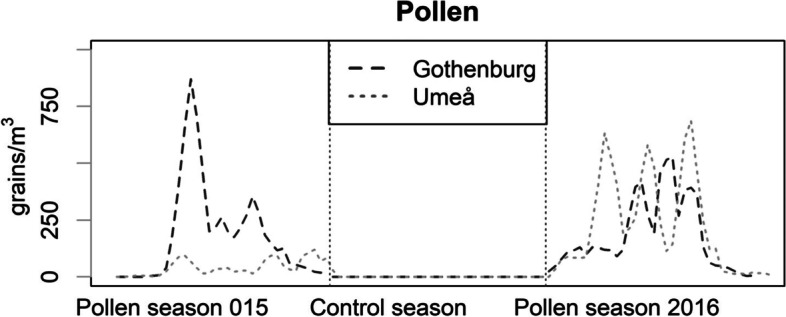
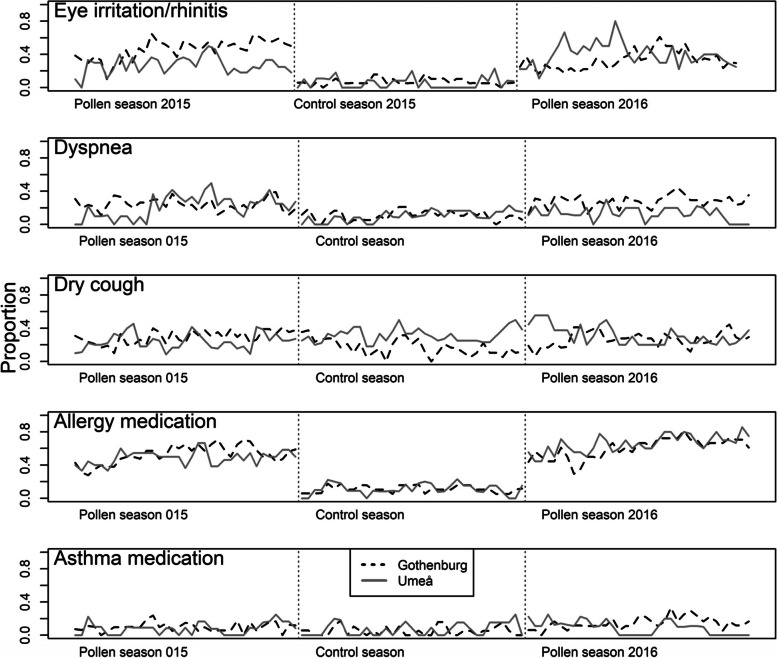
Thirty-seven subjects from two Swedish cities (Gothenburg and Umeå) with large variation in exposure to both birch-pollen and air pollutants, participated in the study. All subjects had confirmed allergy to birch and self-reported physician-diagnosed asthma. The subjects recorded respiratory symptoms such as rhinitis or eye irritation, dry cough, dyspnoea, the use of any asthma or allergy medication and peak respiratory flow (PEF), daily for five consecutive weeks during two separate pollen seasons and a control season without pollen. Nitrogen oxides (NO), ozone (O), particulate matter (PM), birch pollen counts, and meteorological data were obtained from an urban background monitoring stations in the study city centres. The data were analysed using linear mixed effects models.
During pollen seasons all symptoms and medication use were higher, and PEF was reduced in the subjects. In regression analysis, exposure to pollen at lags 0 to 2 days, and lags 0 to 6 days was associated with increased ORs of symptoms and decreased RRs for PEF. Pollen and air pollution interacted in some cases; during low pollen exposure, there were no associations between air pollution and symptoms, but during high pollen exposure, O concentrations were associated with increased OR of rhinitis or eye irritation, and PM concentrations were associated with increased ORs of rhinitis or eye irritation, dyspnea and increased use of allergy medication.
Pollen and air pollutants interacted to increase the effect of air pollution on respiratory symptoms in allergic asthma. Implementing the results from this study, advisories for individuals with allergic asthma could be improved, minimizing the morbidities associated with the condition.
空气污染和花粉暴露相互作用对过敏性哮喘患者的影响的证据有限,需要进一步探索以促进采取充分的预防措施。本研究的目的是评估环境空气污染和桦树花粉暴露对桦树过敏哮喘患者呼吸道症状恶化的影响。
来自瑞典两个城市(哥德堡和于默奥)的 37 名受试者参加了这项研究,这两个城市的桦树花粉和空气污染物暴露差异很大。所有受试者均对桦树过敏,并经医生诊断患有哮喘。在两个单独的花粉季节和一个无花粉的对照季节中,连续五周,每天记录呼吸道症状(如鼻炎或眼睛刺激、干咳、呼吸困难、使用任何哮喘或过敏药物以及峰值呼吸流量(PEF)。在研究城市中心的城市背景监测站获得了氮氧化物 (NO)、臭氧 (O)、颗粒物 (PM)、桦树花粉计数和气象数据。使用线性混合效应模型对数据进行分析。
在花粉季节,所有症状和药物使用均较高,PEF 降低。在回归分析中,在 0 至 2 天和 0 至 6 天的滞后时间内暴露于花粉与症状的 OR 增加以及 PEF 的 RR 降低有关。花粉和空气污染物在某些情况下相互作用;在低花粉暴露下,空气污染与症状之间没有关联,但在高花粉暴露下,O 浓度与鼻炎或眼睛刺激的 OR 增加有关,PM 浓度与鼻炎或眼睛刺激、呼吸困难和过敏药物使用增加的 OR 增加有关。
花粉和空气污染物相互作用,增加了空气污染对过敏性哮喘患者呼吸道症状的影响。实施本研究的结果,可以改善对过敏性哮喘患者的建议,最大限度地减少与该疾病相关的发病率。