Gwynne-Jones David P, Sullivan Trudy, Wilson Ross, Abbott J Haxby
Department of Surgical Sciences, Centre for Musculoskeletal Outcomes Research, Dunedin School of Medicine, University of Otago, Dunedin, New Zealand.
Department of Orthopaedic Surgery, Dunedin Hospital, Southern District Health Board, Dunedin, New Zealand.
Arthroplast Today. 2020 May 21;6(3):585-589.e1. doi: 10.1016/j.artd.2020.04.009. eCollection 2020 Sep.
In countries with publicly funded health care, there is an increasing need for explicit rationing for total joint arthroplasty (TJA). The Oxford Hip and Knee Scores (OHS/OKS) have been used to set access thresholds for TJA despite not being developed for that purpose. The aim of this study was to determine whether preoperative OHS/OKS can aid rationing decisions by investigating the changes in general health-related quality of life after TJA.
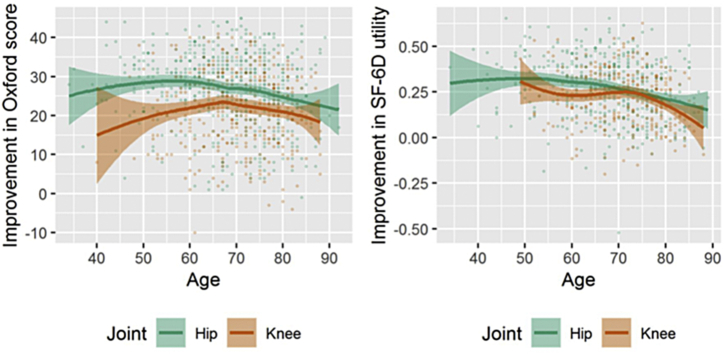
OHS/OKS, Short Form-12, and Short Form-6D (SF-6D) scores were collected preoperatively and at 1 year postoperatively in a cohort of patients undergoing total hip arthroplasty (THA; n = 713) and total knee arthroplasty (TKA; n = 520). The association between preoperative OHS/OKS and postoperative score and the change in OHS/OKS and SF-6D was investigated, adjusting for age and gender.
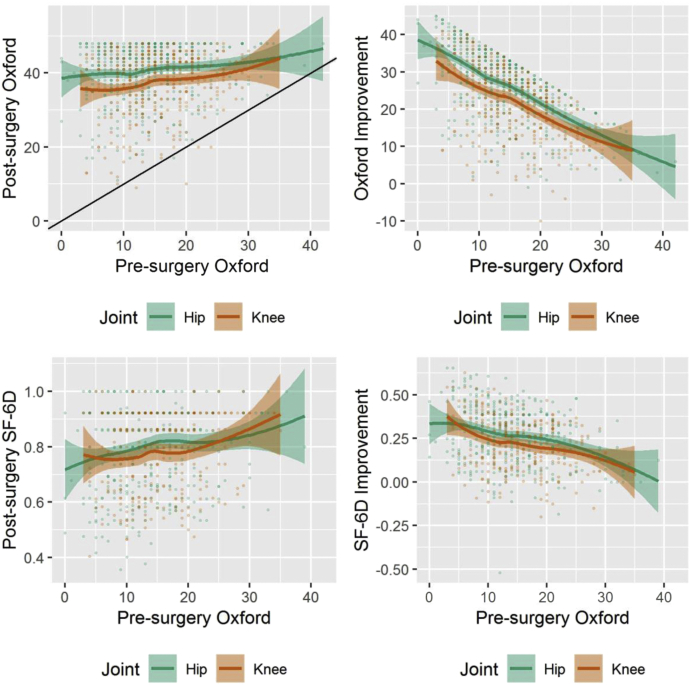
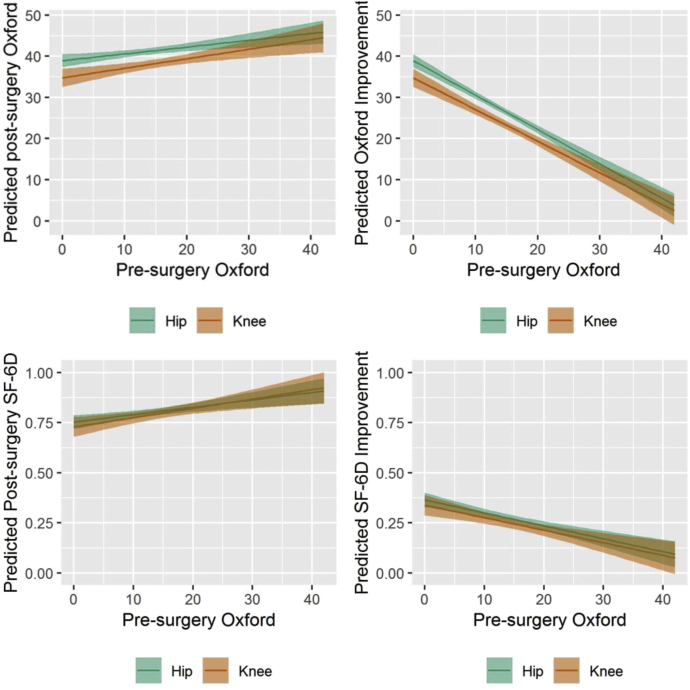
The mean Oxford scores improved from 13.9 to 40.7 (OHS) and 15.6 to 37.4 (OKS). The mean SF-6D improved after THA (0.53 to 0.80) and TKA (0.56 to 0.78) (all < .0001). Poorer preoperative Oxford scores were associated with poorer postoperative OHS/OKS and SF-6D but larger improvements. For every 5 points lower preoperative OHS/OKS, the postoperative SF-6D score was worse by a margin of 0.019 (THA) and 0.023 (TKA).
Preoperative OHS/OKS can help inform rationing decisions. A lower preoperative OHS/OKS will result in greater gains but a lower final outcome score in general health-related quality of life.
在实行公费医疗的国家,对全关节置换术(TJA)进行明确的资源分配需求日益增加。牛津髋关节和膝关节评分(OHS/OKS)虽并非为此目的而制定,但已被用于设定TJA的准入门槛。本研究的目的是通过调查TJA后总体健康相关生活质量的变化,确定术前OHS/OKS是否有助于资源分配决策。
收集了一组接受全髋关节置换术(THA;n = 713)和全膝关节置换术(TKA;n = 520)患者术前及术后1年的OHS/OKS、简明健康调查问卷12项量表(Short Form-12)和简明健康调查问卷6维度量表(Short Form-6D,SF-6D)评分。研究了术前OHS/OKS与术后评分之间的关联,以及OHS/OKS和SF-6D的变化,并对年龄和性别进行了校正。
牛津评分均值从13.9提高到40.7(OHS),从15.6提高到37.4(OKS)。THA(从0.53提高到0.80)和TKA(从0.56提高到0.78)后SF-6D均值均有所改善(均P <.0001)。术前牛津评分越差,术后OHS/OKS和SF-6D越差,但改善幅度越大。术前OHS/OKS每降低5分,术后SF-6D评分在THA中降低0.019,在TKA中降低0.023。
术前OHS/OKS有助于为资源分配决策提供参考。术前OHS/OKS较低会带来更大的改善,但总体健康相关生活质量的最终评分会较低。