School of Optometry, The Hong Kong Polytechnic University, Kowloon, Hong Kong.
Centre for Eye and Vision Research (CEVR), Hong Kong.
Acta Ophthalmol. 2021 May;99(3):e423-e432. doi: 10.1111/aos.14595. Epub 2020 Sep 30.
The effect of contrast-balanced dichoptic video game training on distance visual acuity (DVA) and stereo acuity has been investigated in severe-to-moderate amblyopia, but its effect on mild amblyopia and fixation stability has not been assessed. This pilot study aimed to evaluate the effect of home-based dichoptic video game on amblyopic eye DVA, stereo acuity and fixation stability in adults with mild amblyopia.
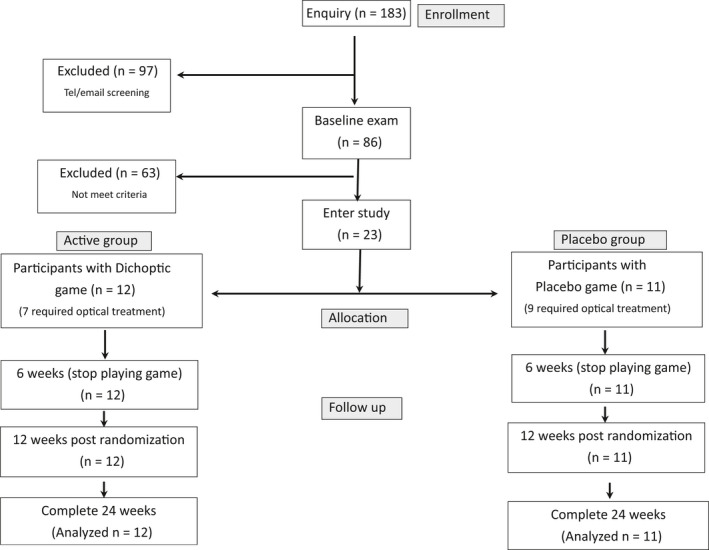
A randomized single-masked design was adopted. The active 6-week home-based treatment was an anaglyphic, contrast-balanced dichoptic video game, and the placebo was an identical non-dichoptic game. Participants (n = 23) had mild amblyopia (amblyopic DVA ≤ 0.28 log Minimum Angle of Resolution (logMAR)). The primary outcome was change in amblyopic DVA at 6 weeks postrandomization. Near visual acuity, stereo acuity and fixation stability (bivariate contour eclipse area) were also measured. Follow-up occurred at 12 and 24 weeks postrandomization.
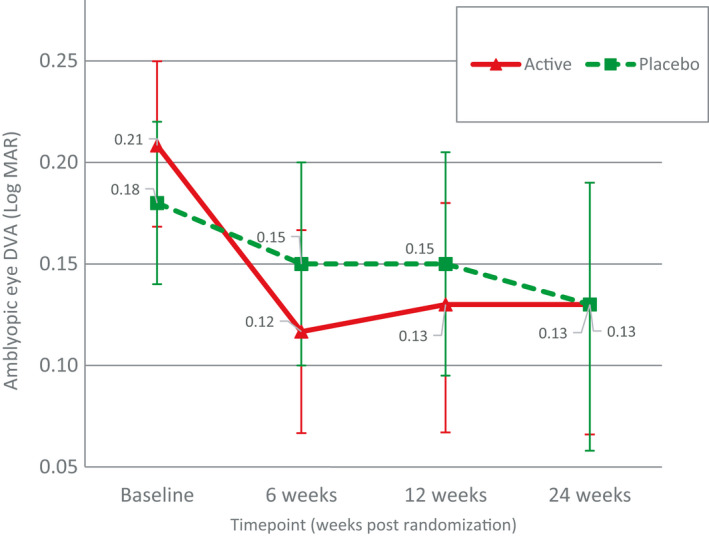
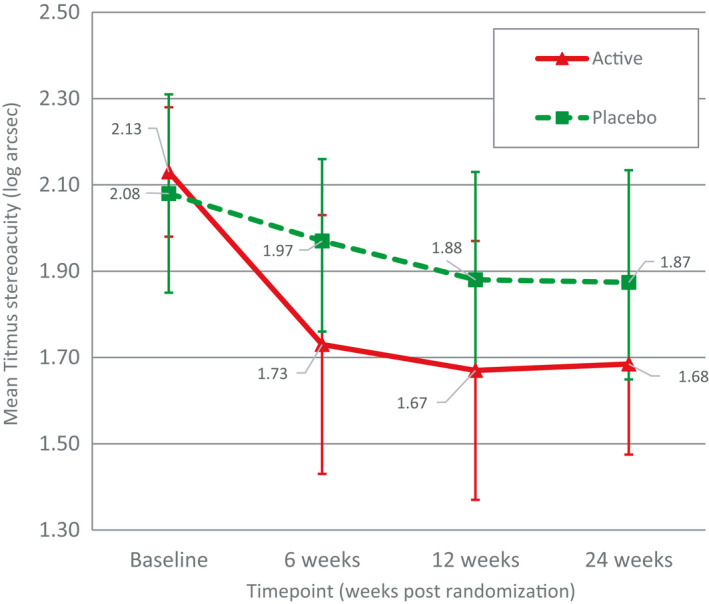
Mean amblyopic eye DVA was 0.21 ± 0.06 and 0.18 ± 0.06 logMAR for the active (n = 12) and placebo (n = 11) group, respectively. Amblyopic DVA improved significantly more in the active group (0.09 ± 0.05) than in the placebo group (0.03 ± 0.04 logMAR; p < 0.05). The difference between groups remained at 12 weeks postrandomization (p = 0.04) but not at 24 weeks (p = 0.43). Titmus stereo acuities improved significantly more in the active group (0.40 log arcsec) than in the placebo group (0.09 log arcsec) after 6 weeks of gameplay. The between-group difference was still present at 24 weeks postrandomization (p = 0.05). There were no differences between groups on any other secondary outcomes.
Home-based dichoptic video gameplay may be an effective method to improve amblyopic DVA and stereo acuity in mild amblyopia.
对比度平衡的双眼视频游戏训练对重度至中度弱视的远距视力(DVA)和立体锐度的影响已经得到了研究,但它对轻度弱视和注视稳定性的影响尚未得到评估。本初步研究旨在评估基于家庭的双眼视频游戏对成人轻度弱视的弱视眼 DVA、立体锐度和注视稳定性的影响。
采用随机单盲设计。为期 6 周的主动家庭治疗是一种立体镜、对比度平衡的双眼视频游戏,而安慰剂是一种相同的非双眼游戏。参与者(n=23)患有轻度弱视(弱视 DVA≤0.28 对数最小分辨角对数(logMAR))。主要结局是在随机分组后 6 周时弱视眼 DVA 的变化。还测量了近视力、立体锐度和注视稳定性(双变量等高线掩蔽区面积)。在随机分组后 12 周和 24 周进行随访。
主动组(n=12)和安慰剂组(n=11)的弱视眼 DVA 平均值分别为 0.21±0.06 和 0.18±0.06 logMAR。主动组的弱视 DVA 改善明显更多(0.09±0.05),而安慰剂组的弱视 DVA 改善较少(0.03±0.04 logMAR;p<0.05)。在随机分组后 12 周时,两组之间仍存在差异(p=0.04),但在 24 周时无差异(p=0.43)。主动组的 Titmus 立体视锐度在 6 周游戏后改善明显更多(0.40 对数弧秒),而安慰剂组改善较少(0.09 对数弧秒)。在随机分组后 24 周时,两组之间仍存在差异(p=0.05)。在其他次要结局方面,两组之间没有差异。
基于家庭的双眼视频游戏可能是一种有效改善轻度弱视的弱视眼 DVA 和立体锐度的方法。