Independent Max Planck Research Group for Social Neuroscience, Max Planck Institute of Psychiatry, Munich, Germany.
Graduate School for Systemic Neurosciences, Munich, Germany.
PLoS Comput Biol. 2020 Sep 30;16(9):e1008162. doi: 10.1371/journal.pcbi.1008162. eCollection 2020 Sep.
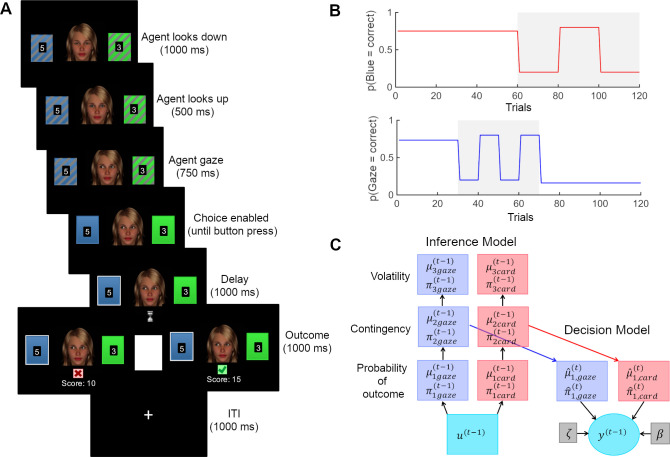
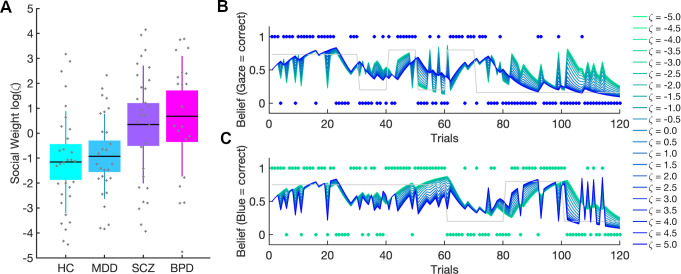
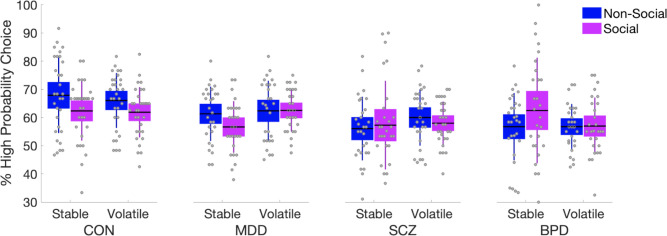
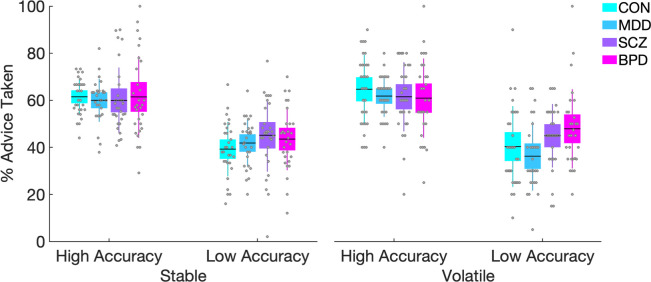
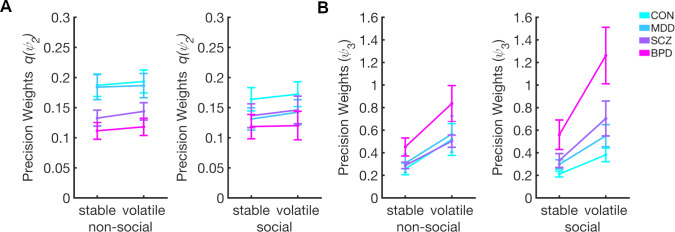
Psychiatric disorders are ubiquitously characterized by debilitating social impairments. These difficulties are thought to emerge from aberrant social inference. In order to elucidate the underlying computational mechanisms, patients diagnosed with major depressive disorder (N = 29), schizophrenia (N = 31), and borderline personality disorder (N = 31) as well as healthy controls (N = 34) performed a probabilistic reward learning task in which participants could learn from social and non-social information. Patients with schizophrenia and borderline personality disorder performed more poorly on the task than healthy controls and patients with major depressive disorder. Broken down by domain, borderline personality disorder patients performed better in the social compared to the non-social domain. In contrast, controls and major depressive disorder patients showed the opposite pattern and schizophrenia patients showed no difference between domains. In effect, borderline personality disorder patients gave up a possible overall performance advantage by concentrating their learning in the social at the expense of the non-social domain. We used computational modeling to assess learning and decision-making parameters estimated for each participant from their behavior. This enabled additional insights into the underlying learning and decision-making mechanisms. Patients with borderline personality disorder showed slower learning from social and non-social information and an exaggerated sensitivity to changes in environmental volatility, both in the non-social and the social domain, but more so in the latter. Regarding decision-making the modeling revealed that compared to controls and major depression patients, patients with borderline personality disorder and schizophrenia showed a stronger reliance on social relative to non-social information when making choices. Depressed patients did not differ significantly from controls in this respect. Overall, our results are consistent with the notion of a general interpersonal hypersensitivity in borderline personality disorder and schizophrenia based on a shared computational mechanism characterized by an over-reliance on beliefs about others in making decisions and by an exaggerated need to make sense of others during learning specifically in borderline personality disorder.
精神障碍的一个普遍特征是社会功能严重受损。这些困难被认为是源于异常的社会推理。为了阐明潜在的计算机制,我们对 29 名被诊断为重度抑郁症、31 名精神分裂症和 31 名边缘型人格障碍的患者以及 34 名健康对照者进行了一项概率奖励学习任务,参与者可以从社会和非社会信息中进行学习。精神分裂症和边缘型人格障碍患者在任务中的表现比健康对照组和重度抑郁症患者差。按领域划分,边缘型人格障碍患者在社会领域的表现优于非社会领域。相比之下,对照组和重度抑郁症患者表现出相反的模式,而精神分裂症患者在两个领域之间没有差异。实际上,边缘型人格障碍患者通过专注于社会领域的学习而放弃了可能的整体表现优势,从而牺牲了非社会领域的学习。我们使用计算模型来评估从每个参与者的行为中估计的学习和决策参数。这为深入了解潜在的学习和决策机制提供了额外的见解。边缘型人格障碍患者从社会和非社会信息中学习较慢,对环境波动性变化的敏感性增强,无论是在非社会领域还是社会领域,后者更为明显。在决策方面,建模结果表明,与对照组和重度抑郁症患者相比,边缘型人格障碍和精神分裂症患者在做出选择时,对社会信息的依赖程度强于非社会信息,而在后者中更为明显。在这方面,抑郁患者与对照组没有显著差异。总的来说,我们的结果与基于共享计算机制的边缘型人格障碍和精神分裂症中存在一般人际超敏反应的观点一致,该机制的特征是在做出决策时过度依赖他人的信念,以及在学习过程中特别在边缘型人格障碍中过度需要理解他人。