Department of Psychology, Temple University, Philadelphia, USA.
Department of Psychology, New York University, New York, USA.
Sci Rep. 2020 Sep 30;10(1):16096. doi: 10.1038/s41598-020-72317-8.
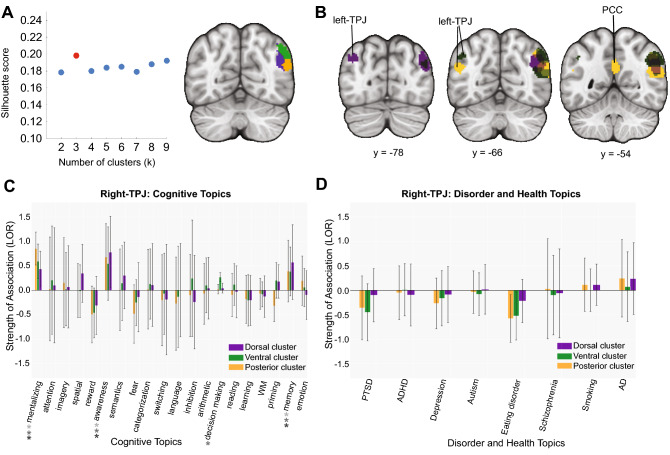
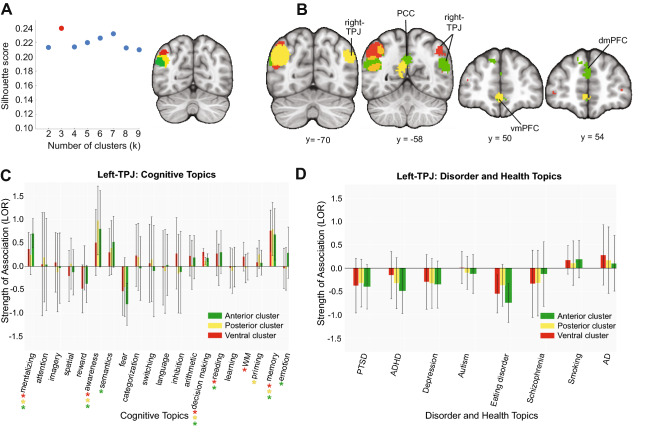
The default mode network (DMN) consists of several regions that selectively interact to support distinct domains of cognition. Of the various sites that partake in DMN function, the posterior cingulate cortex (PCC), temporal parietal junction (TPJ), and medial prefrontal cortex (MPFC) are frequently identified as key contributors. Yet, it remains unclear whether these subcomponents of the DMN make unique contributions to specific cognitive processes and health conditions. To address this issue, we applied a meta-analytic parcellation approach used in prior work. This approach used the Neurosynth database and classification methods to quantify the association between PCC, TPJ, and MPFC activation and specific topics related to cognition and health (e.g., decision making and smoking). Our analyses replicated prior observations that the PCC, TPJ, and MPFC collectively support multiple cognitive functions such as decision making, memory, and awareness. To gain insight into the functional organization of each region, we parceled each region based on its coactivation pattern with the rest of the brain. This analysis indicated that each region could be further subdivided into functionally distinct subcomponents. Taken together, we further delineate DMN function by demonstrating the relative strengths of association among subcomponents across a range of cognitive processes and health conditions. A continued attentiveness to the specialization within the DMN allows future work to consider the nuances in sub-regional contributions necessary for healthy cognition, as well as create the potential for more targeted treatment protocols in various health conditions.
默认模式网络(DMN)由几个选择性相互作用的区域组成,以支持认知的不同领域。在参与 DMN 功能的各种部位中,后扣带回皮质(PCC)、颞顶联合(TPJ)和内侧前额叶皮质(MPFC)经常被认为是关键贡献者。然而,这些 DMN 的子成分是否对特定的认知过程和健康状况有独特的贡献仍不清楚。为了解决这个问题,我们应用了先前工作中使用的基于元分析的分区方法。该方法使用 Neurosynth 数据库和分类方法来量化 PCC、TPJ 和 MPFC 激活与与认知和健康相关的特定主题(例如决策制定和吸烟)之间的关联。我们的分析复制了先前的观察结果,即 PCC、TPJ 和 MPFC 共同支持多种认知功能,如决策制定、记忆和意识。为了深入了解每个区域的功能组织,我们根据每个区域与大脑其他区域的共同激活模式对其进行分区。该分析表明,每个区域都可以进一步细分为具有不同功能的子成分。总的来说,我们通过展示认知过程和健康状况范围内子成分之间关联的相对强度,进一步描绘了 DMN 的功能。对 DMN 内的专业化的持续关注使未来的工作能够考虑到健康认知所需的亚区域贡献的细微差别,并为各种健康状况创造更有针对性的治疗方案的潜力。