University of Cologne, Faculty of Medicine and University Hospital Cologne, Department of Urology, Uro-Oncology, Robot-Assisted and Reconstructive Urology, Cologne, Germany.
PAN Clinic, Urological Practice, Cologne, Germany.
World J Urol. 2021 Jul;39(7):2515-2523. doi: 10.1007/s00345-020-03471-x. Epub 2020 Sep 30.
To report on long-term outcomes of patients treated with active surveillance (AS) for localized prostate cancer (PCa) in the daily routine setting.
HAROW (2008-2013) was a non-interventional, health service research study about the management of localized PCa in the community setting, with 86% of the study centers being office-based urologists. A follow-up examination of all patients who opted for AS as primary treatment was carried out. Overall, cancer-specific, and metastasis-free survival, as well as discontinuation rates, were determined.
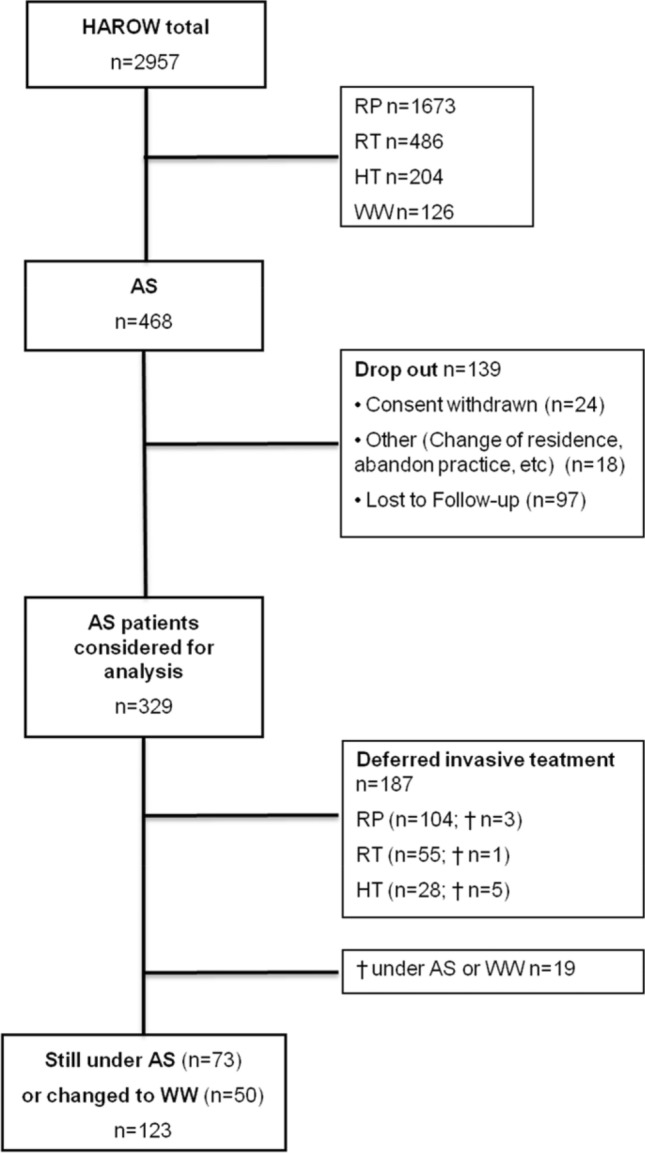
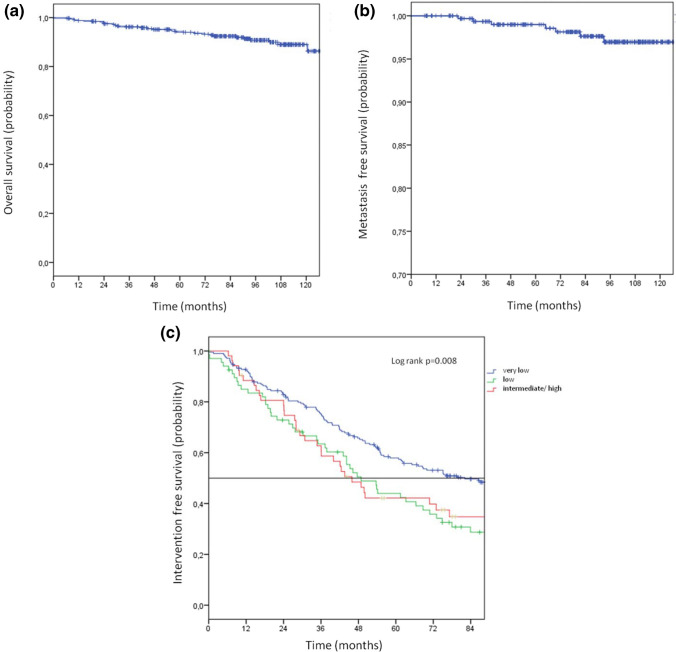
Of 329 patients, 62.9% had very-low- and 21.3% low-risk tumours. The median follow-up was 7.7 years (IQR 4.7-9.1). Twenty-eight patients (8.5%) died unrelated to PCa, of whom 19 were under AS or watchful waiting (WW). Additionally, seven patients (2.1%) developed metastasis. The estimated 10-year overall and metastasis-free survival was 86% (95% CI 81.7-90.3) and 97% (95% CI 94.6-99.3), respectively. One hundred eighty-seven patients (56.8%) discontinued AS changing to invasive treatment: 104 radical prostatectomies (RP), 55 radiotherapies (RT), and 28 hormonal treatments (HT). Another 50 patients switched to WW. Finally, 37.4% remained alive without invasive therapy (22.2% AS and 15.2% WW). Intervention-free survival differed between the risk groups: 47.8% in the very-low-, 33.8% in the low- and 34.6% in the intermediate-/high-risk-group (p = 0.008). On multivariable analysis, PSA-density ≥ 0.2 ng/ml was significantly predictive for receiving invasive treatment (HR 2.55; p = 0.001).
Even in routine care, AS can be considered a safe treatment option. Our results might encourage office-based urologists regarding the implementation of AS and to counteract possible concerns against this treatment option.
报告在日常实践中,对接受主动监测(AS)治疗局限性前列腺癌(PCa)的患者的长期结果。
HAROW(2008-2013)是一项关于社区环境下局限性 PCa 管理的非干预性卫生服务研究,研究中有 86%的中心为门诊泌尿科医生。对所有选择 AS 作为主要治疗方法的患者进行了随访检查。总体上,评估了癌症特异性生存、无转移生存以及停药率。
在 329 名患者中,62.9%的患者肿瘤为极低危,21.3%为低危。中位随访时间为 7.7 年(IQR 4.7-9.1)。28 名患者(8.5%)与 PCa 无关死亡,其中 19 名患者处于 AS 或观察等待(WW)中。此外,有 7 名患者(2.1%)发生了转移。估计的 10 年总生存率和无转移生存率分别为 86%(95%CI 81.7-90.3)和 97%(95%CI 94.6-99.3)。187 名患者(56.8%)停止 AS 治疗转为侵入性治疗:104 例根治性前列腺切除术(RP),55 例放疗(RT),28 例激素治疗(HT)。另外 50 名患者转为 WW。最后,37.4%的患者在没有接受侵入性治疗的情况下仍然存活(22.2%的患者处于 AS 状态,15.2%的患者处于 WW 状态)。不同风险组之间的无干预生存存在差异:极低危组为 47.8%,低危组为 33.8%,中高危组为 34.6%(p=0.008)。多变量分析显示,PSA 密度≥0.2ng/ml 是接受侵入性治疗的显著预测因素(HR 2.55;p=0.001)。
即使在常规治疗中,AS 也可以被视为一种安全的治疗选择。我们的研究结果可能会鼓励门诊泌尿科医生实施 AS,并消除对这种治疗选择的担忧。