Conte Francesca, Cellini Nicola, De Rosa Oreste, Caputo Antonietta, Malloggi Serena, Coppola Alessia, Albinni Benedetta, Cerasuolo Mariangela, Giganti Fiorenza, Marcone Roberto, Ficca Gianluca
Department of Psychology, University of Campania L. Vanvitelli, Viale Ellittico 31, 81100 Caserta, Italy.
Department of General Psychology, University of Padova, Via Venezia 8, 35131 Padova, Italy.
Brain Sci. 2020 Sep 29;10(10):690. doi: 10.3390/brainsci10100690.
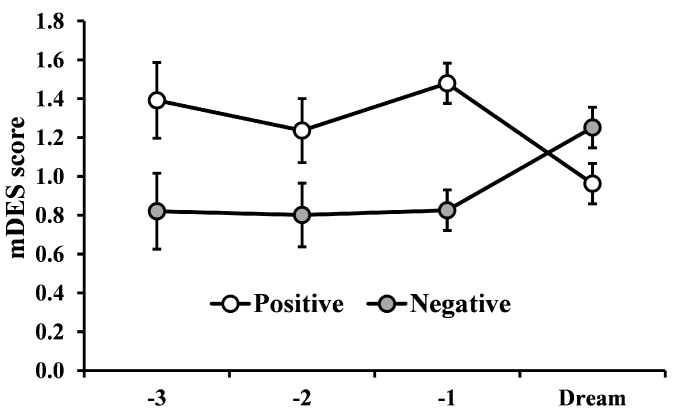
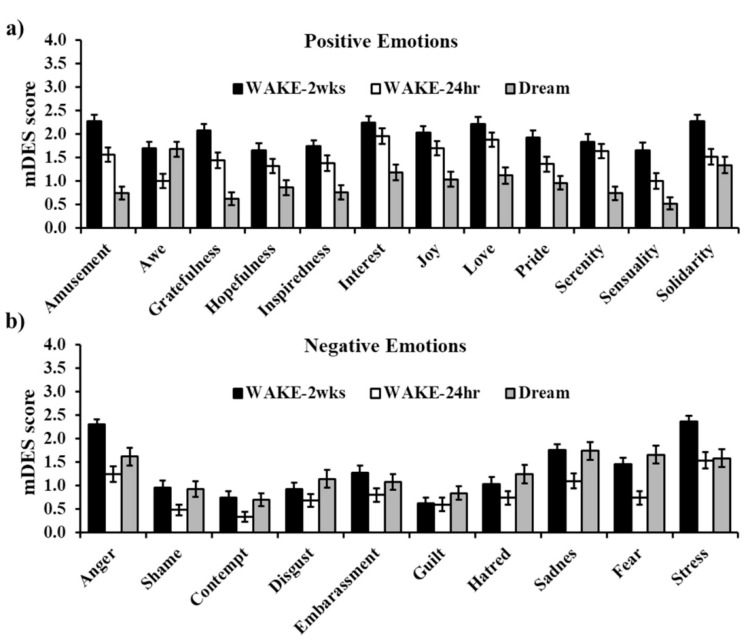
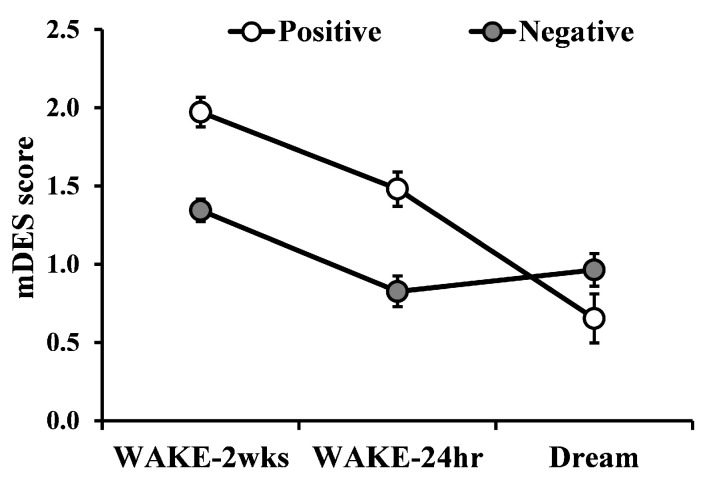
Despite the increasing interest in sleep and dream-related processes of emotion regulation, their reflection into wake and dream emotional experience remains unclear. Here, we aimed to assess dream emotions and their relationships with wake emotions through the modified Differential Emotions Scale (Fredrickson, 2003), which includes a broad array of both positive and negative emotions. The scale has been first validated on 212 healthy Italian participants, in two versions: a WAKE-2wks form, assessing the frequency of 22 emotions over the past 2 weeks, and a WAKE-24hr form, assessing their intensity over the past 24 h. Fifty volunteers from the wider sample completed the WAKE-24hr mDES for several days until a dream was recalled, and dream emotions were self-reported using the same scale. A bifactorial structure was confirmed for both mDES forms, which also showed good validity and reliability. Though Positive and Negative Affect (average intensity of positive and negative items, PA, and NA, respectively) were balanced in dreams, specific negative emotions prevailed; rmANOVA showed a different pattern (prevalence of PA and positive emotions) in wake (both WAKE-2wks and WAKE-24hr), with a decrease of PA and an increase of NA in the dream compared to previous wake. No significant regression model emerged between waking and dream affect, and exploratory analyses revealed a stable proportion of PA and NA (with prevailing PA) over the 3 days preceding the dream. Our findings highlight a discontinuity between wake and dream affect and suggest that positive and negative emotions experienced during wake may undertake distinct sleep-related regulation pathways.
尽管人们对睡眠及与梦相关的情绪调节过程的兴趣日益浓厚,但它们在清醒和梦境情绪体验中的反映仍不明确。在此,我们旨在通过改良的差异情绪量表(弗雷德里克森,2003年)评估梦境情绪及其与清醒时情绪的关系,该量表涵盖了广泛的积极和消极情绪。该量表首先在212名健康的意大利参与者中进行了验证,有两个版本:一个是WAKE - 2wks形式,评估过去两周内22种情绪的出现频率;另一个是WAKE - 24hr形式,评估过去24小时内这些情绪的强度。从更广泛的样本中选取的50名志愿者连续几天填写WAKE - 24hr mDES,直到回忆起一个梦,然后使用相同的量表自我报告梦境情绪。两种mDES形式均证实具有双因素结构,且具有良好的效度和信度。尽管在梦境中积极和消极情绪(分别为积极和消极项目的平均强度,即PA和NA)是平衡的,但特定的消极情绪占主导;重复测量方差分析显示在清醒状态(WAKE - 2wks和WAKE - 24hr)中呈现不同的模式(PA和积极情绪占主导),与之前的清醒状态相比,梦境中的PA降低,NA增加。清醒和梦境情绪之间未出现显著的回归模型,探索性分析显示在梦前3天PA和NA的比例稳定(PA占主导)。我们的研究结果突出了清醒和梦境情绪之间的不连续性,并表明清醒时体验到的积极和消极情绪可能会经历不同的与睡眠相关的调节途径。