Translational Neuromodeling Unit (TNU), Institute for Biomedical Engineering, University of Zurich & ETH Zurich, Zurich, Switzerland.
Department of Psychology and Neuroscience, Bio-Imaging Research Center, University of Georgia, Athens, Georgia, USA.
Hum Brain Mapp. 2021 May;42(7):2159-2180. doi: 10.1002/hbm.25357. Epub 2021 Feb 4.
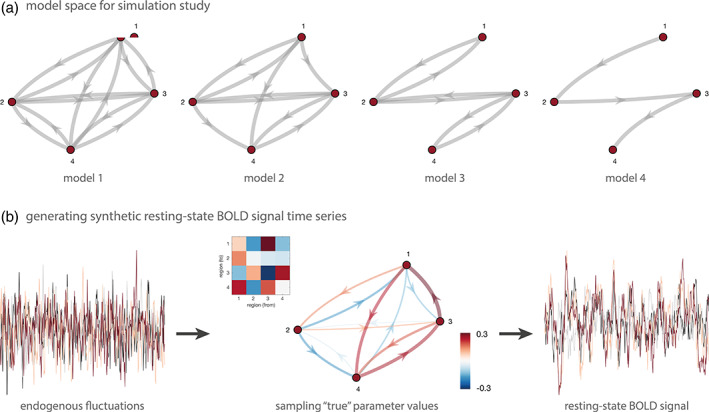
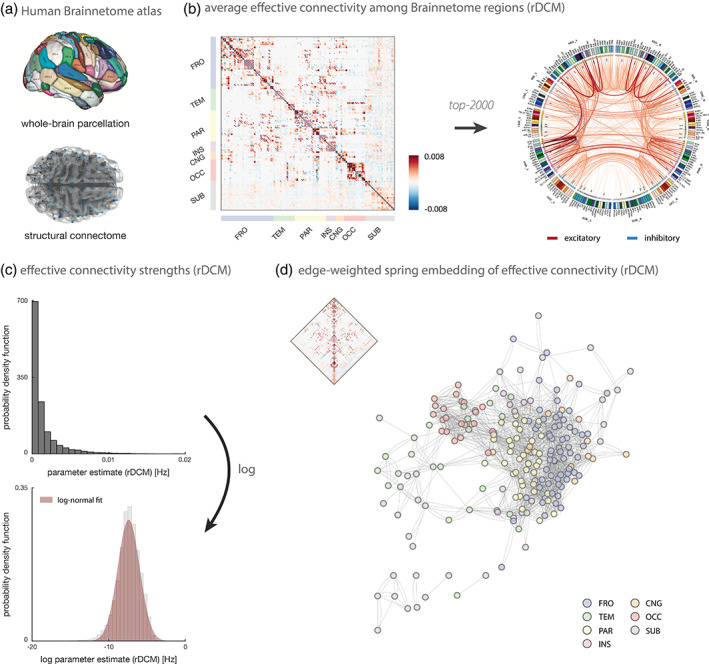
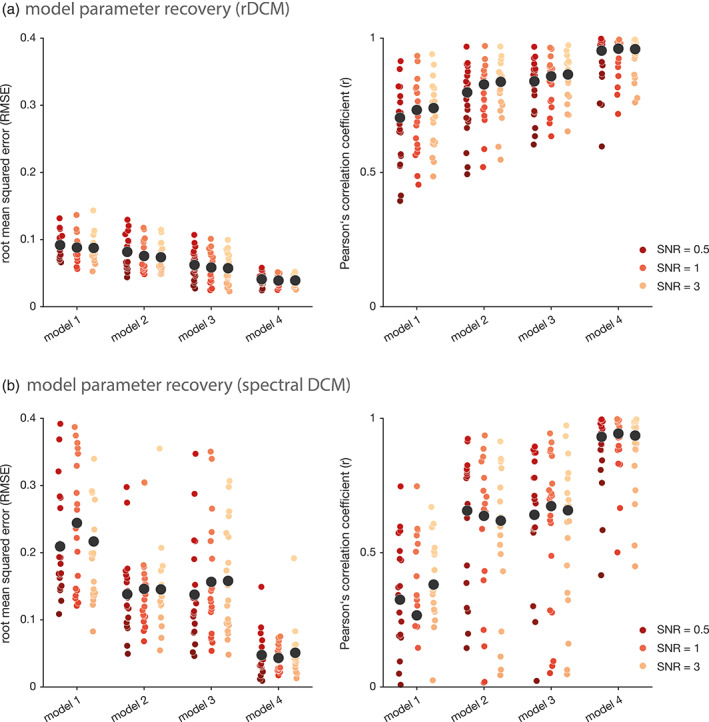
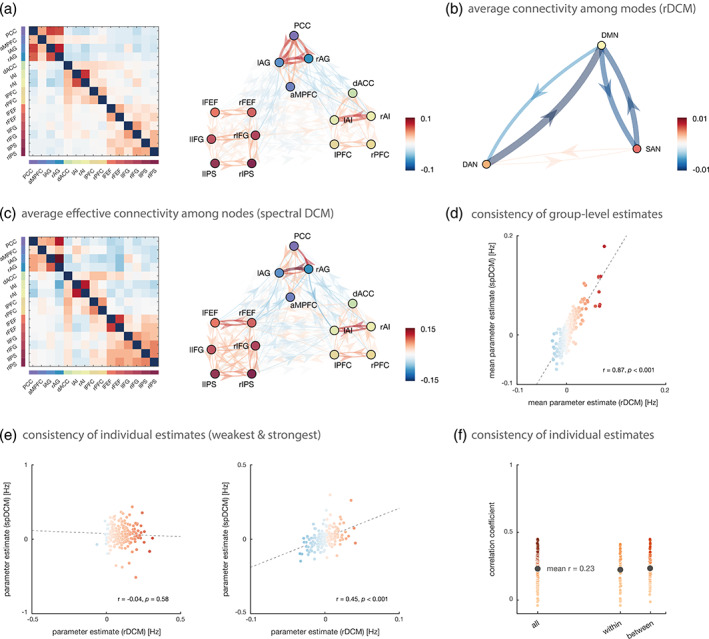
"Resting-state" functional magnetic resonance imaging (rs-fMRI) is widely used to study brain connectivity. So far, researchers have been restricted to measures of functional connectivity that are computationally efficient but undirected, or to effective connectivity estimates that are directed but limited to small networks. Here, we show that a method recently developed for task-fMRI-regression dynamic causal modeling (rDCM)-extends to rs-fMRI and offers both directional estimates and scalability to whole-brain networks. First, simulations demonstrate that rDCM faithfully recovers parameter values over a wide range of signal-to-noise ratios and repetition times. Second, we test construct validity of rDCM in relation to an established model of effective connectivity, spectral DCM. Using rs-fMRI data from nearly 200 healthy participants, rDCM produces biologically plausible results consistent with estimates by spectral DCM. Importantly, rDCM is computationally highly efficient, reconstructing whole-brain networks (>200 areas) within minutes on standard hardware. This opens promising new avenues for connectomics.
静息态功能磁共振成像(rs-fMRI)被广泛用于研究大脑连接。到目前为止,研究人员一直局限于计算效率高但无方向的功能连接测量,或者限于小网络的有效连接估计。在这里,我们展示了一种最近为任务 fMRI-回归动态因果建模(rDCM)开发的方法,它扩展到 rs-fMRI 并提供了方向估计和对全脑网络的可扩展性。首先,模拟表明 rDCM 在广泛的信噪比和重复时间范围内忠实地恢复参数值。其次,我们根据有效的连接的一个既定模型检验 rDCM 的构造有效性,光谱 DCM。使用近 200 名健康参与者的 rs-fMRI 数据,rDCM 产生了与光谱 DCM 估计一致的生物学上合理的结果。重要的是,rDCM 在计算上非常高效,在标准硬件上几分钟内重建整个大脑网络(>200 个区域)。这为连接组学开辟了有前途的新途径。