Pless Evlyn, Hopperstad Kristen A, Ledesma Nicholas, Dixon Daniel, Henke Jennifer A, Powell Jeffrey R
Department of Ecology and Evolutionary Biology Environmental Science Center Yale University New Haven Connecticut USA.
Department of Entomology and Plant Pathology North Carolina State University Raleigh North Carolina USA.
Ecol Evol. 2020 Aug 19;10(18):9588-9599. doi: 10.1002/ece3.6661. eCollection 2020 Sep.
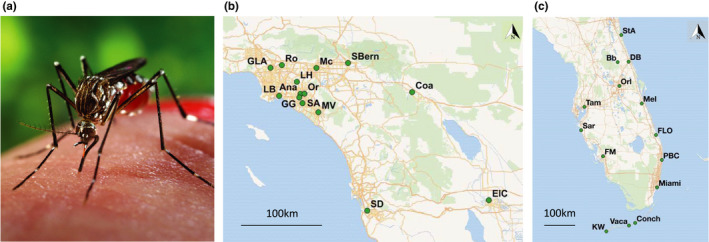
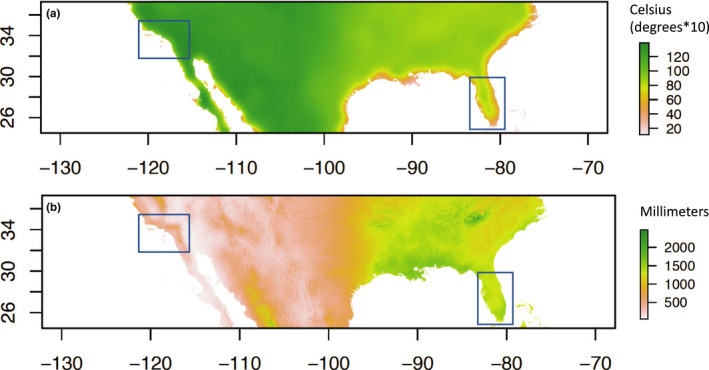
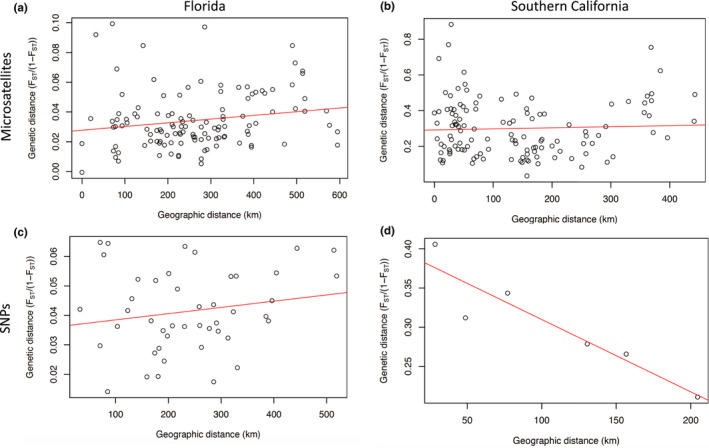
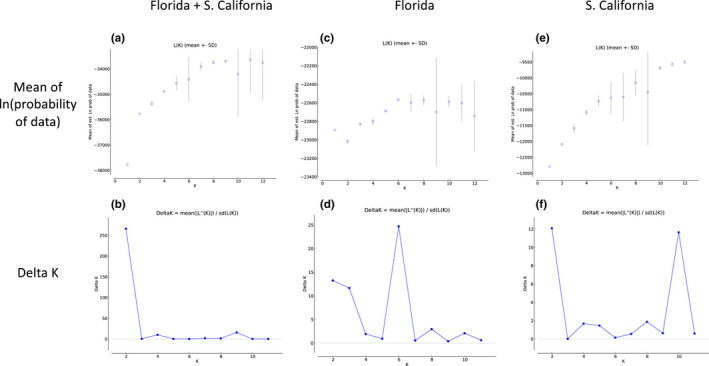
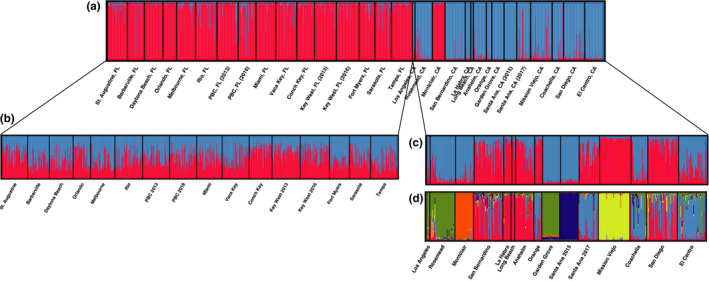
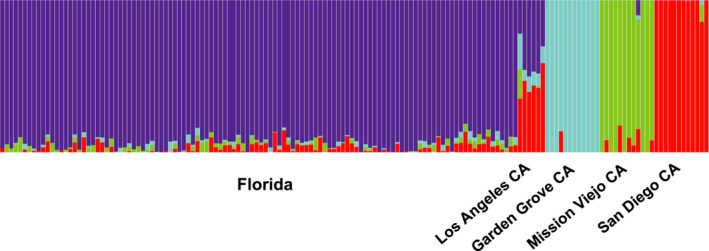
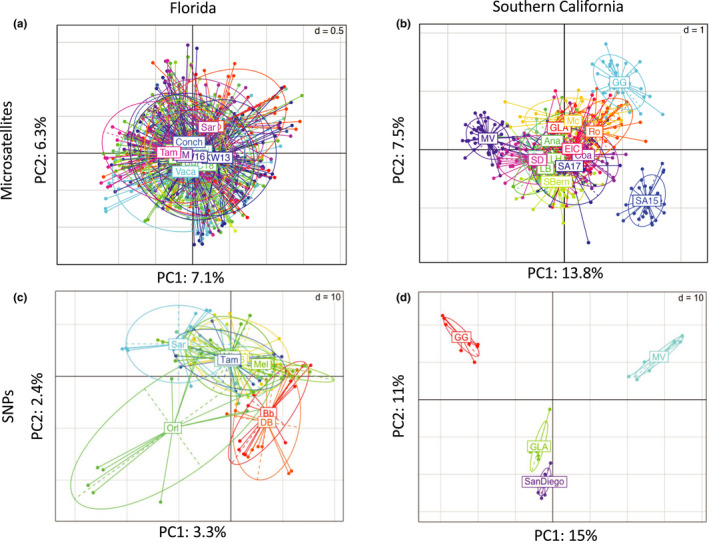
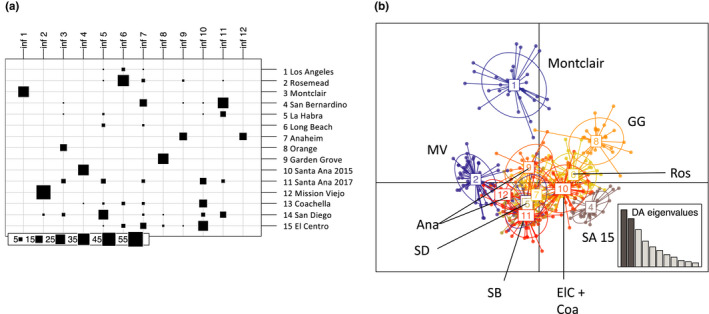
The genetic diversity and structure of invasive species are affected by the time since invasion, but it is not well understood how. We compare likely the oldest populations of in continental North America with some of the newest to illuminate the range of genetic diversity and structure that can be found within the invasive range of this important disease vector. populations in Florida have probably persisted since the 1600-1700s, while populations in southern California derive from new invasions that occurred in the last 10 years. For this comparison, we genotyped 1,193 individuals from 28 sites at 12 highly variable microsatellites and a subset of these individuals at 23,961 single nucleotide polymorphisms (SNPs). This is the largest sample analyzed for genetic structure for either region, and it doubles the number of southern California populations previously analyzed. As predicted, the older populations (Florida) showed fewer indicators of recent founder effect and bottlenecks; in particular, these populations have dramatically higher genetic diversity and lower genetic structure. Geographic distance and driving distance were not good predictors of genetic distance in either region, especially southern California. Additionally, southern California had higher levels of genetic differentiation than any comparably sized documented region throughout the worldwide distribution of the species. Although population age and demographic history are likely driving these differences, differences in climate and transportation practices could also play a role.
入侵物种的遗传多样性和结构受入侵后的时间影响,但具体方式尚不清楚。我们比较了北美大陆可能最古老的种群和一些最新的种群,以阐明在这种重要疾病媒介的入侵范围内可能发现的遗传多样性和结构范围。佛罗里达州的种群可能自17世纪至18世纪以来一直存在,而南加州的种群则源自过去10年发生的新入侵事件。为了进行这种比较,我们对来自28个地点的1193个个体在12个高度可变的微卫星位点进行了基因分型,并对其中一部分个体在23961个单核苷酸多态性(SNP)位点进行了基因分型。这是对这两个地区遗传结构分析的最大样本,并且使之前分析的南加州种群数量增加了一倍。正如预测的那样,较古老的种群(佛罗里达州)显示出较少的近期奠基者效应和瓶颈迹象;特别是,这些种群具有显著更高的遗传多样性和更低的遗传结构。在这两个地区,地理距离和行车距离都不是遗传距离的良好预测指标,尤其是在南加州。此外,在该物种全球分布范围内,南加州的遗传分化水平高于任何规模相当的记录地区。尽管种群年龄和人口历史可能是造成这些差异的原因,但气候和运输方式的差异也可能起到一定作用。