Davis Edward T, Pagkalos Joseph, Kopjar Branko
Royal Orthopaedic Hospital NHS Foundation Trust, Birmingham, UK.
Institute of Inflammation and Ageing, University of Birmingham, Birmingham, UK.
Bone Joint Res. 2020 Sep 20;9(9):563-571. doi: 10.1302/2046-3758.99.BJR-2020-0135.R1. eCollection 2020 Sep.
To investigate the effect of polyethylene manufacturing characteristics and irradiation dose on the survival of cemented and reverse hybrid total hip arthroplasties (THAs).
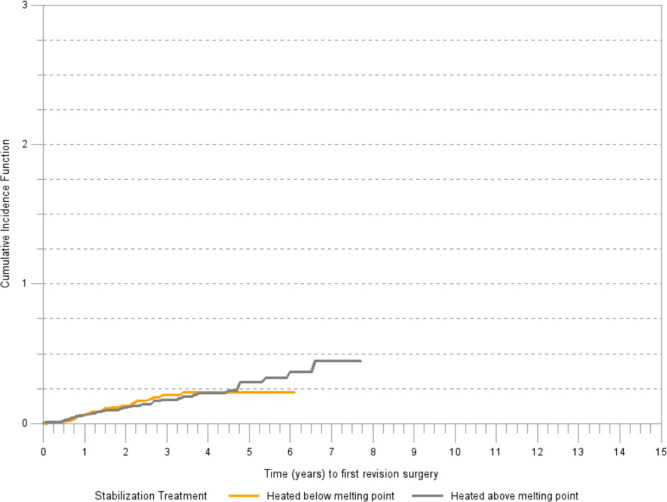
In this registry study, data from the National Joint Registry of England, Wales, Northern Ireland and the Isle of Man (NJR) were linked with manufacturing data supplied by manufacturers. The primary endpoint was revision of any component. Cox proportional hazard regression was a primary analytic approach adjusting for competing risk of death, patient characteristics, head composition, and stem fixation.
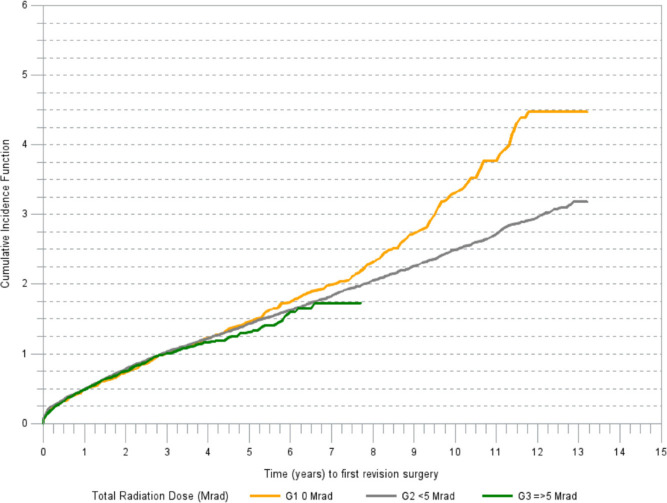
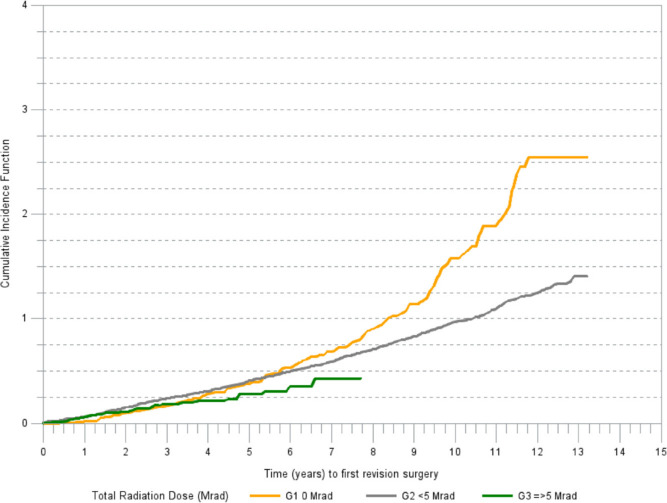
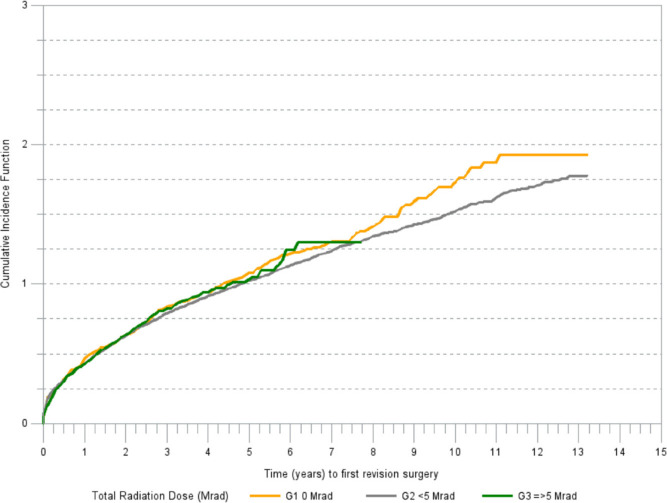
A total of 290,770 primary THAs were successfully linked with manufacturing characteristics. Overall 4,708 revisions were analyzed, 1,260 of which were due to aseptic loosening. Total radiation dose was identified as a risk factor and included in the Cox model. For statistical modelling of aseptic loosening, THAs were grouped into three categories: G1 (no radiation); G2 ( > 0 to < 5 Mrad); and G3 ( ≥ 5 Mrad). G1 had the worst survivorship. The Cox regression hazard ratio for revision due to aseptic loosening for G2 was 0.7 (95% confidence interval (CI) 0.58 to 0.83), and for G3 0.4 (95% CI 0.30 to 0.53). Male sex and uncemented stem fixation were associated with higher risk of revision and ceramic heads with lower risk.
Polyethylene irradiation was associated with reduced risk of revision for aseptic loosening. Radiation doses of ≥ 5 Mrad were associated with a further reduction in risk.Cite this article: 2020;9(9):563-571.
研究聚乙烯制造特性和辐照剂量对骨水泥型和反向混合型全髋关节置换术(THA)生存率的影响。
在这项注册研究中,将来自英格兰、威尔士、北爱尔兰和马恩岛国家关节注册中心(NJR)的数据与制造商提供的制造数据相联系。主要终点是任何部件的翻修。Cox比例风险回归是主要的分析方法,对死亡的竞争风险、患者特征、股骨头成分和股骨柄固定进行了调整。
总共290,770例初次全髋关节置换术成功与制造特性相联系。共分析了4708例翻修病例,其中1260例是由于无菌性松动。总辐射剂量被确定为一个风险因素并纳入Cox模型。对于无菌性松动的统计建模,全髋关节置换术被分为三类:G1(无辐射);G2(>0至<5兆拉德);G3(≥5兆拉德)。G1的生存率最差。G2因无菌性松动导致翻修的Cox回归风险比为0.7(95%置信区间(CI)0.58至0.83),G3为0.4(95%CI 0.30至0.53)。男性和非骨水泥型股骨柄固定与较高的翻修风险相关,而陶瓷股骨头与较低风险相关。
聚乙烯辐照与无菌性松动翻修风险降低相关。≥5兆拉德的辐射剂量与风险进一步降低相关。引用本文:2020;9(9):563 - 571。