Netherlands Institute of Ecology, Wageningen, The Netherlands.
Department of Ecological Sciences - Animal Ecology, Vrije Universiteit Amsterdam, Amsterdam, The Netherlands.
Glob Chang Biol. 2020 Dec;26(12):6685-6701. doi: 10.1111/gcb.15377. Epub 2020 Oct 16.
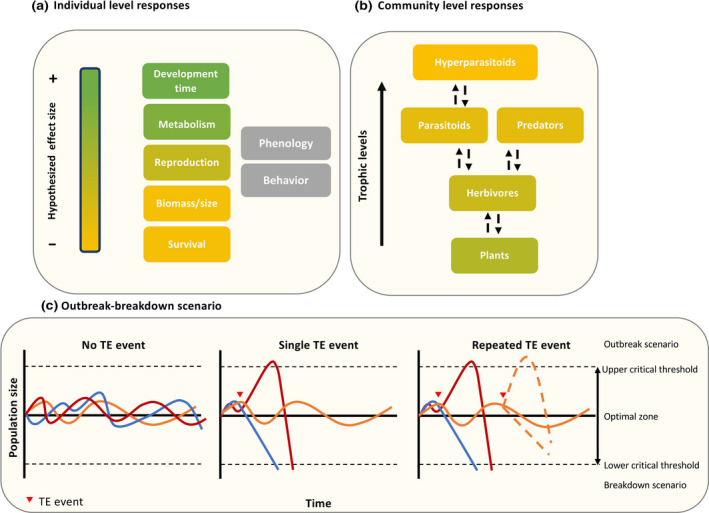
Insects are among the most diverse and widespread animals across the biosphere and are well-known for their contributions to ecosystem functioning and services. Recent increases in the frequency and magnitude of climatic extremes (CE), in particular temperature extremes (TE) owing to anthropogenic climate change, are exposing insect populations and communities to unprecedented stresses. However, a major problem in understanding insect responses to TE is that they are still highly unpredictable both spatially and temporally, which reduces frequency- or direction-dependent selective responses by insects. Moreover, how species interactions and community structure may change in response to stresses imposed by TE is still poorly understood. Here we provide an overview of how terrestrial insects respond to TE by integrating their organismal physiology, multitrophic, and community-level interactions, and building that up to explore scenarios for population explosions and crashes that have ecosystem-level consequences. We argue that TE can push insect herbivores and their natural enemies to and even beyond their adaptive limits, which may differ among species intimately involved in trophic interactions, leading to phenological disruptions and the structural reorganization of food webs. TE may ultimately lead to outbreak-breakdown cycles in insect communities with detrimental consequences for ecosystem functioning and resilience. Lastly, we suggest new research lines that will help achieve a better understanding of insect and community responses to a wide range of CE.
昆虫在整个生物界中是最多样化和分布最广泛的动物之一,它们为生态系统的功能和服务做出了重要贡献。由于人为气候变化导致气候极端事件(CE),特别是温度极端事件(TE)的频率和强度不断增加,正在使昆虫种群和群落面临前所未有的压力。然而,理解昆虫对 TE 响应的一个主要问题是,它们在空间和时间上仍然高度不可预测,这降低了昆虫的频率或方向依赖性选择响应。此外,物种相互作用和群落结构如何响应 TE 施加的压力仍然知之甚少。在这里,我们通过整合陆地昆虫的个体生理学、多营养级和群落水平的相互作用,概述了它们对 TE 的响应,并构建了这些内容,以探索对生态系统产生后果的种群爆发和崩溃的情景。我们认为,TE 可以推动昆虫食草动物及其天敌达到甚至超过它们的适应极限,而这种极限在密切参与营养相互作用的物种之间可能有所不同,从而导致物候中断和食物网的结构重组。TE 最终可能导致昆虫群落的爆发-崩溃循环,对生态系统的功能和恢复力产生不利影响。最后,我们提出了新的研究方向,将有助于更好地理解昆虫和群落对各种 CE 的响应。