Department of Chemistry, Ben Gurion University of the Negev, Beer Sheva, 84105, Israel.
Institute for Macromolecular Chemistry, Freiburg Institute for Advanced Studies, Albert Ludwigs University of Freiburg, 79104, Freiburg, Germany.
Angew Chem Int Ed Engl. 2021 Feb 23;60(9):4512-4517. doi: 10.1002/anie.202012837. Epub 2020 Nov 10.
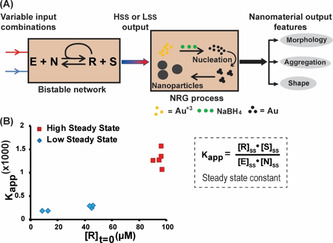
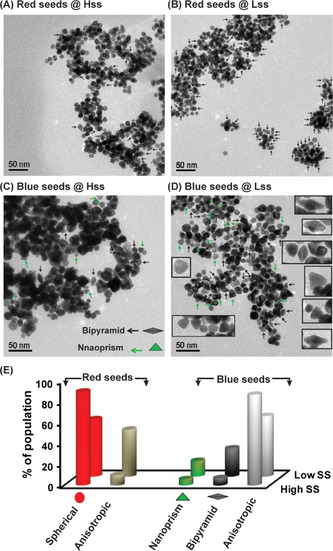
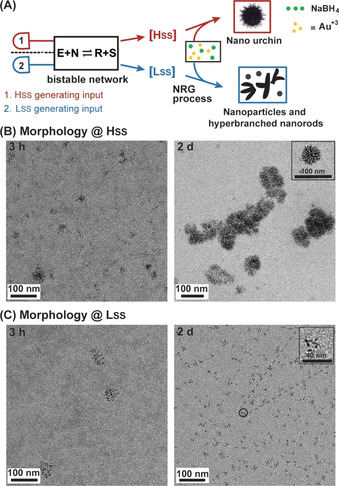
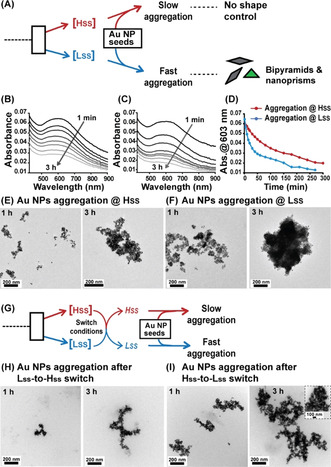
Living cells exploit bistable and oscillatory behaviors as memory mechanisms, facilitating the integration of transient stimuli into sustained molecular responses that control downstream functions. Synthetic bistable networks have also been studied as memory entities, but have rarely been utilized to control orthogonal functions in coupled dynamic systems. We herein present a new cascade pathway, for which we have exploited a well-characterized switchable peptide-based replicating network, operating far from equilibrium, that yields two alternative steady-state outputs, which in turn serve as the input signals for consecutive processes that regulate various features of Au nanoparticle shape and assembly. This study further sheds light on how bridging together the fields of systems chemistry and nanotechnology may open up new opportunities for the dynamically controlled design of functional materials.
活细胞利用双稳态和振荡行为作为记忆机制,将瞬时刺激整合到持续的分子反应中,从而控制下游功能。合成双稳态网络也被研究为记忆实体,但很少被用于控制耦合动态系统中的正交功能。在此,我们提出了一种新的级联途径,我们利用了一种经过充分表征的基于可切换肽的复制网络,该网络在远离平衡的状态下工作,产生两种替代的稳态输出,作为输入信号,用于连续的过程,调节金纳米颗粒形状和组装的各种特征。这项研究进一步揭示了如何将系统化学和纳米技术领域联系起来,为功能材料的动态控制设计开辟新的机会。