Department of Pharmacology and Physiology, University of Rochester Medical Center, USA.
Department of Anesthesiology and Perioperative Medicine, University of Rochester Medical Center, USA.
Redox Biol. 2020 Oct;37:101733. doi: 10.1016/j.redox.2020.101733. Epub 2020 Sep 19.
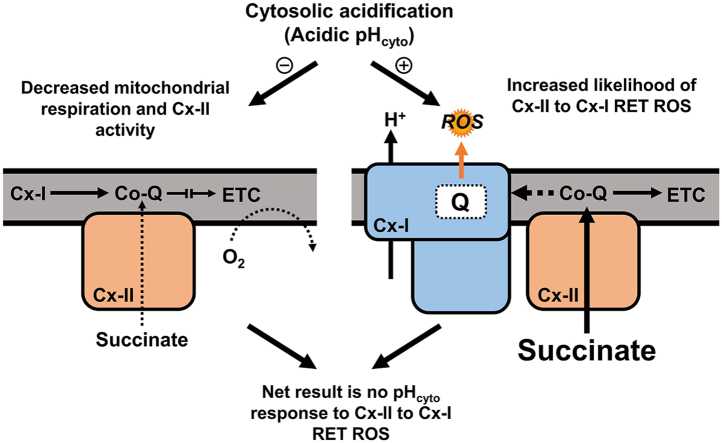
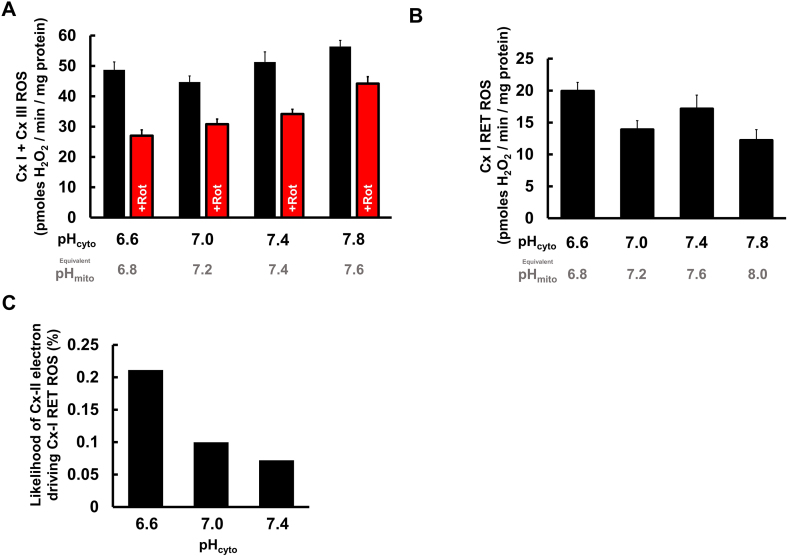
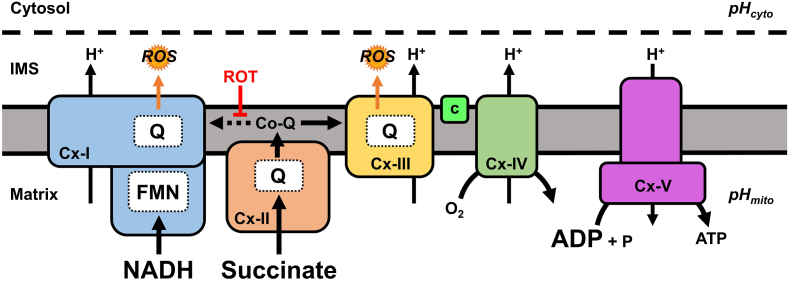
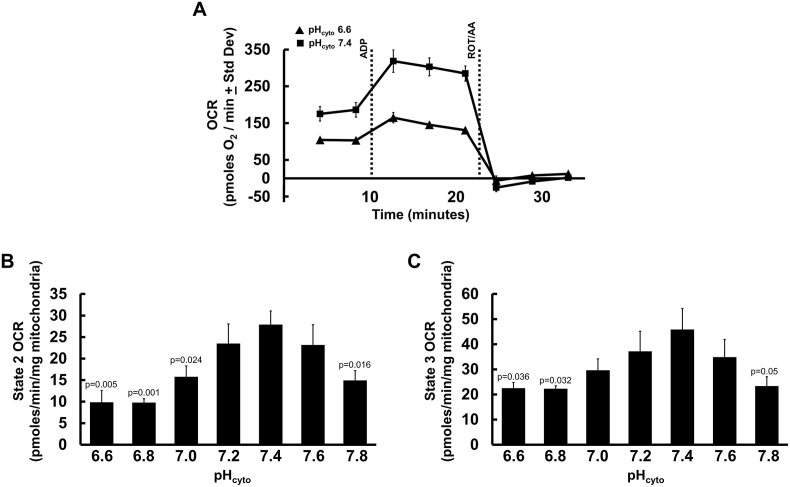
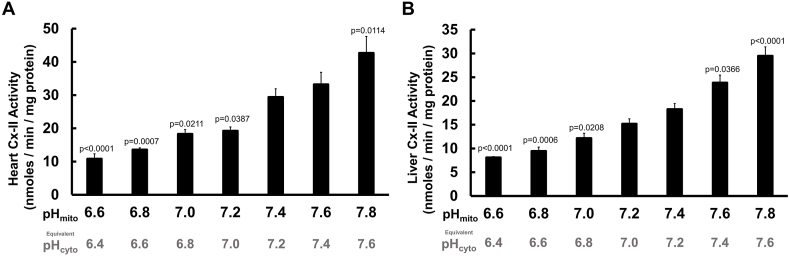
Generation of mitochondrial reactive oxygen species (ROS) is an important process in triggering cellular necrosis and tissue infarction during ischemia-reperfusion (IR) injury. Ischemia results in accumulation of the metabolite succinate. Rapid oxidation of this succinate by mitochondrial complex II (Cx-II) during reperfusion reduces the co-enzyme Q (Co-Q) pool, thereby driving electrons backward into complex-I (Cx-I), a process known as reverse electron transport (RET), which is thought to be a major source of ROS. During ischemia, enhanced glycolysis results in an acidic cellular pH at the onset of reperfusion. While the process of RsET within Cx-I is known to be enhanced by a high mitochondrial trans-membrane ΔpH, the impact of pH itself on the integrated process of Cx-II to Cx-I RET has not been fully studied. Using isolated mouse heart and liver mitochondria under conditions which mimic the onset of reperfusion (i.e., high [ADP]), we show that mitochondrial respiration (state 2 and state 3) as well as isolated Cx-II activity are impaired at acidic pH, whereas the overall generation of ROS by Cx-II to Cx-I RET was insensitive to pH. Together these data indicate that the acceleration of Cx-I RET ROS by ΔpH appears to be cancelled out by the impact of pH on the source of electrons, i.e. Cx-II. Implications for the role of Cx-II to Cx-I RET derived ROS in IR injury are discussed.
线粒体活性氧(ROS)的产生是缺血再灌注(IR)损伤过程中触发细胞坏死和组织梗死的重要过程。缺血导致代谢物琥珀酸的积累。在再灌注期间,线粒体复合物 II(Cx-II)的快速氧化使辅酶 Q(Co-Q)池减少,从而使电子向后驱动到复合物-I(Cx-I),这一过程称为反向电子传递(RET),被认为是 ROS 的主要来源。在缺血期间,糖酵解的增强导致再灌注开始时细胞内 pH 值呈酸性。虽然已知 Cx-I 内的 RsET 过程会被线粒体跨膜 ΔpH 值的升高增强,但 pH 值本身对 Cx-II 到 Cx-I RET 的综合过程的影响尚未得到充分研究。在模拟再灌注开始条件下(即高 [ADP])使用分离的小鼠心脏和肝脏线粒体,我们表明在酸性 pH 值下,线粒体呼吸(状态 2 和状态 3)以及分离的 Cx-II 活性受损,而 Cx-II 到 Cx-I RET 的总体 ROS 生成对 pH 不敏感。这些数据表明,ΔpH 值对 Cx-I RET ROS 的加速似乎被电子源(即 Cx-II)对 pH 值的影响抵消。讨论了 Cx-II 到 Cx-I RET 衍生的 ROS 在 IR 损伤中的作用。