Vanvitelli Cardiology Unit, Monaldi Hospital, 80131 Naples, Italy.
Sbarro Institute for Cancer Research and Molecular Medicine, Center of Biotechnology, College of Science and Technology, Temple University, Philadelphia, PA 19122, USA.
Int J Mol Sci. 2023 Jan 6;24(2):1086. doi: 10.3390/ijms24021086.
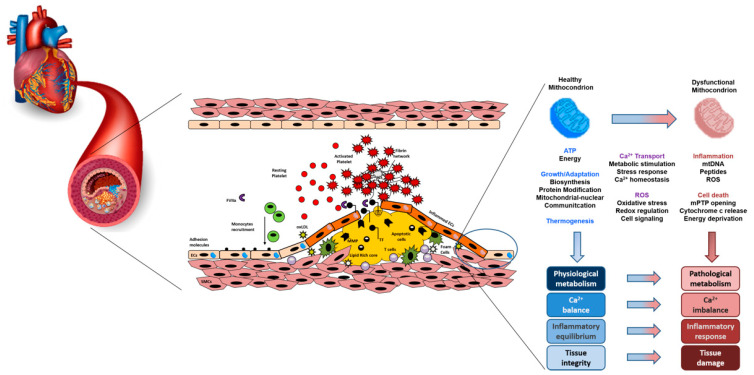
Atherosclerosis is a multifactorial inflammatory pathology that involves metabolic processes. Improvements in therapy have drastically reduced the prognosis of cardiovascular disease. Nevertheless, a significant residual risk is still relevant, and is related to unmet therapeutic targets. Endothelial dysfunction and lipid infiltration are the primary causes of atherosclerotic plaque progression. In this contest, mitochondrial dysfunction can affect arterial wall cells, in particular macrophages, smooth muscle cells, lymphocytes, and endothelial cells, causing an increase in reactive oxygen species (ROS), leading to oxidative stress, chronic inflammation, and intracellular lipid deposition. The detection and characterization of mitochondrial DNA (mtDNA) is crucial for assessing mitochondrial defects and should be considered the goal for new future therapeutic interventions. In this review, we will focus on a new idea, based on the analysis of data from many research groups, namely the link between mitochondrial impairment and endothelial dysfunction and, in particular, its effect on atherosclerosis and aging. Therefore, we discuss known and novel mitochondria-targeting therapies in the contest of atherosclerosis.
动脉粥样硬化是一种涉及代谢过程的多因素炎症性病理。治疗方法的改进极大地降低了心血管疾病的预后。然而,仍然存在显著的残余风险,这与未满足的治疗靶点有关。内皮功能障碍和脂质浸润是动脉粥样硬化斑块进展的主要原因。在这种情况下,线粒体功能障碍会影响动脉壁细胞,特别是巨噬细胞、平滑肌细胞、淋巴细胞和内皮细胞,导致活性氧(ROS)增加,导致氧化应激、慢性炎症和细胞内脂质沉积。线粒体 DNA(mtDNA)的检测和特征对于评估线粒体缺陷至关重要,应被视为新的未来治疗干预的目标。在这篇综述中,我们将重点关注一个新的想法,即基于许多研究小组的数据分析,即线粒体损伤与内皮功能障碍之间的联系,特别是其对动脉粥样硬化和衰老的影响。因此,我们将讨论动脉粥样硬化背景下已知和新型的靶向线粒体治疗方法。