Institute of Bioinformatics and Applied Biotechnology, Electronic City Phase 1, Bangalore 560100, India.
Manipal Academy of Higher Education, Manipal 576104, India.
Molecules. 2020 Sep 30;25(19):4499. doi: 10.3390/molecules25194499.
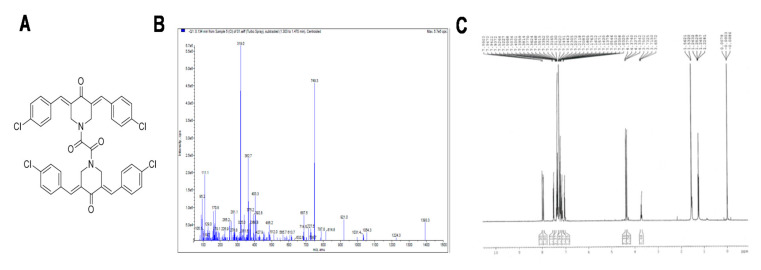
Curcumin is known for its anticancer and migrastatic activity in various cancers, including breast cancer. Newer curcumin derivatives are being explored to overcome limitations of curcumin like low bioavailability, stability, and side effects due to its higher dose. In this study, the synthesis of ST09, a novel curcumin derivative, and its antiproliferative, cytotoxic, and migrastatic properties have been explored both in vitro and in vivo.
After ST09 synthesis, anticancer activity was studied by performing standard cytotoxicity assays namely, lactate dehydrogenase (LDH) release assay, 3-(4, 5-dimethylthiazol-2-yl)-2-5-diphenyletrazolium bromide (MTT), and trypan blue exclusion assay. Annexin-FITC, cell cycle analysis using flow cytometry, and Western blotting were performed to elucidate cell death mechanisms. The effect on the inhibition of cell migration was studied by transwell migration assay. An EAC (Ehrlich Ascites carcinoma) induced mouse tumor model was used to study the effect of ST09 on tumor regression. Drug toxicity was measured using aspartate aminotransferase (AST), alanine aminotransferase (ALT), blood urea nitrogen (BUN), and flow-cytometry based lymphocyte count. Histological analysis was performed for assessment of any tissue injury post ST09 treatment.
ST09 shows an approximate 100-fold higher potency than curcumin, its parent compound, on breast tumor cell lines MCF-7 and MDA-MB231. ST09 arrests the cell cycle in a cell type-specific manner and induces an intrinsic apoptotic pathway both in vitro and in vivo. ST09 inhibits migration by downregulating matrix metalloprotease 1,2 (MMP1,2) and Vimentin. In vivo, ST09 administration led to decreased tumor volume in a mouse allograft model by boosting immunity with no significant drug toxicity.
ST09 exhibits antiproliferative and cytotoxic activity at nanomolar concentrations. It induces cell death by activation of the intrinsic pathway of apoptosis both in vitro and in vivo. It also inhibits migration and invasion. This study provides evidence that ST09 can potentially be developed as a novel antitumor drug candidate for highly metastatic and aggressive breast cancer.
姜黄素具有多种抗癌作用,包括抑制乳腺癌转移。为克服姜黄素生物利用度低、稳定性差和副作用大等缺点,人们正在探索新型姜黄素衍生物。本研究合成了新型姜黄素衍生物 ST09,并研究了其在体外和体内的抗增殖、细胞毒性和迁移抑制作用。
ST09 合成后,通过进行标准细胞毒性测定,即乳酸脱氢酶(LDH)释放测定、3-(4,5-二甲基噻唑-2-基)-2,5-二苯基四氮唑溴盐(MTT)和台盼蓝排斥试验,研究其抗癌活性。采用 Annexin-FITC、流式细胞术细胞周期分析和 Western blot 研究细胞死亡机制。通过 Transwell 迁移试验研究对细胞迁移抑制的影响。采用 EAC(艾氏腹水癌)诱导的小鼠肿瘤模型研究 ST09 对肿瘤消退的影响。采用天冬氨酸氨基转移酶(AST)、丙氨酸氨基转移酶(ALT)、血尿素氮(BUN)和基于流式细胞术的淋巴细胞计数来测量药物毒性。对 ST09 治疗后的组织损伤进行组织学分析。
与母体化合物姜黄素相比,ST09 对 MCF-7 和 MDA-MB231 两种乳腺癌细胞系的效力约高 100 倍。ST09 以细胞类型特异性的方式使细胞周期停滞,并在体外和体内诱导内在的凋亡途径。ST09 通过下调基质金属蛋白酶 1、2(MMP1、2)和波形蛋白抑制迁移。在体内,ST09 通过增强免疫抑制肿瘤体积,在小鼠同种异体移植模型中无明显的药物毒性。
ST09 在纳摩尔浓度下表现出抗增殖和细胞毒性活性。它通过激活体外和体内的内在凋亡途径诱导细胞死亡。它还抑制迁移和侵袭。这项研究为 ST09 可能作为一种新型抗肿瘤药物候选物用于治疗高度转移和侵袭性乳腺癌提供了证据。