Department of Ophthalmology, CHA Bundang Medical Center, CHA University, Seongnam, Republic of Korea.
Department of Ophthalmology, Kim's Eye Hospital, Konyang University College of Medicine, Seoul, Republic of Korea.
Stem Cell Res Ther. 2020 Oct 2;11(1):428. doi: 10.1186/s13287-020-01943-w.
Stem cell transplantation has been proposed as an alternative treatment for intractable optic nerve disorders characterized by irrecoverable loss of cells. Mesenchymal stem cells, with varying tissue regeneration and recovery capabilities, are being considered for potential cell therapies. To overcome the limitations of cell therapy, we isolated exosomes from human placenta-derived mesenchymal stem cells (hPMSCs) and investigated their therapeutic effects in R28 cells (retinal precursor cells) exposed to CoCl.
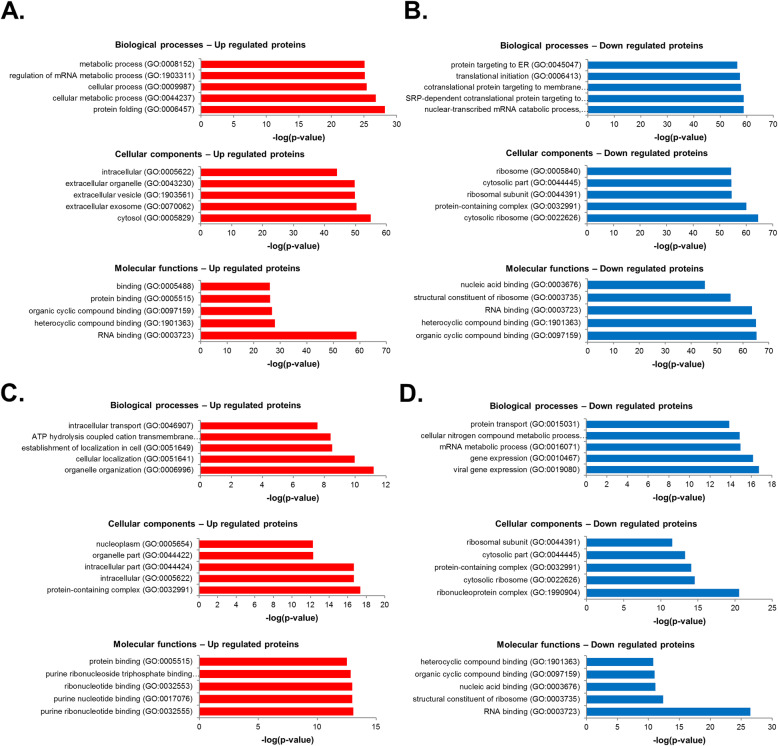
After 9 h of exposure to CoCl, the hypoxic damaged R28 cells were divided into the non-treatment group (CoCl + R28 cells) and treatment group (CoCl + R28 cells treated with exosome). Immunoblot analysis was performed for Pcna, Hif-1α, Vegf, Vimentin, Thy-1, Gap43, Ermn, Neuroflament, Wnt3a, β-catenin, phospo-GSK3β, Lef-1, UBA2, Skp1, βTrcp, and ubiquitin. The proteomes of each group were analyzed by liquid chromatography/tandem mass (LC-MS/MS) spectrometry. Differentially expressed proteins (DEPs) were detected by label-free quantification, and the interactions of the proteins were examined through signal transduction pathway and gene ontology analysis.
We observed that exosome could significantly recover proliferation damaged by CoCl treatment. In addition, the treatment group presented the decreased expression of Hif-1α protein (P < 0.05) and increased expression of proliferation marker, Pcna, and nerve regeneration-related factors such as Vimentin, Thy-1, and Neuroflament (P < 0.05) compared with the non-treatment group. In total, 200 DEPs were identified in the non-treatment group and treatment group (fold change ≥ 2, p < 0.05). Catenin and ubiquitin systems (UBA2, UBE2E3, UBE2I) were found in both the DEP lists of downregulated proteins from the non-treatment group and upregulated proteins from the treatment group. The mRNA expressions of ubiquitin systems were significantly decreased under hypoxic conditions. Moreover, UBA2 and Wnt/β-catenin protein were associated with the rescue of the hypoxic damaged R28 cells. Using a siRNA system, we could find it out that hPMSC exosomes could not repair altered expressions of target proteins by CoCl in lacking UBA2 R28 cells.
This study reported that hypoxic damaged expression of regeneration markers in R28 cells was significantly recovered by hPMSC exosomes. We could also demonstrate that UBA2 played a key role in activating the Wnt/β-catenin signaling pathway during protection of hypoxic damaged R28 cells, induced by hPMSC exosomes.
干细胞移植已被提议作为一种治疗方法,用于治疗以细胞不可恢复性丧失为特征的难治性视神经疾病。间充质干细胞具有不同的组织再生和恢复能力,被认为具有潜在的细胞治疗作用。为了克服细胞治疗的局限性,我们从人胎盘间充质干细胞(hPMSC)中分离出外泌体,并研究了它们在暴露于 CoCl 的 R28 细胞(视网膜前体细胞)中的治疗效果。
在 CoCl 暴露 9 小时后,将缺氧损伤的 R28 细胞分为未处理组(CoCl+R28 细胞)和处理组(用外泌体处理的 CoCl+R28 细胞)。用免疫印迹法分析 Pcna、Hif-1α、Vegf、Vimentin、Thy-1、Gap43、Ermn、Neuroflament、Wnt3a、β-catenin、磷酸化-GSK3β、Lef-1、UBA2、Skp1、βTrcp 和泛素。通过液相色谱/串联质谱(LC-MS/MS)对每个组的蛋白质组进行分析。通过无标记定量检测差异表达蛋白(DEPs),并通过信号转导通路和基因本体分析检测蛋白质之间的相互作用。
我们观察到外泌体可以显著恢复 CoCl 处理引起的增殖损伤。此外,与未处理组相比,处理组 Hif-1α 蛋白的表达降低(P<0.05),增殖标志物 Pcna 以及神经再生相关因子 Vimentin、Thy-1 和 Neuroflament 的表达增加(P<0.05)。在未处理组和处理组中,共鉴定出 200 个差异表达蛋白(fold change≥2,p<0.05)。在下调蛋白的 DEP 列表和上调蛋白的 DEP 列表中均发现了连接蛋白和泛素系统(UBA2、UBE2E3、UBE2I)。在缺氧条件下,泛素系统的 mRNA 表达明显下降。此外,UBA2 和 Wnt/β-catenin 蛋白与缺氧损伤的 R28 细胞的修复有关。使用 siRNA 系统,我们发现 hPMSC 外泌体不能在缺乏 UBA2 的 R28 细胞中修复 CoCl 引起的靶蛋白表达改变。
本研究报告 hPMSC 外泌体可显著恢复 R28 细胞中缺氧损伤再生标志物的表达。我们还证明了 UBA2 在 hPMSC 外泌体诱导的缺氧损伤的 R28 细胞保护中,在激活 Wnt/β-catenin 信号通路中发挥关键作用。