Morris Brian J, Krieger John N
School of Medical Sciences, University of Sydney, Sydney, New South Wales, Australia.
Department of Urology, University of Washington School of Medicine, Seattle, WA, USA.
Sex Med. 2020 Dec;8(4):577-598. doi: 10.1016/j.esxm.2020.08.011. Epub 2020 Sep 30.
Active debate concerns whether male circumcision (MC) affects sexual function, penile sensation, or sexual pleasure.
To perform a systematic review examining the effect of MC on these parameters.
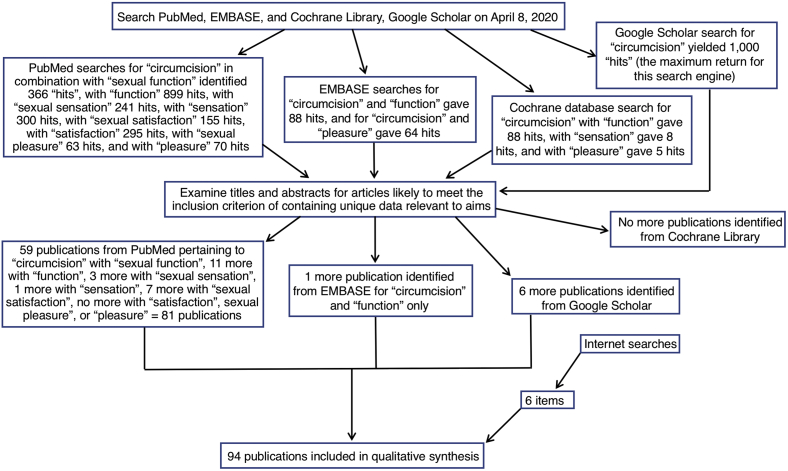
PRISMA-compliant searches of PubMed, EMBASE, the Cochrane Library, and Google Scholar were performed, with "circumcision" used together with appropriate search terms. Articles meeting the inclusion criteria were rated for quality by the Scottish Intercollegiate Guidelines Network system.
Evidence rated by quality.
Searches identified 46 publications containing original data, as well as 4 systematic reviews (2 with meta-analyses), plus 29 critiques of various studies and 15 author replies, which together comprised a total of 94 publications. There was overall consistency in conclusions arising from high- and moderate-quality survey data in randomized clinical trials, systematic reviews and meta-analyses, physiological studies, large longitudinal studies, and cohort studies in diverse populations. Those studies found MC has no or minimal adverse effect on sexual function, sensation, or pleasure, with some finding improvements. A consensus from physiological and histological studies was that the glans and underside of the shaft, not the foreskin, are involved in neurological pathways mediating erogenous sensation. In contrast to the higher quality evidence, data supporting adverse effects of MC on function, sensation, or pleasure were found to be of low quality, as explained in critiques of those studies.
The consensus of the highest quality literature is that MC has minimal or no adverse effect, and in some studies, it has benefits on sexual functions, sensation, satisfaction, and pleasure for males circumcised neonatally or in adulthood. Morris BJ, Krieger JN. The Contrasting Evidence Concerning the Effect of Male Circumcision on Sexual Function, Sensation, and Pleasure: A Systematic Review. Sex Med 2020;8:577-598.
关于男性包皮环切术(MC)是否会影响性功能、阴茎感觉或性快感,目前存在激烈争论。
进行一项系统综述,研究MC对这些参数的影响。
按照PRISMA标准对PubMed、EMBASE、Cochrane图书馆和谷歌学术进行检索,搜索词为“包皮环切术”及相关术语。符合纳入标准的文章由苏格兰跨学院指南网络系统进行质量评级。
按质量评级的证据。
检索共找到46篇包含原始数据的出版物,以及4篇系统综述(其中2篇有荟萃分析),另外还有29篇对各项研究的评论和15篇作者回复,总计94篇出版物。随机临床试验、系统综述和荟萃分析、生理学研究、大型纵向研究以及不同人群的队列研究中,高质量和中等质量调查数据得出的结论总体一致。这些研究发现,MC对性功能、感觉或快感没有或只有极小的不良影响,有些研究还发现有改善作用。生理学和组织学研究的共识是,介导性敏感的神经通路涉及龟头和阴茎体腹侧,而非包皮。与高质量证据形成对比的是,那些支持MC对功能、感觉或快感有不良影响的数据质量较低,这些研究的评论中对此进行了解释。
最高质量文献的共识是,MC对性功能、感觉、满意度和快感的不良影响极小或没有,在一些研究中,对于新生儿期或成年期接受包皮环切术的男性,MC还有益处。莫里斯·BJ,克里格·JN。关于男性包皮环切术对性功能、感觉和快感影响的对比证据:一项系统综述。性医学2020;8:577 - 598。