Périard Julien D, Pyne David B, Bishop David J, Wallett Alice, Girard Olivier
Research Institute for Sport and Exercise, University of Canberra, Canberra, ACT, Australia.
Institute of Health and Sport, Victoria University, Melbourne, VIC, Australia.
Front Physiol. 2020 Aug 27;11:1023. doi: 10.3389/fphys.2020.01023. eCollection 2020.
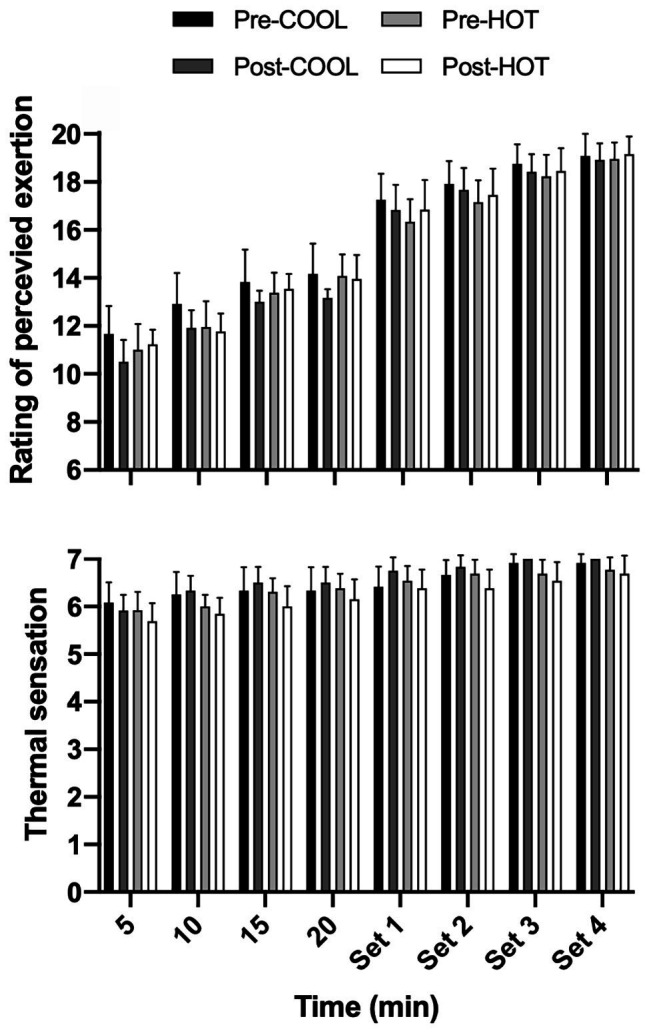
This study compared the performance and physiological adaptations of short-term repeated-sprint training in HOT [40°C and 40% relative humidity (RH)] and COOL (20°C and 40% RH) conditions in team-sport athletes. Twenty-five trained males completed five training sessions of 60 min over 7 days in HOT ( = 13) or COOL ( = 12) conditions, consisting of a submaximal warm-up and four sets of maximal sprints. Before and after the intervention, intermittent shuttle running performance was assessed in cool and repeated-sprint ability in hot conditions; the latter preceded and followed by neuromuscular function testing. During the repeated-sprint training sessions, skin (8.4°C) and core (0.17°C) temperatures were higher in HOT than COOL ( < 0.05) conditions. Shuttle running distance increased after both interventions ( < 0.001), with a non-significant ( = 0.131) but larger effect in HOT (315 m, = 1.18) than COOL (207 m, = 0.51) conditions. Mean (7%, < 0.001) and peak (5%, < 0.05) power during repeated-sprinting increased following both interventions, whereas peak twitch force before the repeated-sprint assessment was 10% lower after the interventions ( = 0.001). Heart rate during the repeated-sprint warm-up was reduced (6 beats.min) following both interventions ( < 0.01). Rectal temperature was ~0.14°C lower throughout the repeated-sprint assessment after the interventions ( < 0.001), with larger effects in HOT than COOL during the warm-up ( = 0.082; = -0.53 vs. = -0.15) and repeated-sprints ( = 0.081; = -0.54 vs. = -0.02). Skin temperature ( = 0.004, = -1.11) and thermal sensation ( = 0.015, = -0.93) were lower during the repeated-sprints after training in HOT than COOL. Sweat rate increased (0.2 L.h) only after training in HOT ( = 0.027; = 0.72). The intensive nature of brief repeated-sprint training induces similar improvements in repeated-sprint cycling ability in hot conditions and intermittent running performance in cool conditions, along with analogous physiological adaptations, irrespective of the environmental conditions in which training is undertaken.
本研究比较了在炎热[40°C和40%相对湿度(RH)]和凉爽(20°C和40%RH)条件下,团队运动运动员进行短期重复冲刺训练的表现和生理适应性。25名受过训练的男性在7天内于炎热(n = 13)或凉爽(n = 12)条件下完成了5次60分钟的训练课程,包括次最大强度热身和四组最大冲刺。在干预前后,在凉爽环境中评估间歇性穿梭跑表现,在炎热条件下评估重复冲刺能力;后者在神经肌肉功能测试之前和之后进行。在重复冲刺训练期间,炎热条件下的皮肤(约8.4°C)和核心(约0.17°C)温度高于凉爽条件(P < 0.05)。两种干预后穿梭跑距离均增加(P < 0.001),炎热条件下(315米,ES = 1.18)的增加虽不显著(P = 0.131)但比凉爽条件下(207米,ES = 0.51)更大。重复冲刺期间的平均功率(约7%,P < 0.001)和峰值功率(约5%,P < 0.05)在两种干预后均增加,而重复冲刺评估前的峰值抽搐力在干预后降低了约10%(P = 0.001)。两种干预后重复冲刺热身期间的心率均降低(约6次·分钟)(P < 0.01)。干预后在整个重复冲刺评估期间直肠温度降低了约0.14°C(P < 0.001),在热身期间炎热条件下的影响比凉爽条件下更大(P = 0.082;ES = -0.53 vs. ES = -0.15),在重复冲刺期间也是如此(P = 0.081;ES = -0.54 vs. ES = -0.02)。炎热条件下训练后重复冲刺期间的皮肤温度(P = 0.004,ES = -1.11)和热感觉(P = 0.015,ES = -0.93)低于凉爽条件。仅在炎热条件下训练后出汗率增加(0.2升·小时)(P = 0.027;ES = 0.72)。短暂重复冲刺训练的高强度性质在炎热条件下的重复冲刺骑行能力和凉爽条件下的间歇性跑步表现方面诱导了类似的改善,以及类似的生理适应性,无论训练所处的环境条件如何。