Department of Human Movement Sciences, Faculty of Behavioural and Movement Sciences, Amsterdam Movement Sciences, Vrije Universiteit Amsterdam, Van der Boechorststraat 7, 1081BT, Amsterdam, The Netherlands.
Athlete Health and Performance Research Centre, Aspetar Orthopaedic and Sports Medicine Hospital, Doha, Qatar.
Sports Med. 2018 Feb;48(2):409-430. doi: 10.1007/s40279-017-0808-x.
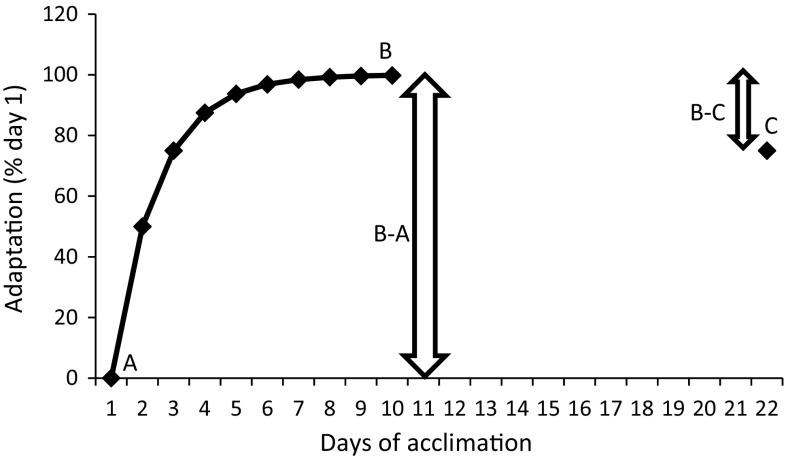
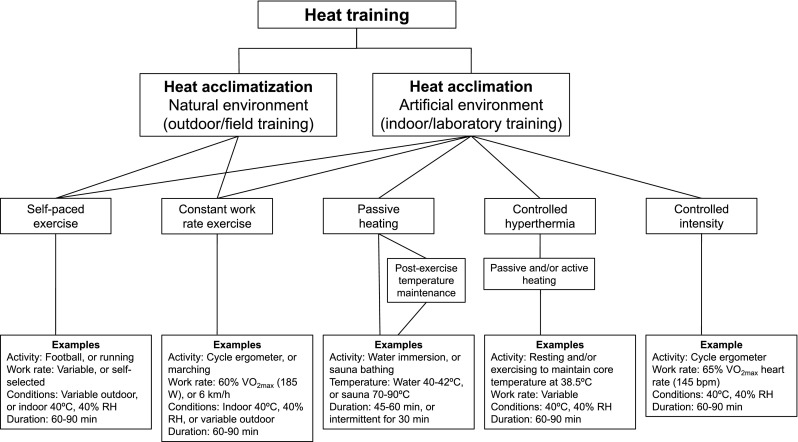
Although the acquisition of heat acclimation (HA) is well-documented, less is known about HA decay (HAD) and heat re-acclimation (HRA). The available literature suggests 1 day of HA is lost following 2 days of HAD. Understanding this relationship has the potential to impact upon the manner in which athletes prepare for major competitions, as a HA regimen may be disruptive during final preparations (i.e., taper).
The aim of this systematic review and meta-analysis was to determine the rate of HAD and HRA in three of the main physiological adaptations occurring during HA: heart rate (HR), core temperature (T ), and sweat rate (SR).
Data for this systematic review were retrieved from Scopus and critical review of the cited references.
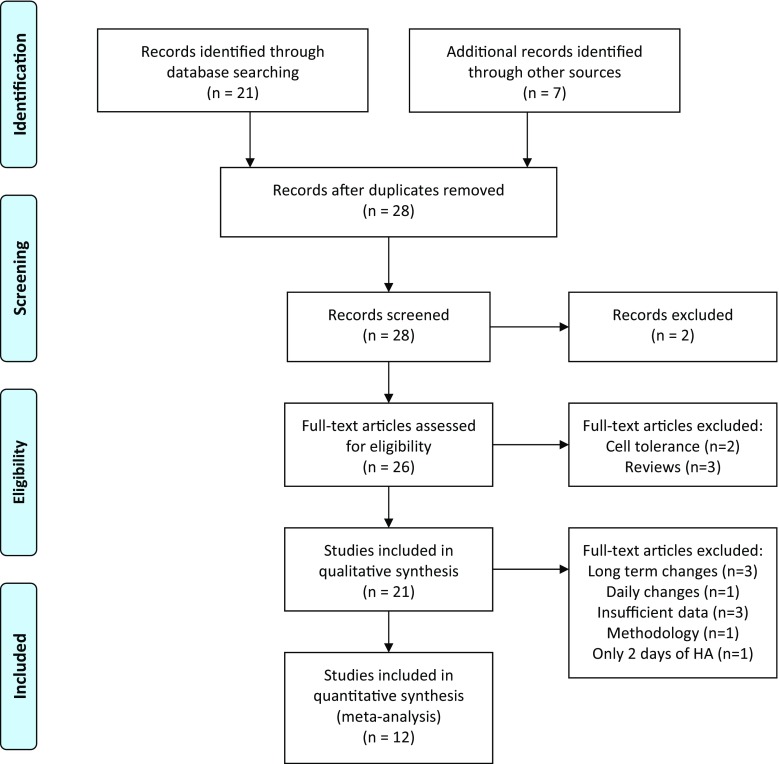
Studies were included when they met the following criteria: HA, HAD, and HRA (when available) were quantified in terms of exposure and duration. HA had to be for at least 5 days and HAD for at least 7 days for longitudinal studies. HR, T , or SR had to be monitored in human participants.
The level of bias in each study was assessed using the McMaster critical review form. Multiple linear regression techniques were used to determine the dependency of HAD in HR, T , and SR from the number of HA and HAD days, daily HA exposure duration, and intensity.
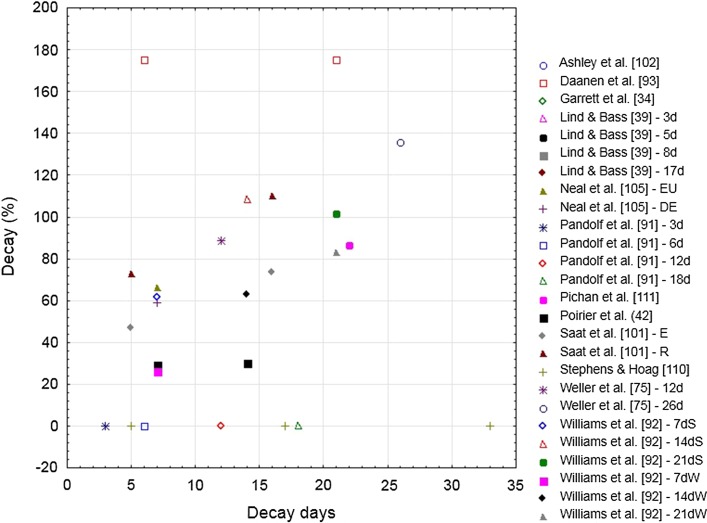
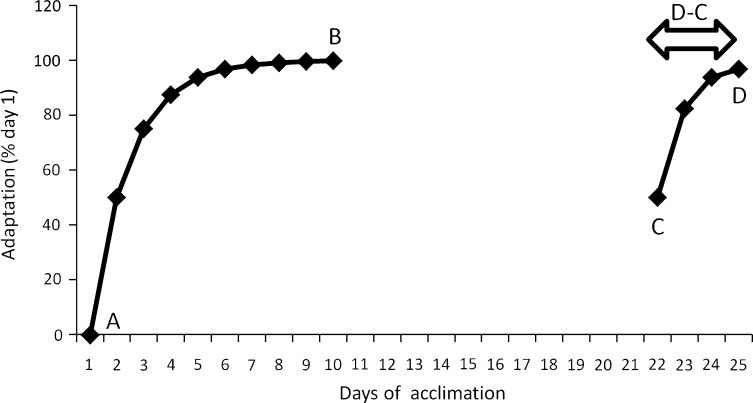
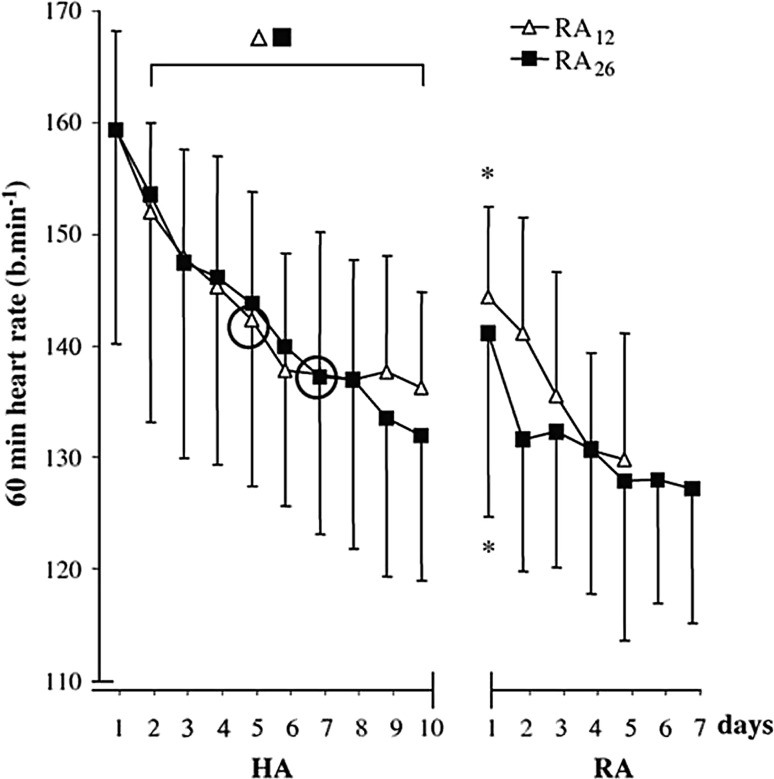
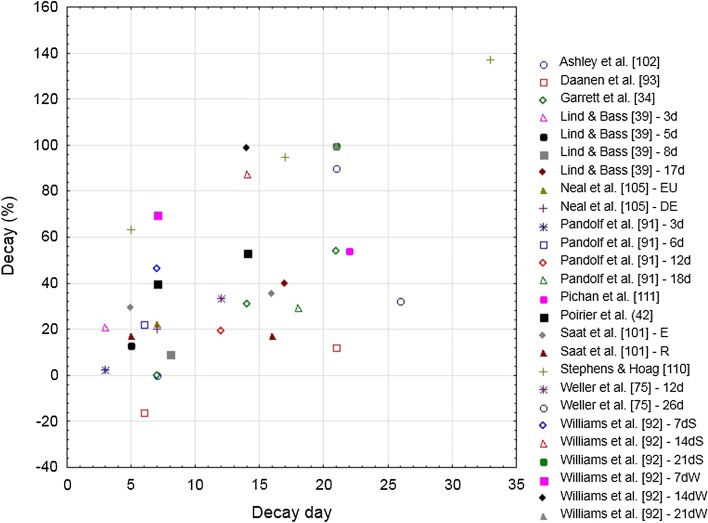
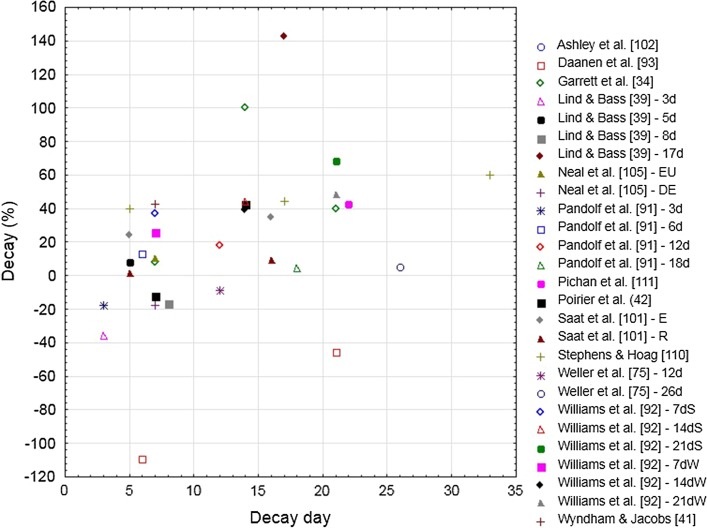
Twelve studies met the criteria and were systematically reviewed. HAD was quantified as a percentage change relative to HA (0% = HA, 100% = unacclimated state). Adaptations in end-exercise HR decreased by 2.3% (P < 0.001) for every day of HAD. For end-exercise T , the daily decrease was 2.6% (P < 0.01). The adaptations in T during the HA period were more sustainable when the daily heat exposure duration was increased and heat exposure intensity decreased. The decay in SR was not related to the number of decay days. However, protracted HA-regimens seem to induce longer-lasting adaptations in SR. High heat exposure intensities during HA seem to evoke more sustained adaptations in SR than lower heat stress. Only eight studies investigated HRA. HRA was 8-12 times faster than HAD at inducing adaptations in HR and T , but no differences could be established for SR.
The available studies lacked standardization in the protocols for HA and HAD.
HAD and HRA differ considerably between physiological systems. Five or more HA days are sufficient to cause adaptations in HR and T ; however, extending the daily heat exposure duration enhances T adaptations. For every decay day, ~ 2.5% of the adaptations in HR and T are lost. For SR, longer HA periods are related to better adaptations. High heat exposure intensities seem beneficial for adaptations in SR, but not in T . HRA induces adaptations in HR and T at a faster rate than HA. HRA may thus provide a practical and less disruptive means of maintaining and optimizing HA prior to competition.
尽管热适应(HA)的获得已得到充分证明,但人们对 HA 衰减(HAD)和热再适应(HRA)的了解较少。现有文献表明,进行 2 天 HAD 后,HA 会损失 1 天。了解这种关系有可能会影响运动员为重大比赛做准备的方式,因为 HA 方案在最后的准备阶段(即 taper 阶段)可能会受到干扰。
本系统评价和荟萃分析的目的是确定 HA 过程中发生的三种主要生理适应中的 HAD 和 HRA 速率:心率(HR)、核心温度(T)和出汗率(SR)。
本系统评价的数据来自 Scopus,并对引用文献进行了批判性回顾。
当研究符合以下标准时,将其纳入:HA、HAD 和 HRA(如果可用)根据暴露和持续时间进行量化。纵向研究的 HA 时间必须至少为 5 天,HAD 时间至少为 7 天。必须在人类参与者中监测 HR、T或 SR。
使用麦克马斯特批判性评论表评估每项研究的偏倚程度。多元线性回归技术用于确定 HAD 在 HR、T和 SR 中的依赖性,包括 HA 和 HAD 天数、每日 HA 暴露持续时间和强度。
共有 12 项研究符合标准并进行了系统评价。HAD 被量化为相对于 HA 的百分比变化(0%=HA,100%=未适应状态)。在 HAD 期间,HR 的适应性降低了 2.3%(P<0.001),每增加一天 HAD。对于运动结束时的 T,每日下降 2.6%(P<0.01)。当每日热暴露持续时间增加和热暴露强度降低时,T 期间的适应更持久。SR 的衰减与衰减天数无关。然而,长期的 HA 方案似乎会诱导 SR 更长时间的适应。HA 期间的高热暴露强度似乎比低热应激更能引起 SR 的持续适应。只有八项研究调查了 HRA。HRA 诱导 HR 和 T 适应性的速度比 HAD 快 8-12 倍,但在 SR 方面没有差异。
现有研究在 HA 和 HAD 的方案方面缺乏标准化。
HAD 和 HRA 在生理系统之间存在很大差异。进行 5 天或更长时间的 HA 即可引起 HR 和 T 的适应性变化;然而,延长每日热暴露持续时间可增强 T 的适应性。每增加一天 HAD,HR 和 T 的适应性就会丧失约 2.5%。对于 SR,较长的 HA 时间与更好的适应性有关。高热暴露强度似乎有利于 SR 的适应,但对 T 没有影响。HRA 以比 HA 更快的速度诱导 HR 和 T 的适应性。因此,HRA 可能是在比赛前保持和优化 HA 的一种实用且干扰较小的方法。