Tan Xunmin, Huang Yu, Chai Tingjia, Zhao Xiaoli, Li Yifan, Wu Jing, Zhang Hanping, Duan Jiajia, Liang Weiwei, Yin Bangmin, Cheng Ke, Yu Gang, Zheng Peng, Xie Peng
Department of Neurology, The First Affiliated Hospital of Chongqing Medical University, Chongqing, China.
NHC Key Laboratory of Diagnosis and Treatment on Brain Functional Diseases, Chongqing Medical University, Chongqing, China.
Front Microbiol. 2020 Sep 8;11:564579. doi: 10.3389/fmicb.2020.564579. eCollection 2020.
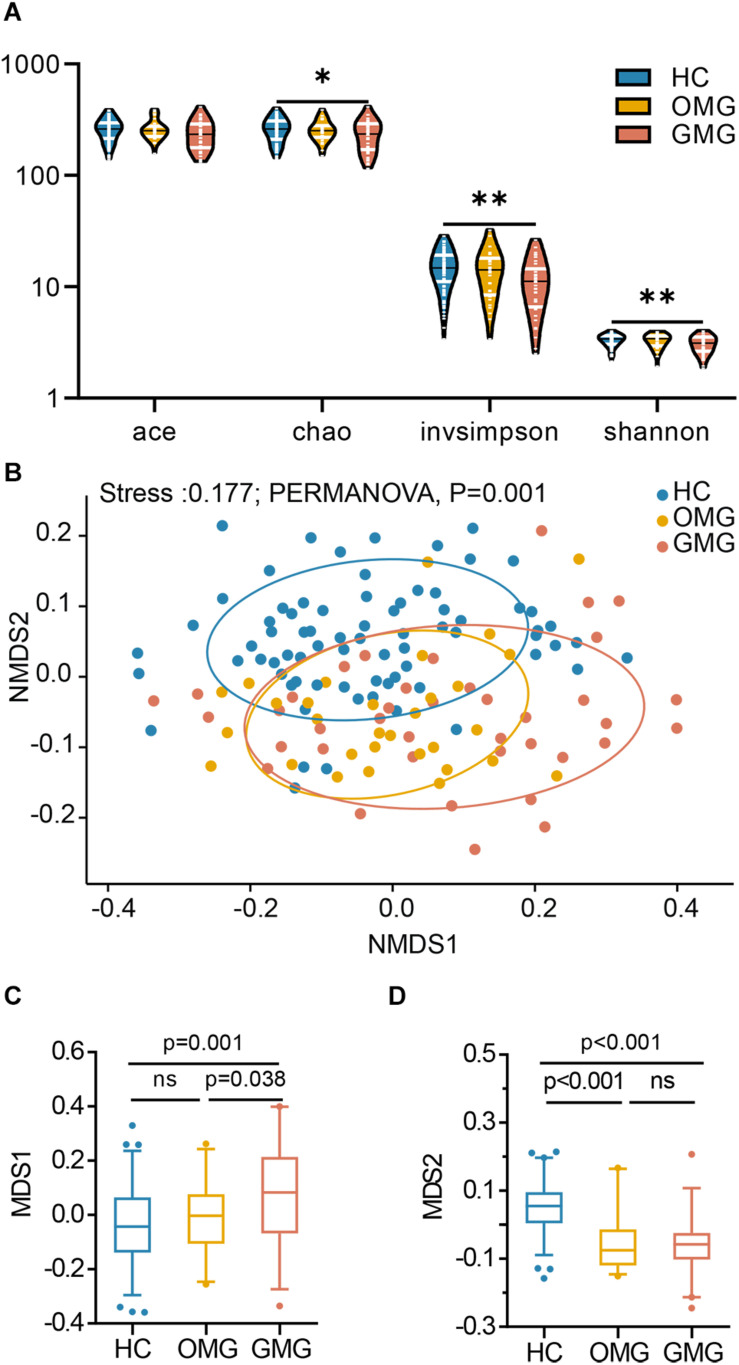
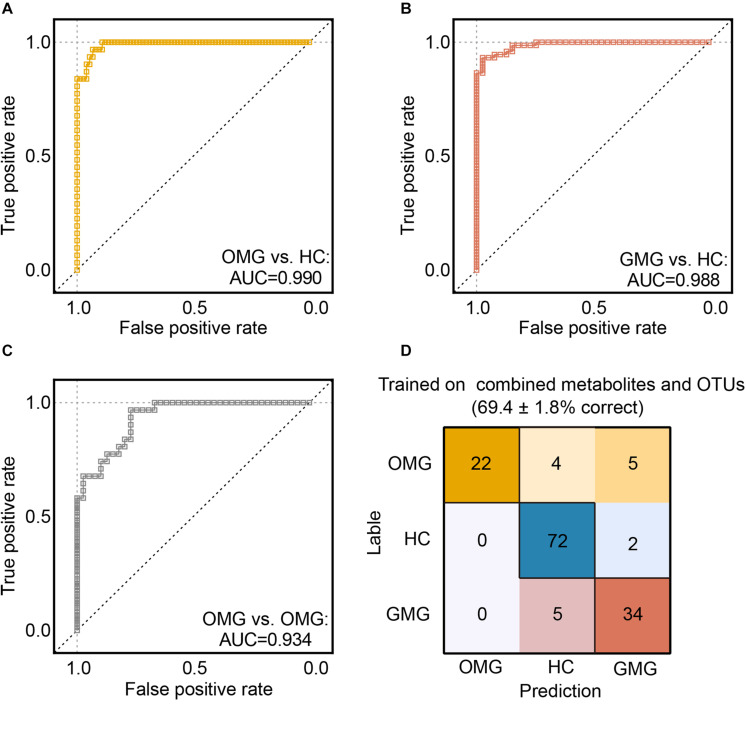
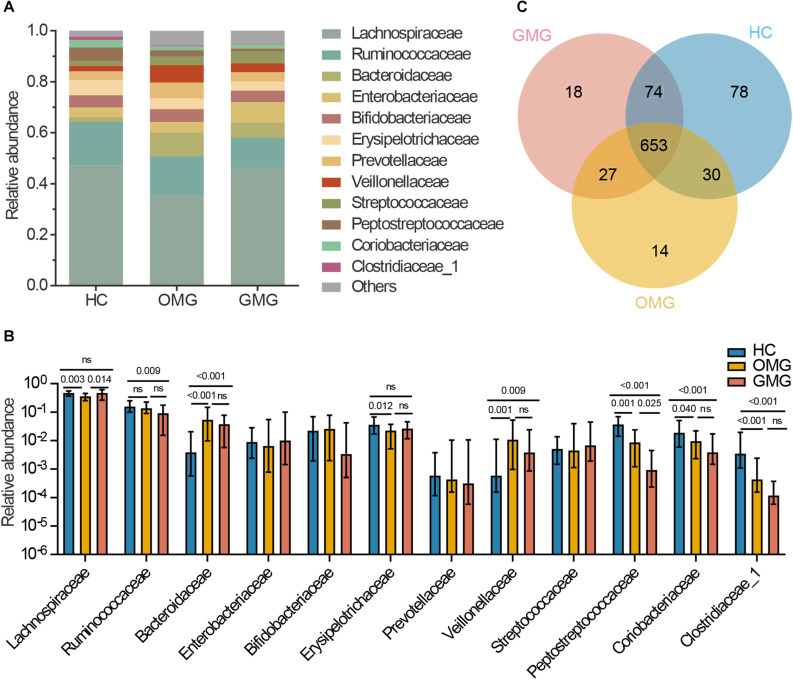
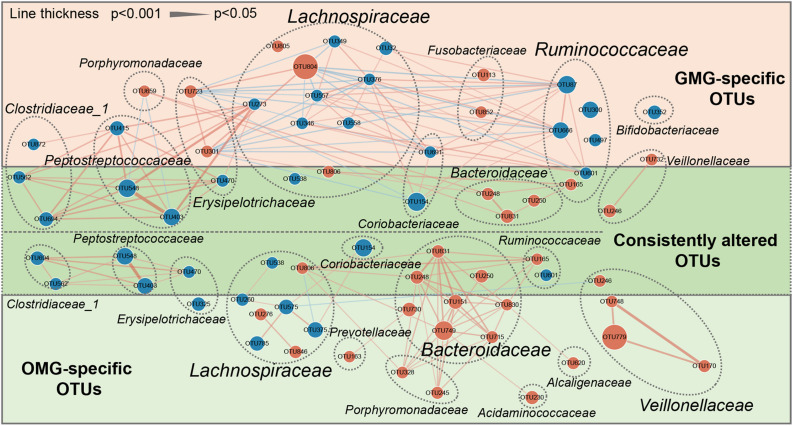
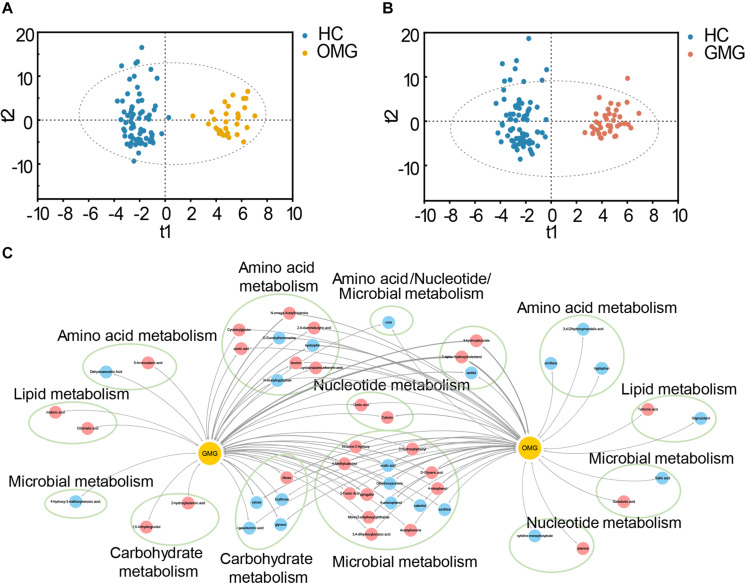
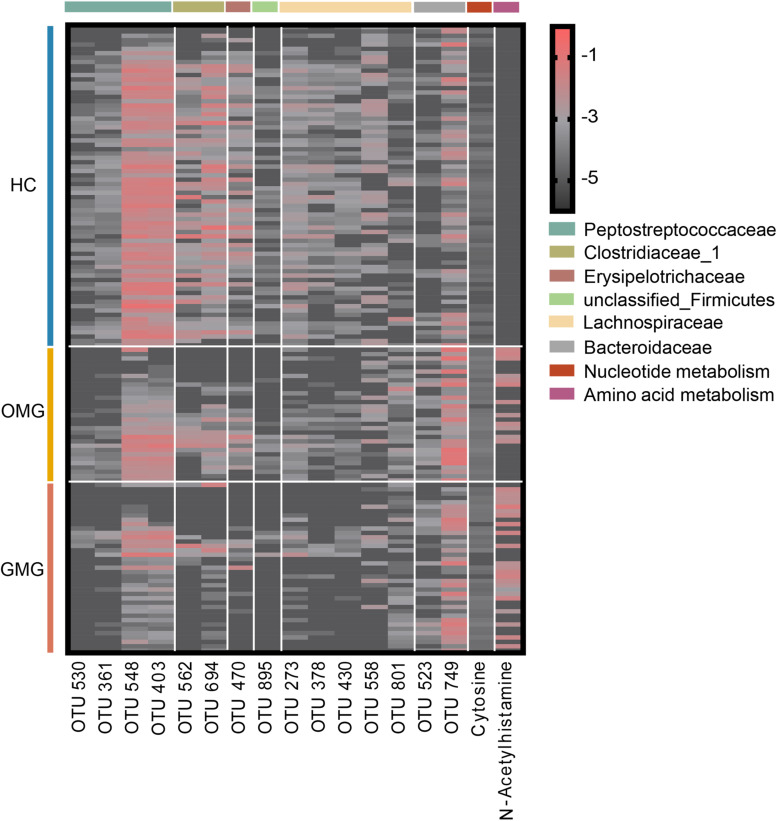
Myasthenia gravis (MG) is a devastating acquired autoimmune disease. Previous studies have observed that disturbances of gut microbiome may attribute to the development of MG through fecal metabolomic signatures in humans. However, whether there were differential gut microbial and fecal metabolomic phenotypes in different subtypes of MG remains unclear. Here, our objective was to explore whether the microbial and metabolic signatures of ocular (OMG) and generalized myasthenia gravis (GMG) were different, and further identify the shared and distinct markers for patients with OMG and GMG. In this study, 16S ribosomal RNA (rRNA) gene sequencing and gas chromatography-mass spectrometry (GC/MS) were performed to capture the microbial and metabolic signatures of OMG and GMG, respectively. Random forest (RF) classifiers was used to identify the discriminative markers for OMG and GMG. Compared with healthy control (HC) group, GMG group, but not OMG group, showed a significant decrease in α-phylogenetic diversity. Both OMG and GMG groups, however, displayed significant gut microbial and metabolic disorders. Totally, we identified 20 OTUs and 9 metabolites specific to OMG group, and 23 OTUs and 7 metabolites specific to GMG group. Moreover, combinatorial biomarkers containing 15 discriminative OTUs and 2 differential metabolites were capable of discriminating OMG and GMG from each other, as well as from HCs, with AUC values ranging from 0.934 to 0.990. In conclusion, different subtypes of MG harbored differential gut microbiota, which generated discriminative fecal metabolism.
重症肌无力(MG)是一种严重的获得性自身免疫性疾病。先前的研究观察到,肠道微生物群的紊乱可能通过人类粪便代谢组学特征导致MG的发生。然而,不同亚型的MG是否存在不同的肠道微生物和粪便代谢组学表型仍不清楚。在此,我们的目的是探讨眼肌型重症肌无力(OMG)和全身型重症肌无力(GMG)的微生物和代谢特征是否不同,并进一步确定OMG和GMG患者的共同和独特标志物。在本研究中,分别进行了16S核糖体RNA(rRNA)基因测序和气相色谱-质谱联用(GC/MS)分析,以获取OMG和GMG的微生物和代谢特征。使用随机森林(RF)分类器来识别OMG和GMG的判别标志物。与健康对照组(HC)相比,GMG组而非OMG组的α-系统发育多样性显著降低。然而,OMG和GMG组均表现出明显的肠道微生物和代谢紊乱。我们总共鉴定出OMG组特有的20个操作分类单元(OTU)和9种代谢物,以及GMG组特有的23个OTU和7种代谢物。此外,包含15个判别性OTU和2种差异代谢物的组合生物标志物能够区分OMG和GMG,以及将它们与HC区分开来,曲线下面积(AUC)值范围为0.934至0.990。总之,MG的不同亚型具有不同的肠道微生物群,这些微生物群产生了有判别力的粪便代谢产物。