Niessner Claudia, Utesch Till, Oriwol Doris, Hanssen-Doose Anke, Schmidt Steffen C E, Woll Alexander, Bös Klaus, Worth Annette
Institute of Sport and Sport Science, Karlsruhe Institute of Technology, Karlsruhe, Germany.
Department of Pedagogical Assessment and Potential Development, Institute of Educational Sciences, University of Münster, Münster, Germany.
Front Public Health. 2020 Sep 11;8:458. doi: 10.3389/fpubh.2020.00458. eCollection 2020.
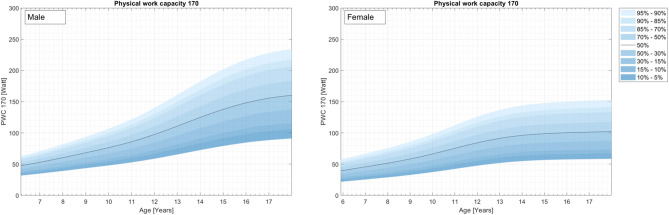
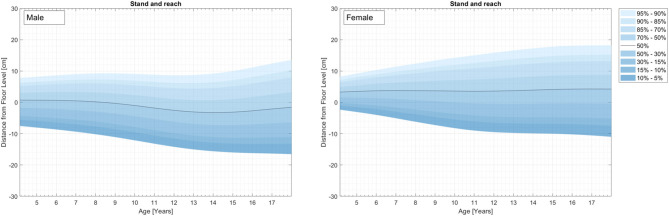
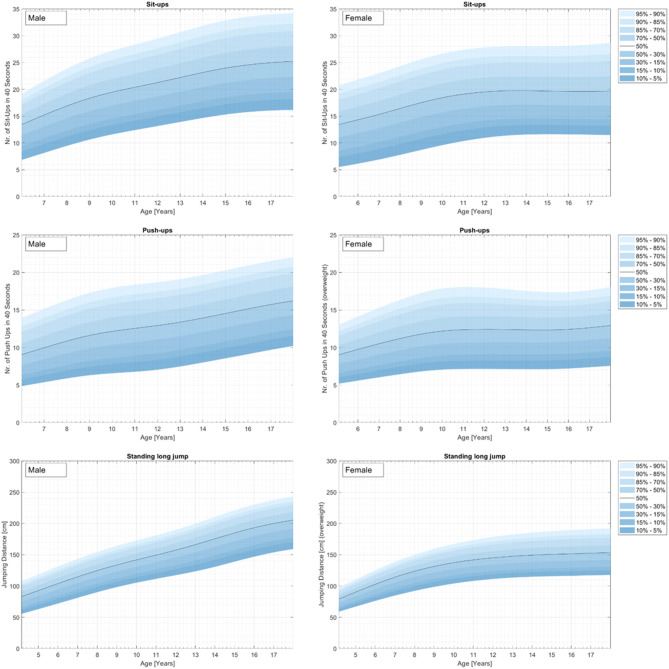
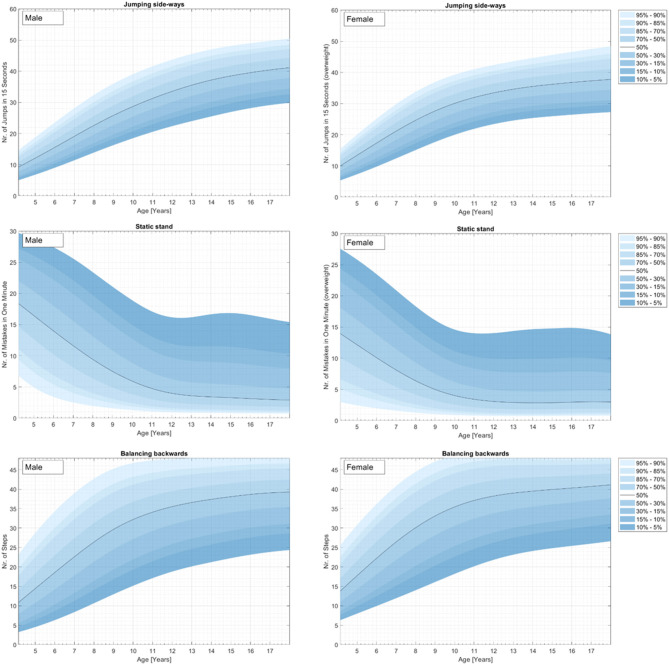
Monitoring of physical fitness in youth is important because physical fitness is a summative indicator of health. From a developmental and preventive perspective, physical fitness levels are relatively stable from childhood to early adulthood. Thus, it is important to monitor physical fitness on a population based level being able to intervene at early stages (1). In order to reliably assess and evaluate the physical fitness of youth, a reliable system of standard values based on representative data is required. The aim of this analysis is to report sex- and age-specific physical fitness percentile curves from childhood to early adulthood in a nationwide sample in Germany. We use data from the nationwide representative Motorik Modul (MoMo) Study in Germany (data collection wave 1: 2009-2012; age: 4-23 years; = 3,742; 50.1% female). Physical fitness was assessed by means of the MoMo test profile covering four dimensions of physical fitness (strength, endurance, coordination, and flexibility) and including eight physical fitness items. Percentile curves were fitted using the LMS transformation method of Cole and Green. Standardized age- and sex-specific physical fitness percentiles were calculated for eight items: ergometric endurance testing, standing long jump, push-ups, sit-ups, jumping side-ways, balancing backwards, static stand, and stand and reach test. The physical fitness curves differ according to gender and the fitness dimension. Physical fitness improvements with age are linear (e.g., max. strength) or curvilinear (e.g., coordination) and have their stagnation points at different times over the course of adolescence. Our results provide for the first time sex- and age-specific physical fitness percentile curves for Germany from 4 to 17 years. Differences in curve-shapes indicating a timed and capacity-specific physical fitness development. Nationwide German physical fitness percentiles can be useful in comparing different populations (e.g., cross-country), reporting secular trends, comparing special groups, and to evaluate physical fitness interventions.
监测青少年的身体素质很重要,因为身体素质是健康的一项综合指标。从发育和预防的角度来看,从童年到成年早期,身体素质水平相对稳定。因此,在基于人群的层面上监测身体素质,以便能够在早期阶段进行干预,这一点很重要(1)。为了可靠地评估和评价青少年的身体素质,需要一个基于代表性数据的可靠标准值系统。本分析的目的是报告德国全国范围内一个样本中从童年到成年早期按性别和年龄划分的身体素质百分位数曲线。我们使用来自德国全国代表性的运动模块(MoMo)研究的数据(数据收集波次1:2009 - 2012年;年龄:4 - 23岁;n = 3742;女性占50.1%)。通过MoMo测试概况评估身体素质,该测试概况涵盖身体素质的四个维度(力量、耐力、协调性和柔韧性),包括八个身体素质项目。使用Cole和Green的LMS转换方法拟合百分位数曲线。针对八个项目计算了标准化的按年龄和性别的身体素质百分位数:测力耐力测试、立定跳远、俯卧撑、仰卧起坐、侧向跳跃、向后平衡、静态站立和站立前伸测试。身体素质曲线因性别和身体素质维度而异。随着年龄增长,身体素质的改善呈线性(如最大力量)或曲线性(如协调性),并且在青春期过程中的不同时间达到停滞点。我们的结果首次提供了德国4至17岁按性别和年龄划分的身体素质百分位数曲线。曲线形状的差异表明身体素质发展具有时间和能力特异性。德国全国范围内的身体素质百分位数可用于比较不同人群(如跨国比较)、报告长期趋势、比较特殊群体以及评估身体素质干预措施。