Wu Jiaqi, Chen Xianghong, Lv Yuan, Gao Kaixin, Liu Zehao, Zhao Yue, Chen Xiumin, He Xiaohong, Chu Yongliang, Wu Xiaodong, Ou Aihua, Wen Zehuai, Zhang Jianyong, Peng Jianhong, Huang Zhisheng, Jakobsson Per-Johan, Huang Qingchun, Huang Runyue
The Second Affiliated Hospital of Guangzhou University of Chinese Medicine (Guangdong Provincial Hospital of Chinese Medicine), Guangzhou, China.
Second Clinical Medical College, Guangzhou University of Chinese Medicine, Guangzhou, China.
Front Med (Lausanne). 2020 Sep 4;7:484. doi: 10.3389/fmed.2020.00484. eCollection 2020.
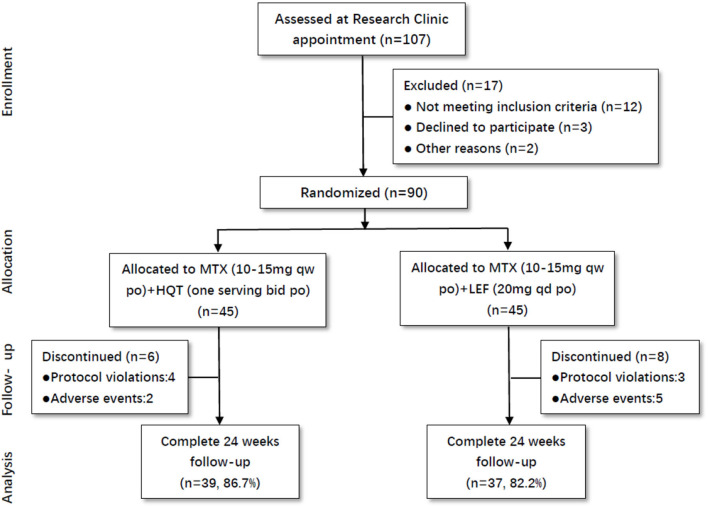
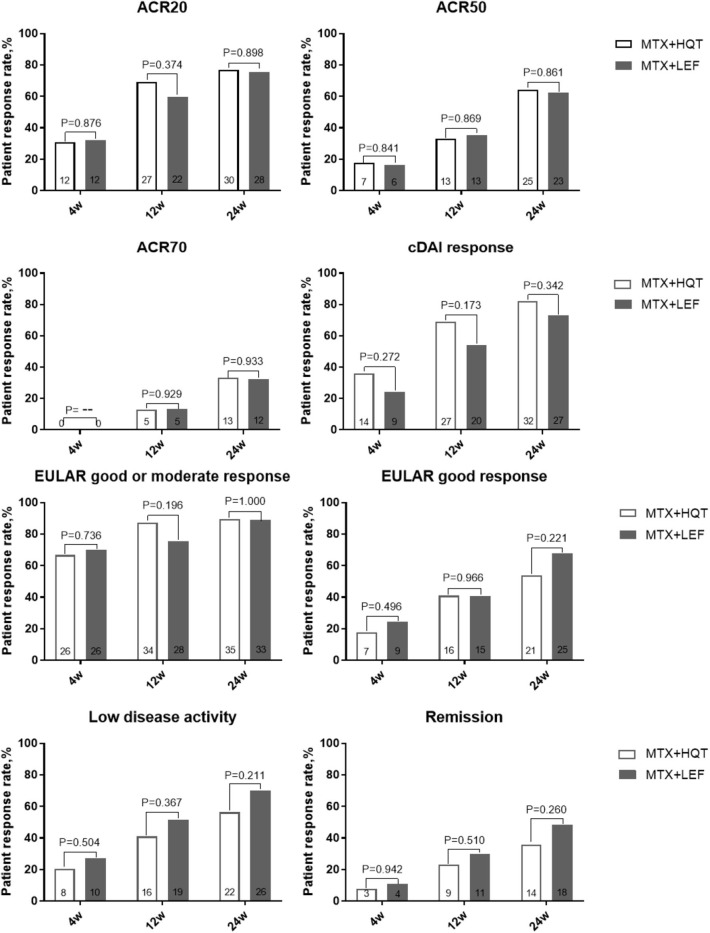
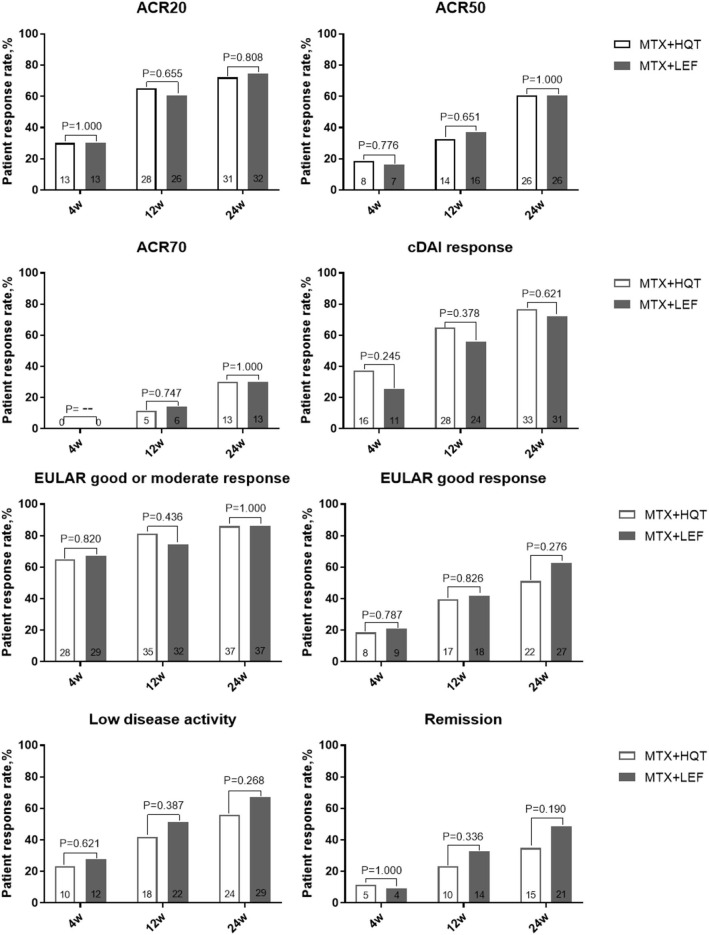
Traditional Chinese Medicine is complementary and an alternative to modern medicine. The combination therapies of herbal products with disease-modifying anti-rheumatic drugs are gradually and widely adopted in the management of rheumatoid arthritis (RA) in China. To evaluate the efficacy and safety of Huayu-Qiangshen-Tongbi (HQT) decoction, a Chinese medicine formula, combined with methotrexate (MTX) in the treatment of patients with active RA, in comparison with the combination therapy of MTX with leflunomide (LEF). This pilot study was a monocenter, open-label, randomized controlled trial with two parallel arms. Ninety patients with active RA were randomly allocated to receive either HQT at a dose of 250 ml twice daily or LEF at a dose of 20 mg once daily, and all participants received MTX at a dose of 10-15 mg once weekly. The primary efficacy endpoint was the proportion of patients who achieved a 20% improvement in the American College of Rheumatology criteria (ACR20) after a 24-week treatment. 84.4% (76/90) patients completed the 24-week observation. In the intention-to-treat analysis, the percentage values of patients achieving the ACR20 response criteria were 72.1% (31/43) in MTX + HQT group and 74.4% (32/43) in MTX + LEF group ( = 0.808). No significant difference was observed in other parameters, including ACR50, ACR70, clinical disease activity index good responses, European League Against Rheumatism good response, remission rate, and low disease activity rate. The results of the per-protocol analysis showed consistency with those of the intention-to-treat analysis. The mean change from baseline at week 24 for the van der Heijde modified total sharp score had no significant difference between two groups (3.59 ± 4.75 and 1.34 ± 8.67 in the MTX + HQT group and MTX + LEF group, respectively, = 0.613). The frequency of adverse events was similar in both groups (11 cases in the MTX + HQT and 17 cases in the MTX + LEF, > 0.05). In patients with active RA, treatment with the combination of HQT and MTX was associated with improvement in signs, symptoms, and physical function. With a beneficial clinical response and acceptable tolerability, HQT or other Chinese medicine formula may be a good therapeutic option in combination with MTX for RA treatment. Chinese Clinical Trails Registry, ChiCTR-INR-16009031, Registered on 15th August 2016, http://www.chictr.org.cn/enindex.aspx.
传统中医是现代医学的补充和替代。在中国,草药产品与改善病情抗风湿药的联合疗法在类风湿关节炎(RA)的管理中逐渐得到广泛应用。为了评估中药方剂化瘀强肾通痹(HQT)汤联合甲氨蝶呤(MTX)治疗活动期RA患者的疗效和安全性,并与MTX联合来氟米特(LEF)的联合疗法进行比较。这项前瞻性研究是一项单中心、开放标签、随机对照试验,分为两个平行组。90例活动期RA患者被随机分配,分别接受每日两次250毫升的HQT或每日一次20毫克的LEF,所有参与者均接受每周一次10 - 15毫克的MTX。主要疗效终点是在24周治疗后达到美国风湿病学会标准(ACR20)改善20%的患者比例。84.4%(76/90)的患者完成了24周的观察。在意向性分析中,MTX + HQT组达到ACR20反应标准的患者百分比为72.1%(31/43),MTX + LEF组为74.4%(32/43)(P = 0.808)。在其他参数方面未观察到显著差异,包括ACR50、ACR70、临床疾病活动指数良好反应、欧洲抗风湿病联盟良好反应、缓解率和低疾病活动率。符合方案分析的结果与意向性分析的结果一致。两组在第24周时从基线开始的范德海伊德改良总 Sharp 评分的平均变化无显著差异(MTX + HQT组和MTX + LEF组分别为3.59±4.75和1.34±8.67,P = 0.613)。两组不良事件的发生率相似(MTX + HQT组11例,MTX + LEF组17例,P>0.05)。在活动期RA患者中,HQT与MTX联合治疗可改善体征、症状和身体功能。具有良好的临床反应和可接受的耐受性,HQT或其他中药方剂可能是与MTX联合用于RA治疗的良好治疗选择。中国临床试验注册中心,ChiCTR-INR-16009031,于2016年8月15日注册,http://www.chictr.org.cn/enindex.aspx。