Laboratoire des Maladies Neurodégénératives, CEA, CNRS, MIRCen, Université Paris-Saclay, Fontenay-aux-Roses, France.
Laboratoire d'Imagerie Biomédicale Multimodale (BioMaps), CEA, CNRS, Inserm, Service Hospitalier Frédéric Joliot, Université Paris-Saclay, Orsay, France.
PLoS One. 2020 Oct 5;15(10):e0240228. doi: 10.1371/journal.pone.0240228. eCollection 2020.
Knowledge of the repeatability of quantitative parameters derived from [18F]FDG PET images is essential to define the group size and allow correct interpretation. Here we tested repeatability and accuracy of different [18F]FDG absolute and relative quantification parameters in a standardized preclinical setup in nonhuman primates (NHP).
Repeated brain [18F]FDG scans were performed in 6 healthy NHP under controlled experimental factors likely to account for variability. Regional cerebral metabolic rate of glucose (CMRglu) was calculated using a Patlak plot with blood input function Semi-quantitative approaches measuring standard uptake values (SUV, SUV×glycemia and SUVR (SUV Ratio) using the pons or cerebellum as a reference region) were considered. Test-retest variability of all quantification parameters were compared in different brain regions in terms of absolute variability and intra-and-inter-subject variabilities. In an independent [18F]FDG PET experiment, robustness of these parameters was evaluated in 4 naive NHP.
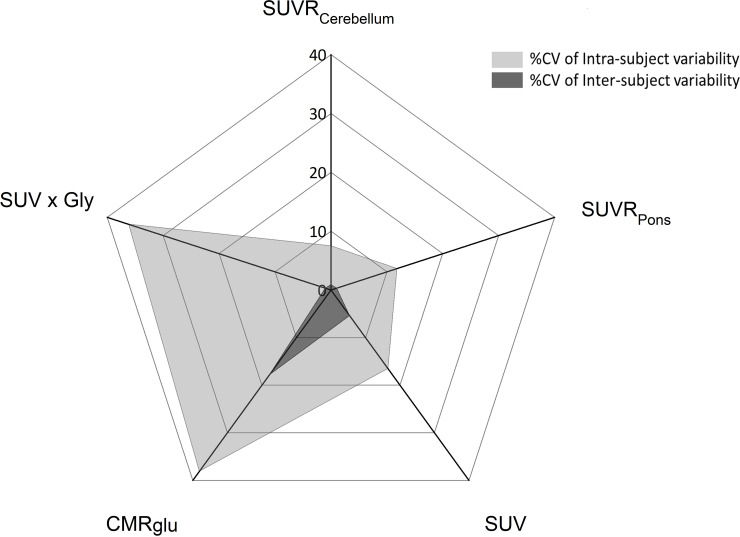
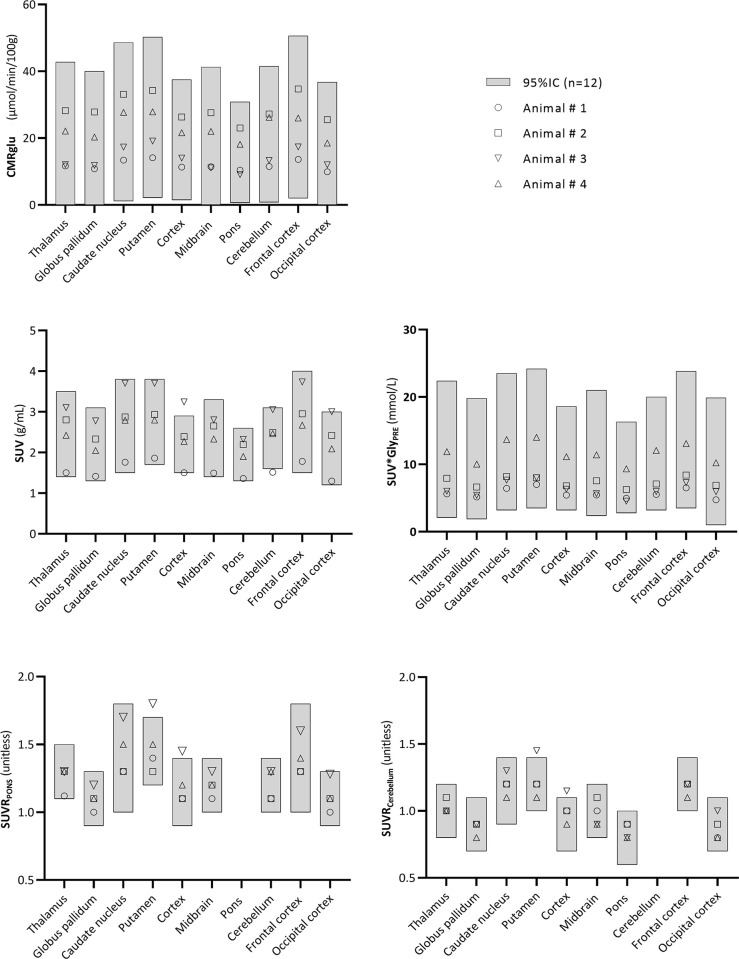
Experimental conditions (injected dose, body weight, animal temperature) were the same at both imaging sessions (p >0.4). No significant difference in the [18F]FDG quantification parameters was found between test and retest sessions. Absolute variability of CMRglu, SUV, SUV×glycemia and normalized SUV ranged from 25 to 43%, 16 to 21%, 23 to 28%, and 7 to 14%, respectively. Intra-subject variability largely explained the absolute variability of all quantitative parameters. They were all significantly correlated to each other and they were all robust. Arterial and venous glycemia were highly correlated (r = 0.9691; p<0.0001).
[18F]FDG test-retest studies in NHP protocols need to be conducted under well-standardized experimental conditions to assess and select the most reliable and reproducible quantification approach. Furthermore, the choice of the quantification parameter has to account for the transversal or follow-up study design. If pons and cerebellum regions are not affected, non-invasive SUVR is the most favorable approach for both designs.
了解来自 [18F]FDG PET 图像的定量参数的可重复性对于确定组大小并允许正确解释至关重要。在这里,我们在非人类灵长类动物(NHP)的标准化临床前设置中测试了不同 [18F]FDG 绝对和相对定量参数的重复性和准确性。
在受控的实验因素下,对 6 只健康的 NHP 进行重复的脑部 [18F]FDG 扫描,这些因素可能会导致变异性。使用 Patlak 图计算局部脑葡萄糖代谢率(CMRglu),并使用血液输入函数。半定量方法测量标准摄取值(SUV、SUV×血糖和 SUVR(SUV 比),使用脑桥或小脑作为参考区域)。在不同的脑区,比较所有定量参数的测试-重测变异性,包括绝对变异性和个体内和个体间变异性。在独立的 [18F]FDG PET 实验中,在 4 只 NHP 中评估了这些参数的稳健性。
两次成像期间的实验条件(注射剂量、体重、动物体温)相同(p >0.4)。在测试和重测期间,[18F]FDG 定量参数没有发现显著差异。CMRglu、SUV、SUV×血糖和标准化 SUV 的绝对变异性范围分别为 25%至 43%、16%至 21%、23%至 28%和 7%至 14%。个体内变异性在很大程度上解释了所有定量参数的绝对变异性。它们彼此之间都有显著的相关性,而且都很稳健。动脉和静脉血糖高度相关(r = 0.9691;p<0.0001)。
在 NHP 协议的 [18F]FDG 测试-重测研究中,需要在标准化的实验条件下进行,以评估和选择最可靠和可重复的定量方法。此外,定量参数的选择必须考虑到横向或随访研究设计。如果脑桥和小脑区域不受影响,非侵入性 SUVR 是两种设计的最佳选择。