Ron-Doitch Sapir, Kohen Ron
Institute for Drug Research, School of Pharmacy, Faculty of Medicine, Hebrew University of Jerusalem, Jerusalem 9112000, Israel.
Antioxidants (Basel). 2020 Oct 1;9(10):942. doi: 10.3390/antiox9100942.
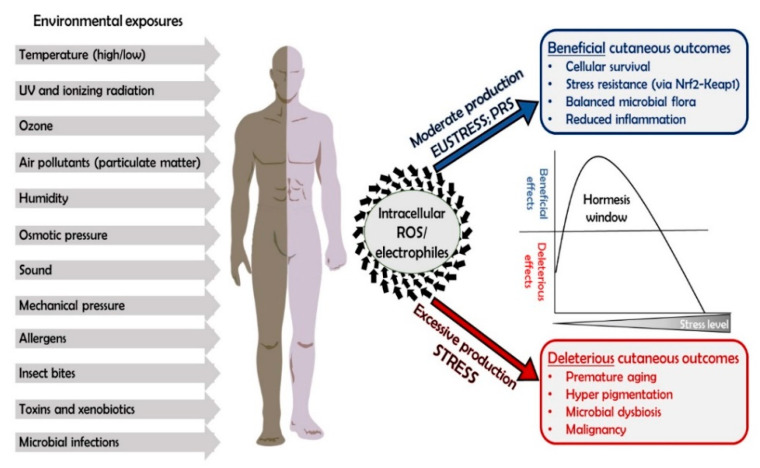
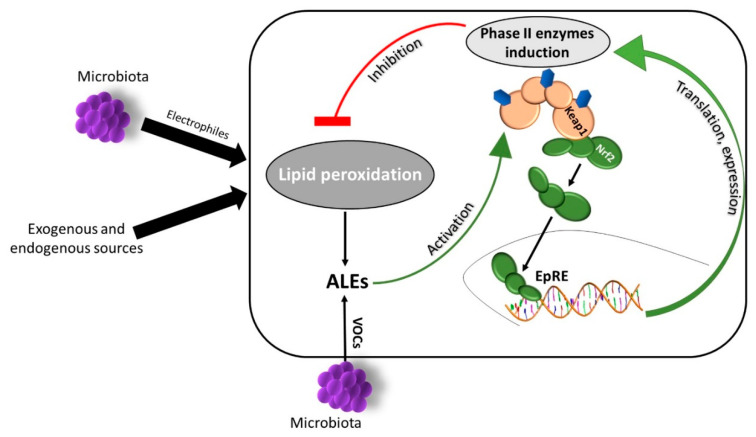
Skin is a unique tissue, possessing extremely efficient protective and regulative mechanisms, similar only to the gut and lungs. These tissues serve as an interface with the environment and are exposed to stressors from both endogenous and exogenous sources. Interestingly, all these stressors lead downstream to a cellular production of reactive oxygen species (ROS) and other electrophiles, which, in turn could have deleterious outcomes for the living organism. Hence, such tissues should always maintain a "high-alert" condition in order to cope with these various insults. Nevertheless, a moderate production of ROS induced by stressors could actually be beneficial, although it is impossible to predict if and which exposure would lead to which outcome. Consequently, a parameter which would indicate the skin's readiness to cope with continuously fluctuating conditions is required. It has been proposed that the redox status may serve as a suitable indicator. In this opinion manuscript, we argue that the redox status is a vague parameter that is difficult to characterized and quantify due to its extremely dynamic nature. The common convention that the redox status is composed solely of the balance between oxidants and reductants (ROS and antioxidants) is also thought-provoking. Since this parameter in vivo behaves in a dynamic and complex manner, it better fits the description of a process, rather than an individual parameter. We suggest that the homeostatic modulation of the physiological redox (PR) should be in focus, rather than the redox status parameter itself. It is further suggested that low molecular weight antioxidants (LMWA) are, in fact, rather insignificant concerning the PR maintenance, and that the major contributors to this delicate modulation are regulative, protein-based systems such as the protective phase II antioxidant enzymes. Moreover, we show that skin microbiome and cutaneous advanced lipid peroxidation end-products (ALEs) take part in sustaining the cutaneous PR homoeostasis via activation of the Nrf2-Keap1 protective pathway.
皮肤是一种独特的组织,拥有极其高效的保护和调节机制,仅与肠道和肺部相似。这些组织作为与环境的界面,暴露于来自内源性和外源性的应激源。有趣的是,所有这些应激源都会导致下游细胞产生活性氧(ROS)和其他亲电试剂,这反过来可能对生物体产生有害影响。因此,此类组织应始终保持“高度警戒”状态,以应对这些各种损伤。然而,应激源诱导的适度ROS产生实际上可能是有益的,尽管无法预测何种暴露以及会导致何种结果。因此,需要一个能够表明皮肤应对持续波动状况准备程度的参数。有人提出氧化还原状态可能是一个合适的指标。在这篇观点手稿中,我们认为氧化还原状态是一个模糊的参数,由于其极其动态的性质,难以进行表征和量化。氧化还原状态仅由氧化剂和还原剂(ROS和抗氧化剂)之间的平衡组成这一普遍观点也发人深省。由于该参数在体内以动态和复杂的方式表现,它更符合对一个过程的描述,而不是一个单独的参数。我们建议应关注生理氧化还原(PR)的稳态调节,而不是氧化还原状态参数本身。进一步表明,低分子量抗氧化剂(LMWA)实际上对于PR维持而言相当微不足道,而对这种精细调节的主要贡献者是调节性的、基于蛋白质的系统,如保护性II期抗氧化酶。此外,我们表明皮肤微生物群和皮肤晚期脂质过氧化终产物(ALE)通过激活Nrf2-Keap1保护途径参与维持皮肤PR稳态。